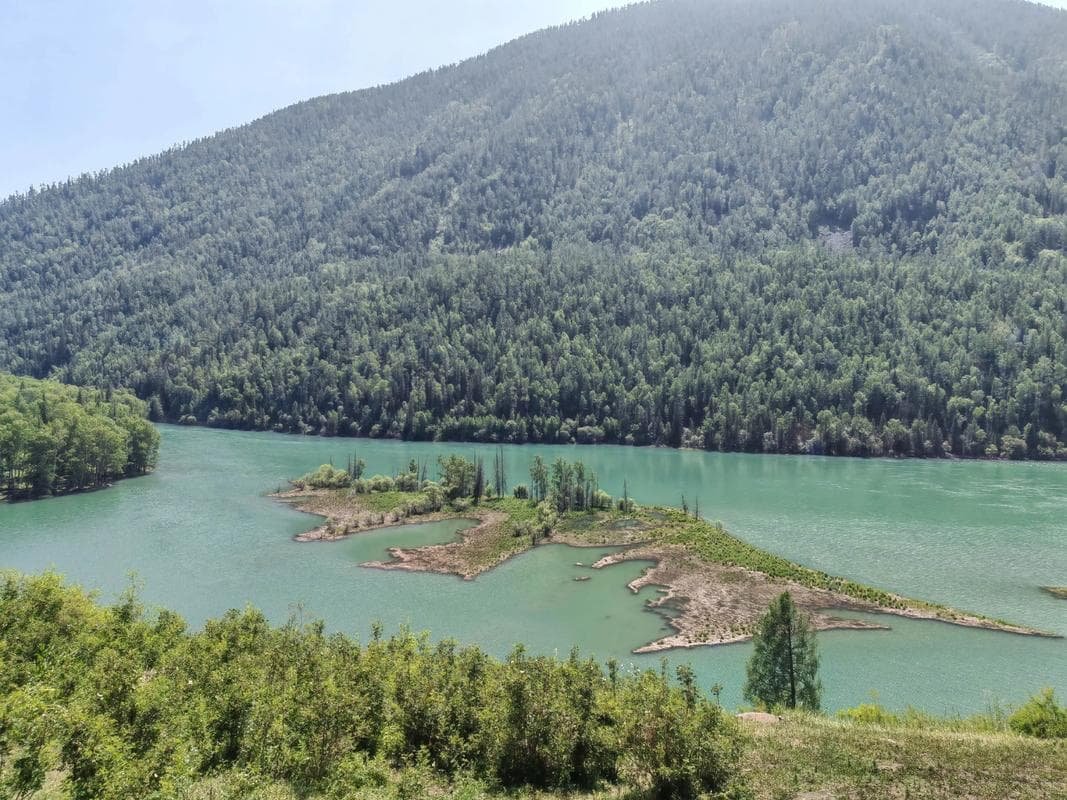
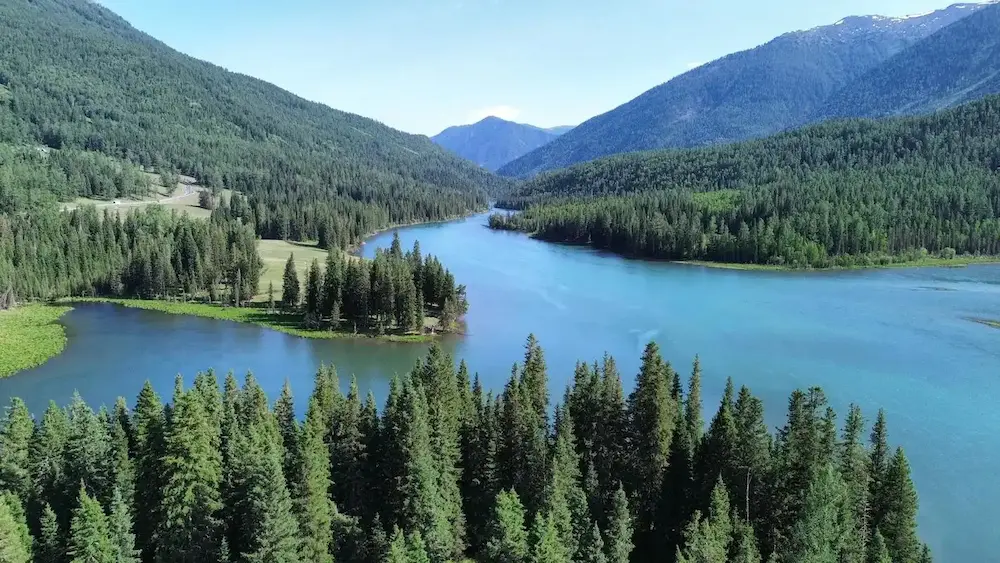
If there’s one place in Xinjiang that makes people who’ve been there sound like they’re exaggerating, it’s Kanas Lake.
This guide is part of our complete Xinjiang Travel Guide series for foreign travelers.
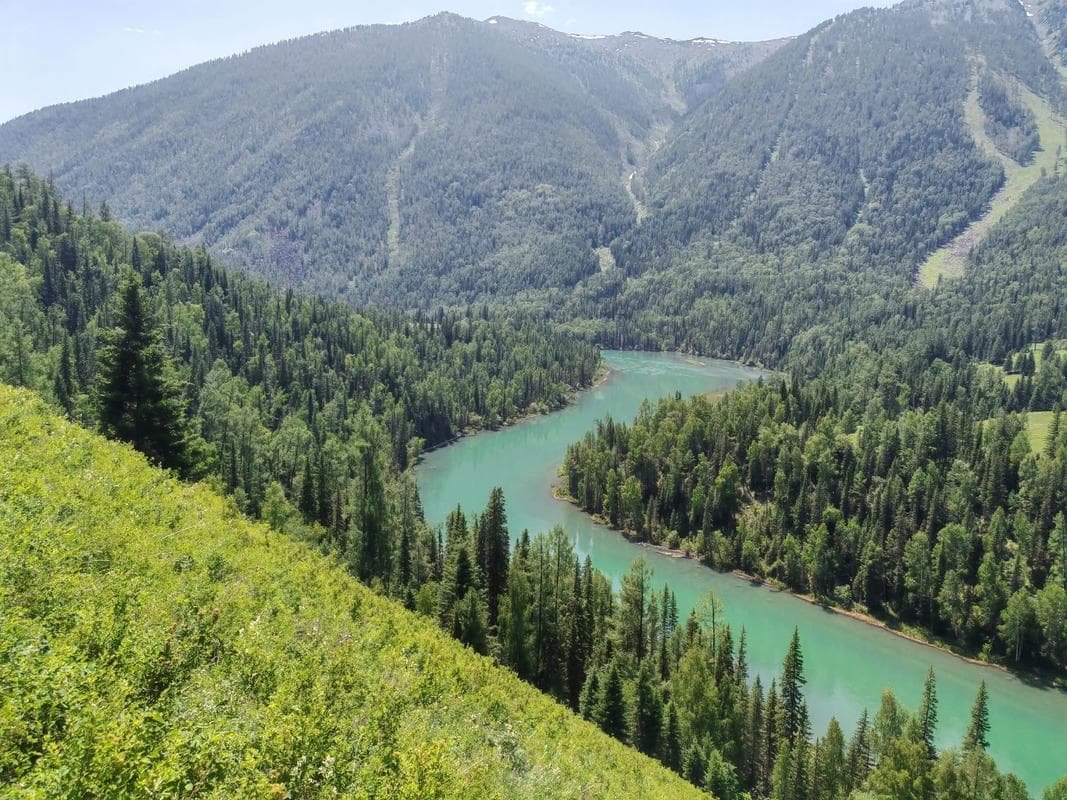
I went there expecting a nice alpine lake. What I found was a body of water so clear it looks fake — and a surrounding landscape (spruce forests, snow-capped peaks, Tuvan villages) that actually does look like the photos. Not always (it can be cloudy and rainy for days), but when the weather clears, it’s the kind of view that makes you stop talking and just look.
What Kanas Lake Actually Is
Kanas Lake is a glacial moraine lake in the Altai Mountains, near the border where China, Mongolia, Russia, and Kazakhstan meet. It’s at 1,374 meters, about 24 km long, and up to 197 meters deep. The water is a distinct blue-green that changes with the light — and with the season (it’s clearest in September-October, after the summer rains have stopped).
The lake is part of the Kanas Nature Reserve, which is also home to Tuvan (图瓦人, Tǔwǎrén) communities — descendants of Mongolian nomads who’ve lived in these valleys for centuries. It’s one of the few places in Xinjiang where you’ll encounter a culture that isn’t Uyghur, Han, or Kazakh.
Getting There
Kanas is remote. The nearest city is Urumqi (800+ km away), and the drive takes 10-12 hours (or 1.5 hours by flight to Kanas Airport — yes, there’s an airport that close to the lake, though flights are seasonal and weather-dependent).
The Standard Route
Most travelers:
1. Fly or take the train to Urumqi
2. Take an overnight train or a 1-hour flight to Karamay (not the lake — Karamay is the nearest city with an airport)
3. Hire a car or take a bus from Karamay to Kanas (4-5 hours)
Or:
1. Fly directly to Kanas Airport (seasonal — usually June-September, and only from Urumqi and a few other cities)
2. Take the shuttle bus from the airport to the lake (30 minutes)
The “I Want to See the Countryside” Route
Take the overnight train from Urumqi to Beitun (a small city near the Kazak border), then a bus to Kanas (3-4 hours). It’s slower, but the train ride goes through some of the best scenery in northern Xinjiang.
Do You Need a Border Permit?
Yes, for some areas. Kanas Lake itself doesn’t require a permit for foreign visitors (as of 2026). But if you want to visit Baihaba Village (a Tuvan village near the Kazakhstan border, about 30 km from the lake), you need a Border Area Entry Permit (边境管理区通行证).
The permit is easy to arrange:
- Apply at the Public Security Bureau in Burjin (the nearest town to Kanas, about 2 hours from the lake) or in Urumqi before you go
- Bring your passport and a photo
- Processing time: 1-2 business days (or same-day if you go in the morning)
Most tour groups include the permit in their package. If you’re traveling independently, ask your hotel in Burjin or Kanas to help you apply.
When to Go
The Best Months
September-mid-October: The best time. The spruce forests turn gold, the weather is clear (after the rainy season ends in August), and the lake is at its clearest. This is also when the Kanasphoto is at its peak — the fog lifts from the lake in the early morning, and if you’re lucky, you’ll see the famous “Kanas cloud sea” (云海, yúnhǎi).
June-August: Green, lush, but rainy. The lake is less clear (from the runoff). The advantage: everything is open, and the weather is warm (15-25°C / 59-77°F during the day).
November-May: The road to Kanas is sometimes closed after heavy snow. Even if it’s open, most facilities (hotels, restaurants) are closed for the season. You can still visit, but it’s a winter wilderness experience — not a standard travel itinerary.
Time of Day
Early morning (7-9 AM): The lake is calm, the light is soft, and the tour groups haven’t arrived yet. This is when you might see the fog lifting.
Late afternoon (5-7 PM): The light on the surrounding peaks turns gold. The tour groups have left. It’s a good time for photos.
What to Do at Kanas
Most visitors spend 2-3 days at Kanas. That’s enough to see the main sights, do a short hike, and spend a night in a Tuvan village.
The Lake Shore (湖边, Húbiān)
There’s a boardwalk along part of the lake shore (similar to Heavenly Lake, but longer and less developed). It’s an easy walk, and it gives you different angles of the water and the surrounding mountains.
The full boardwalk is about 8 km one way. You don’t need to do the whole thing — the first 3-4 km have the best views.
Guanyin Pavilion (观鱼台, Guānyútái)
A pavilion on a hill above the lake that gives you a panoramic view. It’s a 20-30 minute hike up (or you can take a shuttle — 20 RMB). The view is genuinely spectacular — you can see the entire lake and the valley beyond.
Tip: Go in the late afternoon. The light is better for photos.
Baihaba Village (白哈巴村, Báihābā Cūn)
A Tuvan village near the Kazakhstan border. It’s a 1-hour drive from the lake, and it requires the border permit (see above). The village has traditional wooden houses, and the surrounding valley is beautiful.
Where to stay: There are a few guesthouses in Baihaba. Staying overnight means you can see the sunset and sunrise over the valley — and you’ll have the place mostly to yourself (the day-trippers leave by 5 PM).
Hemu Village (禾木村, Hémù Cūn)
Another Tuvan village, about 2 hours from Kanas Lake. It’s less developed than Baihaba, and the scenery is slightly different — more grassland, fewer steep peaks.
When to go: September-October, when the birch and spruce forests turn gold. The light is incredible for photography.
Where to Stay
Kanas has accommodation options ranging from basic to surprisingly good:
Inside the nature reserve (near the lake shore): There are several hotels and guesthouses. They’re more expensive than outside (a standard room that costs 300 RMB in Urumqi costs 600-800 RMB here in peak season), but staying inside means you can see the lake at sunrise without a 1-hour commute.
In Jiadengyu (贾登峪, Jiàdēngyǔ): A small town about 30 km from the lake. It has more accommodation options (and lower prices), but you’ll need to take the shuttle bus to the lake each day (the shuttle is included in your entrance ticket).
Budget tip: Book in advance during peak season (July-September). Kanas is the most popular destination in northern Xinjiang, and good rooms sell out.
The Food Situation
Kanas is remote, so the food options are limited and prices are higher than in Urumqi or Kashgar.
What’s available: Lamb dishes (kebabs, polo, hot pot), noodles, and some vegetable dishes. The ingredients are local — the lamb is from nearby pastures, and it tastes different from the lamb in the south.
Where to eat: The hotels and guesthouses usually have restaurants. There are also a few small restaurants near the lake shore. Expect to pay 50-80 RMB for a main dish.
Bring snacks: If you’re doing hikes, bring your own food. There are no restaurants on the trails.
A Note on Crowds
Kanas is the most visited destination in northern Xinjiang. In July-August, the lake shore can be crowded with domestic tour groups.
It’s not “ruined” — the lake is big enough that you can find quiet spots if you walk 15-20 minutes away from the main boardwalk. But if you’re traveling in peak season, manage your expectations (and go early in the morning).
Getting Around Kanas
The Kanas Nature Reserve has a shuttle bus system (included in your entrance ticket). The buses run regularly between the entrance gate, the lake shore, Baihaba, and Hemu.
You can’t drive your own car inside the reserve (even if you have a Chinese driver’s license). Everyone takes the shuttle.
Hiking: There are marked trails (the boardwalk along the lake, the hike up to Guanyin Pavilion). Unmarked trails exist, but don’t go off-trail alone — the terrain is steep, and it’s easy to get lost.
The Bottom Line
Kanas Lake is the most famous natural attraction in Xinjiang for a reason. It delivers. Just go in the right season, at the right time of day, and you’ll see why people who’ve been there sound like they’re exaggerating.
And if the weather is bad (cloudy, rainy) during your visit? Come back in September. Seriously. The difference between a cloudy Kanas and a clear September Kanas is the difference between a nice view and a view that changes how you think about landscapes.
—
*This guide was updated in June 2026 based on first-hand travel experience.*