
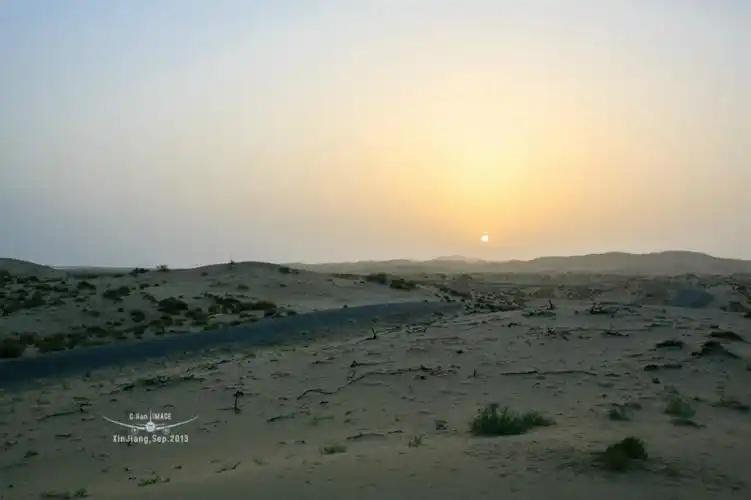
The Taklamakan Desert does not give things back lightly. For a thousand years it swallowed cities whole, and only in the last century have archaeologists coaxed a few of them into the light. I stood once at the edge of the dunes near the Tarim’s dried riverbeds and felt the particular chill of a place that used to be somebody’s home.
The basin that ate kingdoms
The Tarim Basin is a closed world, ringed by mountains and floored with sand. Rivers fed by melted snow once ran through it, and where they ran, people built. When the rivers shifted, the cities died. The Silk Road passed along the rim, and the towns along it traded jade, silk, and ideas between China and the west.
What survives is fragmentary, but it is enough to break the illusion that this was ever empty.
Niya – the Pompeii of the Tarim
Niya, deep in the southern desert, was the capital of an oasis kingdom the Chinese records call Jingjue. Aurel Stein found it in 1901, and what he described still holds: a town of timber houses, orchards, and a script called Kharoshthi that nobody in the region speaks anymore.
- Wooden doors still hang in their frames, preserved by the dry air.
- Textiles and lacquerware show clear Han Chinese influence alongside Indian and Persian forms.
- The famous “Cloth with Nike” and the woven wool rugs hint at a cosmopolitan oasis.
I’ve only seen Niya’s objects in museums, not the site itself, because access is tightly controlled and the desert protects its dead. That distance, honestly, feels right.
Niya is not a tourist stop. It is a research site, and the sand that buried it is the only curator tough enough to keep it.
Loulan – the city the lake forgot
Loulan sat where a great lake, Lop Nor, once shimmered. When the lake dried, the city emptied. Explorers found mummies there with Caucasian features and woollen clothing, the so-called Loulan Beauty now kept in Urumqi, a face from two thousand years ago that stops you mid-step.
The kingdom appears in Han dynasty reports as a stop on the route west, then vanishes from the record. Climate, not conquest, did the killing. Standing on the cracked lakebed today, you understand: water was the only law out here, and when it left, everything followed.
Jiaohe – the city cut from a cliff
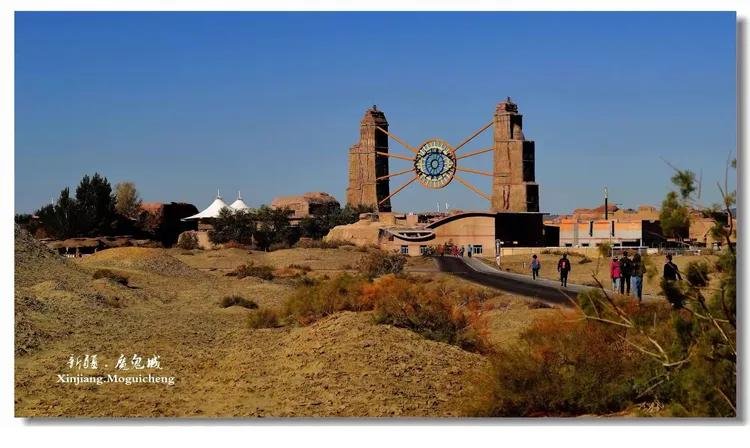
Jiaohe is the one you can actually walk. Built on a long narrow plateau between two rivers near what is now Turpan, it was the capital of the Jushi kingdom. Unlike Niya and Loulan, its mud-brick walls still stand in rows, because the climate baked them rather than buried them.
I’ll write more about Jiaohe in its own piece, but here it belongs as the third of the trio: the lost city you can touch, where the others you can only imagine.
What archaeology actually tells us
The recovered objects rewrite the lazy story of the Silk Road as a Chinese highway. The Tarim cities were multilingual, multi-faith places.
- Kharoshthi and Gandhari texts show Buddhist learning deep in the desert.
- Woollen and silk fragments prove trade ran both ways, not just east to west.
- The mummies prove movement of peoples long before the imperial records catch up.
A Xinjiang Travel Guide that skips these cities sells you a shallow version of the place. The depth is in the sand.
Why the sites matter to a visitor
You may never reach Niya. You likely won’t get permits for Loulan’s dry heart. But you can see their treasures in the regional museum, and you can stand at Jiaohe and feel the pattern.
I think the value is perspective. The Silk Road wasn’t a line on a map; it was a set of fragile oases that the desert reclaimed whenever it chose. Knowing that changes how you look at the living towns, Kashgar and Turpan, that hang on today by the same thread of water.
Seeing the story without the permits
You’ll likely never walk Niya or Loulan, and that’s a hard truth to accept. The sites are protected for good reason: the dry air that preserved them is also easily broken by foot traffic and humidity from breath and hands. Looters and careless diggers have already cost us more than we’ll ever know.
So how do you meet these cities? Through the things they left behind, shown well.
- The museum in Urumqi holds the marquee objects, including the Loulan mummies and woven goods from Niya.
- Smaller town museums along the southern route display local finds you won’t see in the capital.
- Books and the few careful documentaries fill the gap between the artefact and the imagination.
I treat the inaccessible sites as reading assignments. Before Turpan I read what I could about Jushi life, then walked Jiaohe with the text in my head. The ruin stopped being a pile of mud and became a capital with a market, a monastery, and a river on each side.
The Silk Road was never one road; it was a web of oases that the Taklamakan Desert allowed to exist only where water surfaced. Niya, Loulan, and Jiaohe are three knots in that web, two buried and one standing. Knowing which is which, and why, turns a sightseeing stop into a real encounter with the past. A good Xinjiang Travel Guide points you to the open site and tells you honestly about the closed ones, and that honesty is the respect the desert is owed.
Practical FAQ
Can I visit Niya or Loulan independently? Almost never. Both are protected and require research permits, usually tied to scientific expeditions.
Where can I see their artefacts? The museum in Urumqi holds the standout pieces, including the Loulan mummies.
Is Jiaohe open to the public? Yes, and it’s an easy half-day from Turpan.
When is best time to visit Xinjiang for ruins? Spring and autumn avoid the Turpan summer inferno; April-May and September-October are kind.
The Tarim’s lost cities are a reminder that the desert keeps better archives than any library. We just have to earn the right to read them.