

- Xinhua South Road (新华南路): The street food center. Kebab stalls, noodle shops, and nang ovens — all in a 2-km stretch.
- International Bazaar area: Touristier, but the food court has decent options.
- People’s Square (人民广场) area: Where Urumqi people actually eat. Look for places where the menu is only in Chinese and Uyghur.
- Street food (kebabs, nang, bakes): 5-15 RMB per item
- Noodle or rice dish in a casual restaurant: 20-40 RMB
- Sit-down meal with multiple dishes (for 2 people): 100-200 RMB
- Dapanji (大盘鸡, “big plate chicken”): A Xinjiang invention — chicken, potatoes, and noodles in a spicy, cumin-heavy sauce. It was invented in Shawan, near Urumqi, in the 199s. The versions in Urumqi are still the best.
- Nang bread (馕, “nang”): Xinjiang’s staple bread. It’s a flat oven-baked bread, sometimes plain, sometimes with sesame or onion. Buy it fresh from any nang shop (they’re everywhere) for 3-5 RMB.
- Xinhua South Road (新华南路): The street food center. Kebab stalls, noodle shops, and nang ovens — all in a 2-km stretch.
- International Bazaar area: Touristier, but the food court has decent options.
- People’s Square (人民广场) area: Where Urumqi people actually eat. Look for places where the menu is only in Chinese and Uyghur.
- Street food (kebabs, nang, bakes): 5-15 RMB per item
- Noodle or rice dish in a casual restaurant: 20-40 RMB
- Sit-down meal with multiple dishes (for 2 people): 100-200 RMB
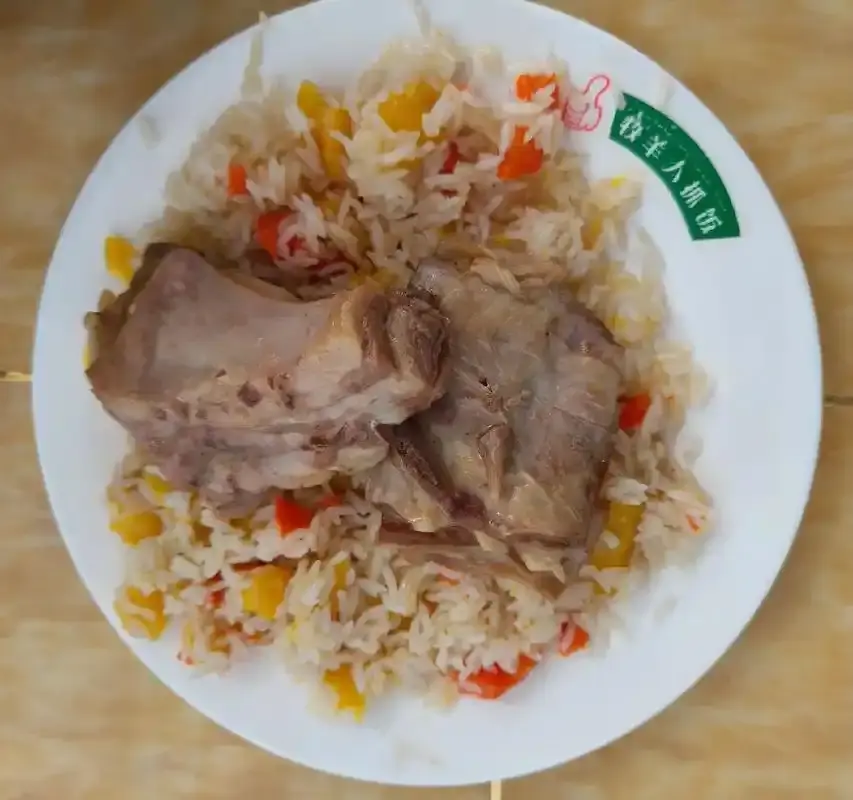
- Zhuafan (抓饭, “grab rice”): Rice cooked with lamb, carrots, and onions. The best versions have the rice slightly crisped at the bottom of the pot. Every region has its own version — the Urumqi version is the standard, the Kashgar version is slightly oilier, the Turpan version sometimes includes raisins.
- Laghman (拉面, “pull noodles”): Hand-pulled noodles with a meat and vegetable sauce. The noodles are chewy, the sauce is rich, and the portion is large enough to share (but you won’t want to).
- Kavap (烤包子, “baked buns”): Filled with lamb and onion, cooked in a tandoor-like oven (馕坑, nángkēng). They come out crispy on the outside, juicy on the inside. Buy them fresh from any nang shop.
- Shashlik (烤肉, “kebabs”): Every second street corner in Xinjiang has a kebab stall in the evening. The meat is lamb, cubed or sliced, grilled over charcoal. It’s cheap (5-10 RMB per skewer) and genuinely good.
- Dapanji (大盘鸡, “big plate chicken”): A Xinjiang invention — chicken, potatoes, and noodles in a spicy, cumin-heavy sauce. It was invented in Shawan, near Urumqi, in the 199s. The versions in Urumqi are still the best.
- Nang bread (馕, “nang”): Xinjiang’s staple bread. It’s a flat oven-baked bread, sometimes plain, sometimes with sesame or onion. Buy it fresh from any nang shop (they’re everywhere) for 3-5 RMB.
- Xinhua South Road (新华南路): The street food center. Kebab stalls, noodle shops, and nang ovens — all in a 2-km stretch.
- International Bazaar area: Touristier, but the food court has decent options.
- People’s Square (人民广场) area: Where Urumqi people actually eat. Look for places where the menu is only in Chinese and Uyghur.
- Street food (kebabs, nang, bakes): 5-15 RMB per item
- Noodle or rice dish in a casual restaurant: 20-40 RMB
- Sit-down meal with multiple dishes (for 2 people): 100-200 RMB
- Zhuafan (抓饭, “grab rice”): Rice cooked with lamb, carrots, and onions. The best versions have the rice slightly crisped at the bottom of the pot. Every region has its own version — the Urumqi version is the standard, the Kashgar version is slightly oilier, the Turpan version sometimes includes raisins.
- Laghman (拉面, “pull noodles”): Hand-pulled noodles with a meat and vegetable sauce. The noodles are chewy, the sauce is rich, and the portion is large enough to share (but you won’t want to).
- Kavap (烤包子, “baked buns”): Filled with lamb and onion, cooked in a tandoor-like oven (馕坑, nángkēng). They come out crispy on the outside, juicy on the inside. Buy them fresh from any nang shop.
- Shashlik (烤肉, “kebabs”): Every second street corner in Xinjiang has a kebab stall in the evening. The meat is lamb, cubed or sliced, grilled over charcoal. It’s cheap (5-10 RMB per skewer) and genuinely good.
- Dapanji (大盘鸡, “big plate chicken”): A Xinjiang invention — chicken, potatoes, and noodles in a spicy, cumin-heavy sauce. It was invented in Shawan, near Urumqi, in the 199s. The versions in Urumqi are still the best.
- Nang bread (馕, “nang”): Xinjiang’s staple bread. It’s a flat oven-baked bread, sometimes plain, sometimes with sesame or onion. Buy it fresh from any nang shop (they’re everywhere) for 3-5 RMB.
- Xinhua South Road (新华南路): The street food center. Kebab stalls, noodle shops, and nang ovens — all in a 2-km stretch.
- International Bazaar area: Touristier, but the food court has decent options.
- People’s Square (人民广场) area: Where Urumqi people actually eat. Look for places where the menu is only in Chinese and Uyghur.
- Street food (kebabs, nang, bakes): 5-15 RMB per item
- Noodle or rice dish in a casual restaurant: 20-40 RMB
- Sit-down meal with multiple dishes (for 2 people): 100-200 RMB
- Dapanji (大盘鸡, “big plate chicken”): A Xinjiang invention — chicken, potatoes, and noodles in a spicy, cumin-heavy sauce. It was invented in Shawan, near Urumqi, in the 199s. The versions in Urumqi are still the best.
- Nang bread (馕, “nang”): Xinjiang’s staple bread. It’s a flat oven-baked bread, sometimes plain, sometimes with sesame or onion. Buy it fresh from any nang shop (they’re everywhere) for 3-5 RMB.
- Xinhua South Road (新华南路): The street food center. Kebab stalls, noodle shops, and nang ovens — all in a 2-km stretch.
- International Bazaar area: Touristier, but the food court has decent options.
- People’s Square (人民广场) area: Where Urumqi people actually eat. Look for places where the menu is only in Chinese and Uyghur.
- Street food (kebabs, nang, bakes): 5-15 RMB per item
- Noodle or rice dish in a casual restaurant: 20-40 RMB
- Sit-down meal with multiple dishes (for 2 people): 100-200 RMB
- Zhuafan (抓饭, “grab rice”): Rice cooked with lamb, carrots, and onions. The best versions have the rice slightly crisped at the bottom of the pot. Every region has its own version — the Urumqi version is the standard, the Kashgar version is slightly oilier, the Turpan version sometimes includes raisins.
- Laghman (拉面, “pull noodles”): Hand-pulled noodles with a meat and vegetable sauce. The noodles are chewy, the sauce is rich, and the portion is large enough to share (but you won’t want to).
- Kavap (烤包子, “baked buns”): Filled with lamb and onion, cooked in a tandoor-like oven (馕坑, nángkēng). They come out crispy on the outside, juicy on the inside. Buy them fresh from any nang shop.
- Shashlik (烤肉, “kebabs”): Every second street corner in Xinjiang has a kebab stall in the evening. The meat is lamb, cubed or sliced, grilled over charcoal. It’s cheap (5-10 RMB per skewer) and genuinely good.
- Dapanji (大盘鸡, “big plate chicken”): A Xinjiang invention — chicken, potatoes, and noodles in a spicy, cumin-heavy sauce. It was invented in Shawan, near Urumqi, in the 199s. The versions in Urumqi are still the best.
- Nang bread (馕, “nang”): Xinjiang’s staple bread. It’s a flat oven-baked bread, sometimes plain, sometimes with sesame or onion. Buy it fresh from any nang shop (they’re everywhere) for 3-5 RMB.
- Xinhua South Road (新华南路): The street food center. Kebab stalls, noodle shops, and nang ovens — all in a 2-km stretch.
- International Bazaar area: Touristier, but the food court has decent options.
- People’s Square (人民广场) area: Where Urumqi people actually eat. Look for places where the menu is only in Chinese and Uyghur.
- Street food (kebabs, nang, bakes): 5-15 RMB per item
- Noodle or rice dish in a casual restaurant: 20-40 RMB
- Sit-down meal with multiple dishes (for 2 people): 100-200 RMB
- Zhuafan (抓饭, “grab rice”): Rice cooked with lamb, carrots, and onions. The best versions have the rice slightly crisped at the bottom of the pot. Every region has its own version — the Urumqi version is the standard, the Kashgar version is slightly oilier, the Turpan version sometimes includes raisins.
- Laghman (拉面, “pull noodles”): Hand-pulled noodles with a meat and vegetable sauce. The noodles are chewy, the sauce is rich, and the portion is large enough to share (but you won’t want to).
- Kavap (烤包子, “baked buns”): Filled with lamb and onion, cooked in a tandoor-like oven (馕坑, nángkēng). They come out crispy on the outside, juicy on the inside. Buy them fresh from any nang shop.
- Shashlik (烤肉, “kebabs”): Every second street corner in Xinjiang has a kebab stall in the evening. The meat is lamb, cubed or sliced, grilled over charcoal. It’s cheap (5-10 RMB per skewer) and genuinely good.
- Dapanji (大盘鸡, “big plate chicken”): A Xinjiang invention — chicken, potatoes, and noodles in a spicy, cumin-heavy sauce. It was invented in Shawan, near Urumqi, in the 199s. The versions in Urumqi are still the best.
- Nang bread (馕, “nang”): Xinjiang’s staple bread. It’s a flat oven-baked bread, sometimes plain, sometimes with sesame or onion. Buy it fresh from any nang shop (they’re everywhere) for 3-5 RMB.
- Xinhua South Road (新华南路): The street food center. Kebab stalls, noodle shops, and nang ovens — all in a 2-km stretch.
- International Bazaar area: Touristier, but the food court has decent options.
- People’s Square (人民广场) area: Where Urumqi people actually eat. Look for places where the menu is only in Chinese and Uyghur.
- Street food (kebabs, nang, bakes): 5-15 RMB per item
- Noodle or rice dish in a casual restaurant: 20-40 RMB
- Sit-down meal with multiple dishes (for 2 people): 100-200 RMB
- Zhuafan (抓饭, “grab rice”): Rice cooked with lamb, carrots, and onions. The best versions have the rice slightly crisped at the bottom of the pot. Every region has its own version — the Urumqi version is the standard, the Kashgar version is slightly oilier, the Turpan version sometimes includes raisins.
- Laghman (拉面, “pull noodles”): Hand-pulled noodles with a meat and vegetable sauce. The noodles are chewy, the sauce is rich, and the portion is large enough to share (but you won’t want to).
- Kavap (烤包子, “baked buns”): Filled with lamb and onion, cooked in a tandoor-like oven (馕坑, nángkēng). They come out crispy on the outside, juicy on the inside. Buy them fresh from any nang shop.
- Shashlik (烤肉, “kebabs”): Every second street corner in Xinjiang has a kebab stall in the evening. The meat is lamb, cubed or sliced, grilled over charcoal. It’s cheap (5-10 RMB per skewer) and genuinely good.
- Dapanji (大盘鸡, “big plate chicken”): A Xinjiang invention — chicken, potatoes, and noodles in a spicy, cumin-heavy sauce. It was invented in Shawan, near Urumqi, in the 199s. The versions in Urumqi are still the best.
- Nang bread (馕, “nang”): Xinjiang’s staple bread. It’s a flat oven-baked bread, sometimes plain, sometimes with sesame or onion. Buy it fresh from any nang shop (they’re everywhere) for 3-5 RMB.
- Xinhua South Road (新华南路): The street food center. Kebab stalls, noodle shops, and nang ovens — all in a 2-km stretch.
- International Bazaar area: Touristier, but the food court has decent options.
- People’s Square (人民广场) area: Where Urumqi people actually eat. Look for places where the menu is only in Chinese and Uyghur.
- Street food (kebabs, nang, bakes): 5-15 RMB per item
- Noodle or rice dish in a casual restaurant: 20-40 RMB
- Sit-down meal with multiple dishes (for 2 people): 100-200 RMB
- Dapanji (大盘鸡, “big plate chicken”): A Xinjiang invention — chicken, potatoes, and noodles in a spicy, cumin-heavy sauce. It was invented in Shawan, near Urumqi, in the 199s. The versions in Urumqi are still the best.
- Nang bread (馕, “nang”): Xinjiang’s staple bread. It’s a flat oven-baked bread, sometimes plain, sometimes with sesame or onion. Buy it fresh from any nang shop (they’re everywhere) for 3-5 RMB.
- Xinhua South Road (新华南路): The street food center. Kebab stalls, noodle shops, and nang ovens — all in a 2-km stretch.
- International Bazaar area: Touristier, but the food court has decent options.
- People’s Square (人民广场) area: Where Urumqi people actually eat. Look for places where the menu is only in Chinese and Uyghur.
- Street food (kebabs, nang, bakes): 5-15 RMB per item
- Noodle or rice dish in a casual restaurant: 20-40 RMB
- Sit-down meal with multiple dishes (for 2 people): 100-200 RMB
- Zhuafan (抓饭, “grab rice”): Rice cooked with lamb, carrots, and onions. The best versions have the rice slightly crisped at the bottom of the pot. Every region has its own version — the Urumqi version is the standard, the Kashgar version is slightly oilier, the Turpan version sometimes includes raisins.
- Laghman (拉面, “pull noodles”): Hand-pulled noodles with a meat and vegetable sauce. The noodles are chewy, the sauce is rich, and the portion is large enough to share (but you won’t want to).
- Kavap (烤包子, “baked buns”): Filled with lamb and onion, cooked in a tandoor-like oven (馕坑, nángkēng). They come out crispy on the outside, juicy on the inside. Buy them fresh from any nang shop.
- Shashlik (烤肉, “kebabs”): Every second street corner in Xinjiang has a kebab stall in the evening. The meat is lamb, cubed or sliced, grilled over charcoal. It’s cheap (5-10 RMB per skewer) and genuinely good.
- Dapanji (大盘鸡, “big plate chicken”): A Xinjiang invention — chicken, potatoes, and noodles in a spicy, cumin-heavy sauce. It was invented in Shawan, near Urumqi, in the 199s. The versions in Urumqi are still the best.
- Nang bread (馕, “nang”): Xinjiang’s staple bread. It’s a flat oven-baked bread, sometimes plain, sometimes with sesame or onion. Buy it fresh from any nang shop (they’re everywhere) for 3-5 RMB.
- Xinhua South Road (新华南路): The street food center. Kebab stalls, noodle shops, and nang ovens — all in a 2-km stretch.
- International Bazaar area: Touristier, but the food court has decent options.
- People’s Square (人民广场) area: Where Urumqi people actually eat. Look for places where the menu is only in Chinese and Uyghur.
- Street food (kebabs, nang, bakes): 5-15 RMB per item
- Noodle or rice dish in a casual restaurant: 20-40 RMB
- Sit-down meal with multiple dishes (for 2 people): 100-200 RMB
- Zhuafan (抓饭, “grab rice”): Rice cooked with lamb, carrots, and onions. The best versions have the rice slightly crisped at the bottom of the pot. Every region has its own version — the Urumqi version is the standard, the Kashgar version is slightly oilier, the Turpan version sometimes includes raisins.
- Laghman (拉面, “pull noodles”): Hand-pulled noodles with a meat and vegetable sauce. The noodles are chewy, the sauce is rich, and the portion is large enough to share (but you won’t want to).
- Kavap (烤包子, “baked buns”): Filled with lamb and onion, cooked in a tandoor-like oven (馕坑, nángkēng). They come out crispy on the outside, juicy on the inside. Buy them fresh from any nang shop.
- Shashlik (烤肉, “kebabs”): Every second street corner in Xinjiang has a kebab stall in the evening. The meat is lamb, cubed or sliced, grilled over charcoal. It’s cheap (5-10 RMB per skewer) and genuinely good.
- Dapanji (大盘鸡, “big plate chicken”): A Xinjiang invention — chicken, potatoes, and noodles in a spicy, cumin-heavy sauce. It was invented in Shawan, near Urumqi, in the 199s. The versions in Urumqi are still the best.
- Nang bread (馕, “nang”): Xinjiang’s staple bread. It’s a flat oven-baked bread, sometimes plain, sometimes with sesame or onion. Buy it fresh from any nang shop (they’re everywhere) for 3-5 RMB.
- Xinhua South Road (新华南路): The street food center. Kebab stalls, noodle shops, and nang ovens — all in a 2-km stretch.
- International Bazaar area: Touristier, but the food court has decent options.
- People’s Square (人民广场) area: Where Urumqi people actually eat. Look for places where the menu is only in Chinese and Uyghur.
- Street food (kebabs, nang, bakes): 5-15 RMB per item
- Noodle or rice dish in a casual restaurant: 20-40 RMB
- Sit-down meal with multiple dishes (for 2 people): 100-200 RMB
- Zhuafan (抓饭, “grab rice”): Rice cooked with lamb, carrots, and onions. The best versions have the rice slightly crisped at the bottom of the pot. Every region has its own version — the Urumqi version is the standard, the Kashgar version is slightly oilier, the Turpan version sometimes includes raisins.
- Laghman (拉面, “pull noodles”): Hand-pulled noodles with a meat and vegetable sauce. The noodles are chewy, the sauce is rich, and the portion is large enough to share (but you won’t want to).
- Kavap (烤包子, “baked buns”): Filled with lamb and onion, cooked in a tandoor-like oven (馕坑, nángkēng). They come out crispy on the outside, juicy on the inside. Buy them fresh from any nang shop.
- Shashlik (烤肉, “kebabs”): Every second street corner in Xinjiang has a kebab stall in the evening. The meat is lamb, cubed or sliced, grilled over charcoal. It’s cheap (5-10 RMB per skewer) and genuinely good.
- Dapanji (大盘鸡, “big plate chicken”): A Xinjiang invention — chicken, potatoes, and noodles in a spicy, cumin-heavy sauce. It was invented in Shawan, near Urumqi, in the 199s. The versions in Urumqi are still the best.
- Nang bread (馕, “nang”): Xinjiang’s staple bread. It’s a flat oven-baked bread, sometimes plain, sometimes with sesame or onion. Buy it fresh from any nang shop (they’re everywhere) for 3-5 RMB.
- Xinhua South Road (新华南路): The street food center. Kebab stalls, noodle shops, and nang ovens — all in a 2-km stretch.
- International Bazaar area: Touristier, but the food court has decent options.
- People’s Square (人民广场) area: Where Urumqi people actually eat. Look for places where the menu is only in Chinese and Uyghur.
- Street food (kebabs, nang, bakes): 5-15 RMB per item
- Noodle or rice dish in a casual restaurant: 20-40 RMB
- Sit-down meal with multiple dishes (for 2 people): 100-200 RMB
- Dapanji (大盘鸡, “big plate chicken”): A Xinjiang invention — chicken, potatoes, and noodles in a spicy, cumin-heavy sauce. It was invented in Shawan, near Urumqi, in the 199s. The versions in Urumqi are still the best.
- Nang bread (馕, “nang”): Xinjiang’s staple bread. It’s a flat oven-baked bread, sometimes plain, sometimes with sesame or onion. Buy it fresh from any nang shop (they’re everywhere) for 3-5 RMB.
- Xinhua South Road (新华南路): The street food center. Kebab stalls, noodle shops, and nang ovens — all in a 2-km stretch.
- International Bazaar area: Touristier, but the food court has decent options.
- People’s Square (人民广场) area: Where Urumqi people actually eat. Look for places where the menu is only in Chinese and Uyghur.
- Street food (kebabs, nang, bakes): 5-15 RMB per item
- Noodle or rice dish in a casual restaurant: 20-40 RMB
- Sit-down meal with multiple dishes (for 2 people): 100-200 RMB
- Zhuafan (抓饭, “grab rice”): Rice cooked with lamb, carrots, and onions. The best versions have the rice slightly crisped at the bottom of the pot. Every region has its own version — the Urumqi version is the standard, the Kashgar version is slightly oilier, the Turpan version sometimes includes raisins.
- Laghman (拉面, “pull noodles”): Hand-pulled noodles with a meat and vegetable sauce. The noodles are chewy, the sauce is rich, and the portion is large enough to share (but you won’t want to).
- Kavap (烤包子, “baked buns”): Filled with lamb and onion, cooked in a tandoor-like oven (馕坑, nángkēng). They come out crispy on the outside, juicy on the inside. Buy them fresh from any nang shop.
- Shashlik (烤肉, “kebabs”): Every second street corner in Xinjiang has a kebab stall in the evening. The meat is lamb, cubed or sliced, grilled over charcoal. It’s cheap (5-10 RMB per skewer) and genuinely good.
- Dapanji (大盘鸡, “big plate chicken”): A Xinjiang invention — chicken, potatoes, and noodles in a spicy, cumin-heavy sauce. It was invented in Shawan, near Urumqi, in the 199s. The versions in Urumqi are still the best.
- Nang bread (馕, “nang”): Xinjiang’s staple bread. It’s a flat oven-baked bread, sometimes plain, sometimes with sesame or onion. Buy it fresh from any nang shop (they’re everywhere) for 3-5 RMB.
- Xinhua South Road (新华南路): The street food center. Kebab stalls, noodle shops, and nang ovens — all in a 2-km stretch.
- International Bazaar area: Touristier, but the food court has decent options.
- People’s Square (人民广场) area: Where Urumqi people actually eat. Look for places where the menu is only in Chinese and Uyghur.
- Street food (kebabs, nang, bakes): 5-15 RMB per item
- Noodle or rice dish in a casual restaurant: 20-40 RMB
- Sit-down meal with multiple dishes (for 2 people): 100-200 RMB
- Zhuafan (抓饭, “grab rice”): Rice cooked with lamb, carrots, and onions. The best versions have the rice slightly crisped at the bottom of the pot. Every region has its own version — the Urumqi version is the standard, the Kashgar version is slightly oilier, the Turpan version sometimes includes raisins.
- Laghman (拉面, “pull noodles”): Hand-pulled noodles with a meat and vegetable sauce. The noodles are chewy, the sauce is rich, and the portion is large enough to share (but you won’t want to).
- Kavap (烤包子, “baked buns”): Filled with lamb and onion, cooked in a tandoor-like oven (馕坑, nángkēng). They come out crispy on the outside, juicy on the inside. Buy them fresh from any nang shop.
- Shashlik (烤肉, “kebabs”): Every second street corner in Xinjiang has a kebab stall in the evening. The meat is lamb, cubed or sliced, grilled over charcoal. It’s cheap (5-10 RMB per skewer) and genuinely good.
- Dapanji (大盘鸡, “big plate chicken”): A Xinjiang invention — chicken, potatoes, and noodles in a spicy, cumin-heavy sauce. It was invented in Shawan, near Urumqi, in the 199s. The versions in Urumqi are still the best.
- Nang bread (馕, “nang”): Xinjiang’s staple bread. It’s a flat oven-baked bread, sometimes plain, sometimes with sesame or onion. Buy it fresh from any nang shop (they’re everywhere) for 3-5 RMB.
- Xinhua South Road (新华南路): The street food center. Kebab stalls, noodle shops, and nang ovens — all in a 2-km stretch.
- International Bazaar area: Touristier, but the food court has decent options.
- People’s Square (人民广场) area: Where Urumqi people actually eat. Look for places where the menu is only in Chinese and Uyghur.
- Street food (kebabs, nang, bakes): 5-15 RMB per item
- Noodle or rice dish in a casual restaurant: 20-40 RMB
- Sit-down meal with multiple dishes (for 2 people): 100-200 RMB
- Zhuafan (抓饭, “grab rice”): Rice cooked with lamb, carrots, and onions. The best versions have the rice slightly crisped at the bottom of the pot. Every region has its own version — the Urumqi version is the standard, the Kashgar version is slightly oilier, the Turpan version sometimes includes raisins.
- Laghman (拉面, “pull noodles”): Hand-pulled noodles with a meat and vegetable sauce. The noodles are chewy, the sauce is rich, and the portion is large enough to share (but you won’t want to).
- Kavap (烤包子, “baked buns”): Filled with lamb and onion, cooked in a tandoor-like oven (馕坑, nángkēng). They come out crispy on the outside, juicy on the inside. Buy them fresh from any nang shop.
- Shashlik (烤肉, “kebabs”): Every second street corner in Xinjiang has a kebab stall in the evening. The meat is lamb, cubed or sliced, grilled over charcoal. It’s cheap (5-10 RMB per skewer) and genuinely good.
- Dapanji (大盘鸡, “big plate chicken”): A Xinjiang invention — chicken, potatoes, and noodles in a spicy, cumin-heavy sauce. It was invented in Shawan, near Urumqi, in the 199s. The versions in Urumqi are still the best.
- Nang bread (馕, “nang”): Xinjiang’s staple bread. It’s a flat oven-baked bread, sometimes plain, sometimes with sesame or onion. Buy it fresh from any nang shop (they’re everywhere) for 3-5 RMB.
- Xinhua South Road (新华南路): The street food center. Kebab stalls, noodle shops, and nang ovens — all in a 2-km stretch.
- International Bazaar area: Touristier, but the food court has decent options.
- People’s Square (人民广场) area: Where Urumqi people actually eat. Look for places where the menu is only in Chinese and Uyghur.
- Street food (kebabs, nang, bakes): 5-15 RMB per item
- Noodle or rice dish in a casual restaurant: 20-40 RMB
- Sit-down meal with multiple dishes (for 2 people): 100-200 RMB
- Dapanji (大盘鸡, “big plate chicken”): A Xinjiang invention — chicken, potatoes, and noodles in a spicy, cumin-heavy sauce. It was invented in Shawan, near Urumqi, in the 199s. The versions in Urumqi are still the best.
- Nang bread (馕, “nang”): Xinjiang’s staple bread. It’s a flat oven-baked bread, sometimes plain, sometimes with sesame or onion. Buy it fresh from any nang shop (they’re everywhere) for 3-5 RMB.
- Xinhua South Road (新华南路): The street food center. Kebab stalls, noodle shops, and nang ovens — all in a 2-km stretch.
- International Bazaar area: Touristier, but the food court has decent options.
- People’s Square (人民广场) area: Where Urumqi people actually eat. Look for places where the menu is only in Chinese and Uyghur.
- Street food (kebabs, nang, bakes): 5-15 RMB per item
- Noodle or rice dish in a casual restaurant: 20-40 RMB
- Sit-down meal with multiple dishes (for 2 people): 100-200 RMB
- Zhuafan (抓饭, “grab rice”): Rice cooked with lamb, carrots, and onions. The best versions have the rice slightly crisped at the bottom of the pot. Every region has its own version — the Urumqi version is the standard, the Kashgar version is slightly oilier, the Turpan version sometimes includes raisins.
- Laghman (拉面, “pull noodles”): Hand-pulled noodles with a meat and vegetable sauce. The noodles are chewy, the sauce is rich, and the portion is large enough to share (but you won’t want to).
- Kavap (烤包子, “baked buns”): Filled with lamb and onion, cooked in a tandoor-like oven (馕坑, nángkēng). They come out crispy on the outside, juicy on the inside. Buy them fresh from any nang shop.
- Shashlik (烤肉, “kebabs”): Every second street corner in Xinjiang has a kebab stall in the evening. The meat is lamb, cubed or sliced, grilled over charcoal. It’s cheap (5-10 RMB per skewer) and genuinely good.
- Dapanji (大盘鸡, “big plate chicken”): A Xinjiang invention — chicken, potatoes, and noodles in a spicy, cumin-heavy sauce. It was invented in Shawan, near Urumqi, in the 199s. The versions in Urumqi are still the best.
- Nang bread (馕, “nang”): Xinjiang’s staple bread. It’s a flat oven-baked bread, sometimes plain, sometimes with sesame or onion. Buy it fresh from any nang shop (they’re everywhere) for 3-5 RMB.
- Xinhua South Road (新华南路): The street food center. Kebab stalls, noodle shops, and nang ovens — all in a 2-km stretch.
- International Bazaar area: Touristier, but the food court has decent options.
- People’s Square (人民广场) area: Where Urumqi people actually eat. Look for places where the menu is only in Chinese and Uyghur.
- Street food (kebabs, nang, bakes): 5-15 RMB per item
- Noodle or rice dish in a casual restaurant: 20-40 RMB
- Sit-down meal with multiple dishes (for 2 people): 100-200 RMB
- Zhuafan (抓饭, “grab rice”): Rice cooked with lamb, carrots, and onions. The best versions have the rice slightly crisped at the bottom of the pot. Every region has its own version — the Urumqi version is the standard, the Kashgar version is slightly oilier, the Turpan version sometimes includes raisins.
- Laghman (拉面, “pull noodles”): Hand-pulled noodles with a meat and vegetable sauce. The noodles are chewy, the sauce is rich, and the portion is large enough to share (but you won’t want to).
- Kavap (烤包子, “baked buns”): Filled with lamb and onion, cooked in a tandoor-like oven (馕坑, nángkēng). They come out crispy on the outside, juicy on the inside. Buy them fresh from any nang shop.
- Shashlik (烤肉, “kebabs”): Every second street corner in Xinjiang has a kebab stall in the evening. The meat is lamb, cubed or sliced, grilled over charcoal. It’s cheap (5-10 RMB per skewer) and genuinely good.
- Dapanji (大盘鸡, “big plate chicken”): A Xinjiang invention — chicken, potatoes, and noodles in a spicy, cumin-heavy sauce. It was invented in Shawan, near Urumqi, in the 199s. The versions in Urumqi are still the best.
- Nang bread (馕, “nang”): Xinjiang’s staple bread. It’s a flat oven-baked bread, sometimes plain, sometimes with sesame or onion. Buy it fresh from any nang shop (they’re everywhere) for 3-5 RMB.
- Xinhua South Road (新华南路): The street food center. Kebab stalls, noodle shops, and nang ovens — all in a 2-km stretch.
- International Bazaar area: Touristier, but the food court has decent options.
- People’s Square (人民广场) area: Where Urumqi people actually eat. Look for places where the menu is only in Chinese and Uyghur.
- Street food (kebabs, nang, bakes): 5-15 RMB per item
- Noodle or rice dish in a casual restaurant: 20-40 RMB
- Sit-down meal with multiple dishes (for 2 people): 100-200 RMB
- Dapanji (大盘鸡, “big plate chicken”): A Xinjiang invention — chicken, potatoes, and noodles in a spicy, cumin-heavy sauce. It was invented in Shawan, near Urumqi, in the 199s. The versions in Urumqi are still the best.
- Nang bread (馕, “nang”): Xinjiang’s staple bread. It’s a flat oven-baked bread, sometimes plain, sometimes with sesame or onion. Buy it fresh from any nang shop (they’re everywhere) for 3-5 RMB.
- Xinhua South Road (新华南路): The street food center. Kebab stalls, noodle shops, and nang ovens — all in a 2-km stretch.
- International Bazaar area: Touristier, but the food court has decent options.
- People’s Square (人民广场) area: Where Urumqi people actually eat. Look for places where the menu is only in Chinese and Uyghur.
- Street food (kebabs, nang, bakes): 5-15 RMB per item
- Noodle or rice dish in a casual restaurant: 20-40 RMB
- Sit-down meal with multiple dishes (for 2 people): 100-200 RMB
- Zhuafan (抓饭, “grab rice”): Rice cooked with lamb, carrots, and onions. The best versions have the rice slightly crisped at the bottom of the pot. Every region has its own version — the Urumqi version is the standard, the Kashgar version is slightly oilier, the Turpan version sometimes includes raisins.
- Laghman (拉面, “pull noodles”): Hand-pulled noodles with a meat and vegetable sauce. The noodles are chewy, the sauce is rich, and the portion is large enough to share (but you won’t want to).
- Kavap (烤包子, “baked buns”): Filled with lamb and onion, cooked in a tandoor-like oven (馕坑, nángkēng). They come out crispy on the outside, juicy on the inside. Buy them fresh from any nang shop.
- Shashlik (烤肉, “kebabs”): Every second street corner in Xinjiang has a kebab stall in the evening. The meat is lamb, cubed or sliced, grilled over charcoal. It’s cheap (5-10 RMB per skewer) and genuinely good.
- Dapanji (大盘鸡, “big plate chicken”): A Xinjiang invention — chicken, potatoes, and noodles in a spicy, cumin-heavy sauce. It was invented in Shawan, near Urumqi, in the 199s. The versions in Urumqi are still the best.
- Nang bread (馕, “nang”): Xinjiang’s staple bread. It’s a flat oven-baked bread, sometimes plain, sometimes with sesame or onion. Buy it fresh from any nang shop (they’re everywhere) for 3-5 RMB.
- Xinhua South Road (新华南路): The street food center. Kebab stalls, noodle shops, and nang ovens — all in a 2-km stretch.
- International Bazaar area: Touristier, but the food court has decent options.
- People’s Square (人民广场) area: Where Urumqi people actually eat. Look for places where the menu is only in Chinese and Uyghur.
- Street food (kebabs, nang, bakes): 5-15 RMB per item
- Noodle or rice dish in a casual restaurant: 20-40 RMB
- Sit-down meal with multiple dishes (for 2 people): 100-200 RMB
- Dapanji (大盘鸡, “big plate chicken”): A Xinjiang invention — chicken, potatoes, and noodles in a spicy, cumin-heavy sauce. It was invented in Shawan, near Urumqi, in the 199s. The versions in Urumqi are still the best.
- Nang bread (馕, “nang”): Xinjiang’s staple bread. It’s a flat oven-baked bread, sometimes plain, sometimes with sesame or onion. Buy it fresh from any nang shop (they’re everywhere) for 3-5 RMB.
- Xinhua South Road (新华南路): The street food center. Kebab stalls, noodle shops, and nang ovens — all in a 2-km stretch.
- International Bazaar area: Touristier, but the food court has decent options.
- People’s Square (人民广场) area: Where Urumqi people actually eat. Look for places where the menu is only in Chinese and Uyghur.
- Street food (kebabs, nang, bakes): 5-15 RMB per item
- Noodle or rice dish in a casual restaurant: 20-40 RMB
- Sit-down meal with multiple dishes (for 2 people): 100-200 RMB
- Zhuafan (抓饭, “grab rice”): Rice cooked with lamb, carrots, and onions. The best versions have the rice slightly crisped at the bottom of the pot. Every region has its own version — the Urumqi version is the standard, the Kashgar version is slightly oilier, the Turpan version sometimes includes raisins.
- Laghman (拉面, “pull noodles”): Hand-pulled noodles with a meat and vegetable sauce. The noodles are chewy, the sauce is rich, and the portion is large enough to share (but you won’t want to).
- Kavap (烤包子, “baked buns”): Filled with lamb and onion, cooked in a tandoor-like oven (馕坑, nángkēng). They come out crispy on the outside, juicy on the inside. Buy them fresh from any nang shop.
- Shashlik (烤肉, “kebabs”): Every second street corner in Xinjiang has a kebab stall in the evening. The meat is lamb, cubed or sliced, grilled over charcoal. It’s cheap (5-10 RMB per skewer) and genuinely good.
- Dapanji (大盘鸡, “big plate chicken”): A Xinjiang invention — chicken, potatoes, and noodles in a spicy, cumin-heavy sauce. It was invented in Shawan, near Urumqi, in the 199s. The versions in Urumqi are still the best.
- Nang bread (馕, “nang”): Xinjiang’s staple bread. It’s a flat oven-baked bread, sometimes plain, sometimes with sesame or onion. Buy it fresh from any nang shop (they’re everywhere) for 3-5 RMB.
- Xinhua South Road (新华南路): The street food center. Kebab stalls, noodle shops, and nang ovens — all in a 2-km stretch.
- International Bazaar area: Touristier, but the food court has decent options.
- People’s Square (人民广场) area: Where Urumqi people actually eat. Look for places where the menu is only in Chinese and Uyghur.
- Street food (kebabs, nang, bakes): 5-15 RMB per item
- Noodle or rice dish in a casual restaurant: 20-40 RMB
- Sit-down meal with multiple dishes (for 2 people): 100-200 RMB
- Zhuafan (抓饭, “grab rice”): Rice cooked with lamb, carrots, and onions. The best versions have the rice slightly crisped at the bottom of the pot. Every region has its own version — the Urumqi version is the standard, the Kashgar version is slightly oilier, the Turpan version sometimes includes raisins.
- Laghman (拉面, “pull noodles”): Hand-pulled noodles with a meat and vegetable sauce. The noodles are chewy, the sauce is rich, and the portion is large enough to share (but you won’t want to).
- Kavap (烤包子, “baked buns”): Filled with lamb and onion, cooked in a tandoor-like oven (馕坑, nángkēng). They come out crispy on the outside, juicy on the inside. Buy them fresh from any nang shop.
- Shashlik (烤肉, “kebabs”): Every second street corner in Xinjiang has a kebab stall in the evening. The meat is lamb, cubed or sliced, grilled over charcoal. It’s cheap (5-10 RMB per skewer) and genuinely good.
- Dapanji (大盘鸡, “big plate chicken”): A Xinjiang invention — chicken, potatoes, and noodles in a spicy, cumin-heavy sauce. It was invented in Shawan, near Urumqi, in the 199s. The versions in Urumqi are still the best.
- Nang bread (馕, “nang”): Xinjiang’s staple bread. It’s a flat oven-baked bread, sometimes plain, sometimes with sesame or onion. Buy it fresh from any nang shop (they’re everywhere) for 3-5 RMB.
- Xinhua South Road (新华南路): The street food center. Kebab stalls, noodle shops, and nang ovens — all in a 2-km stretch.
- International Bazaar area: Touristier, but the food court has decent options.
- People’s Square (人民广场) area: Where Urumqi people actually eat. Look for places where the menu is only in Chinese and Uyghur.
- Street food (kebabs, nang, bakes): 5-15 RMB per item
- Noodle or rice dish in a casual restaurant: 20-40 RMB
- Sit-down meal with multiple dishes (for 2 people): 100-200 RMB
- Zhuafan (抓饭, “grab rice”): Rice cooked with lamb, carrots, and onions. The best versions have the rice slightly crisped at the bottom of the pot. Every region has its own version — the Urumqi version is the standard, the Kashgar version is slightly oilier, the Turpan version sometimes includes raisins.
- Laghman (拉面, “pull noodles”): Hand-pulled noodles with a meat and vegetable sauce. The noodles are chewy, the sauce is rich, and the portion is large enough to share (but you won’t want to).
- Kavap (烤包子, “baked buns”): Filled with lamb and onion, cooked in a tandoor-like oven (馕坑, nángkēng). They come out crispy on the outside, juicy on the inside. Buy them fresh from any nang shop.
- Shashlik (烤肉, “kebabs”): Every second street corner in Xinjiang has a kebab stall in the evening. The meat is lamb, cubed or sliced, grilled over charcoal. It’s cheap (5-10 RMB per skewer) and genuinely good.
- Dapanji (大盘鸡, “big plate chicken”): A Xinjiang invention — chicken, potatoes, and noodles in a spicy, cumin-heavy sauce. It was invented in Shawan, near Urumqi, in the 199s. The versions in Urumqi are still the best.
- Nang bread (馕, “nang”): Xinjiang’s staple bread. It’s a flat oven-baked bread, sometimes plain, sometimes with sesame or onion. Buy it fresh from any nang shop (they’re everywhere) for 3-5 RMB.
- Xinhua South Road (新华南路): The street food center. Kebab stalls, noodle shops, and nang ovens — all in a 2-km stretch.
- International Bazaar area: Touristier, but the food court has decent options.
- People’s Square (人民广场) area: Where Urumqi people actually eat. Look for places where the menu is only in Chinese and Uyghur.
- Street food (kebabs, nang, bakes): 5-15 RMB per item
- Noodle or rice dish in a casual restaurant: 20-40 RMB
- Sit-down meal with multiple dishes (for 2 people): 100-200 RMB
- Zhuafan (抓饭, “grab rice”): Rice cooked with lamb, carrots, and onions. The best versions have the rice slightly crisped at the bottom of the pot. Every region has its own version — the Urumqi version is the standard, the Kashgar version is slightly oilier, the Turpan version sometimes includes raisins.
- Laghman (拉面, “pull noodles”): Hand-pulled noodles with a meat and vegetable sauce. The noodles are chewy, the sauce is rich, and the portion is large enough to share (but you won’t want to).
- Kavap (烤包子, “baked buns”): Filled with lamb and onion, cooked in a tandoor-like oven (馕坑, nángkēng). They come out crispy on the outside, juicy on the inside. Buy them fresh from any nang shop.
- Shashlik (烤肉, “kebabs”): Every second street corner in Xinjiang has a kebab stall in the evening. The meat is lamb, cubed or sliced, grilled over charcoal. It’s cheap (5-10 RMB per skewer) and genuinely good.
- Dapanji (大盘鸡, “big plate chicken”): A Xinjiang invention — chicken, potatoes, and noodles in a spicy, cumin-heavy sauce. It was invented in Shawan, near Urumqi, in the 199s. The versions in Urumqi are still the best.
- Nang bread (馕, “nang”): Xinjiang’s staple bread. It’s a flat oven-baked bread, sometimes plain, sometimes with sesame or onion. Buy it fresh from any nang shop (they’re everywhere) for 3-5 RMB.
- Xinhua South Road (新华南路): The street food center. Kebab stalls, noodle shops, and nang ovens — all in a 2-km stretch.
- International Bazaar area: Touristier, but the food court has decent options.
- People’s Square (人民广场) area: Where Urumqi people actually eat. Look for places where the menu is only in Chinese and Uyghur.
- Street food (kebabs, nang, bakes): 5-15 RMB per item
- Noodle or rice dish in a casual restaurant: 20-40 RMB
- Sit-down meal with multiple dishes (for 2 people): 100-200 RMB
- Dapanji (大盘鸡, “big plate chicken”): A Xinjiang invention — chicken, potatoes, and noodles in a spicy, cumin-heavy sauce. It was invented in Shawan, near Urumqi, in the 199s. The versions in Urumqi are still the best.
- Nang bread (馕, “nang”): Xinjiang’s staple bread. It’s a flat oven-baked bread, sometimes plain, sometimes with sesame or onion. Buy it fresh from any nang shop (they’re everywhere) for 3-5 RMB.
- Xinhua South Road (新华南路): The street food center. Kebab stalls, noodle shops, and nang ovens — all in a 2-km stretch.
- International Bazaar area: Touristier, but the food court has decent options.
- People’s Square (人民广场) area: Where Urumqi people actually eat. Look for places where the menu is only in Chinese and Uyghur.
- Street food (kebabs, nang, bakes): 5-15 RMB per item
- Noodle or rice dish in a casual restaurant: 20-40 RMB
- Sit-down meal with multiple dishes (for 2 people): 100-200 RMB
- Zhuafan (抓饭, “grab rice”): Rice cooked with lamb, carrots, and onions. The best versions have the rice slightly crisped at the bottom of the pot. Every region has its own version — the Urumqi version is the standard, the Kashgar version is slightly oilier, the Turpan version sometimes includes raisins.
- Laghman (拉面, “pull noodles”): Hand-pulled noodles with a meat and vegetable sauce. The noodles are chewy, the sauce is rich, and the portion is large enough to share (but you won’t want to).
- Kavap (烤包子, “baked buns”): Filled with lamb and onion, cooked in a tandoor-like oven (馕坑, nángkēng). They come out crispy on the outside, juicy on the inside. Buy them fresh from any nang shop.
- Shashlik (烤肉, “kebabs”): Every second street corner in Xinjiang has a kebab stall in the evening. The meat is lamb, cubed or sliced, grilled over charcoal. It’s cheap (5-10 RMB per skewer) and genuinely good.
- Dapanji (大盘鸡, “big plate chicken”): A Xinjiang invention — chicken, potatoes, and noodles in a spicy, cumin-heavy sauce. It was invented in Shawan, near Urumqi, in the 199s. The versions in Urumqi are still the best.
- Nang bread (馕, “nang”): Xinjiang’s staple bread. It’s a flat oven-baked bread, sometimes plain, sometimes with sesame or onion. Buy it fresh from any nang shop (they’re everywhere) for 3-5 RMB.
- Xinhua South Road (新华南路): The street food center. Kebab stalls, noodle shops, and nang ovens — all in a 2-km stretch.
- International Bazaar area: Touristier, but the food court has decent options.
- People’s Square (人民广场) area: Where Urumqi people actually eat. Look for places where the menu is only in Chinese and Uyghur.
- Street food (kebabs, nang, bakes): 5-15 RMB per item
- Noodle or rice dish in a casual restaurant: 20-40 RMB
- Sit-down meal with multiple dishes (for 2 people): 100-200 RMB
- Zhuafan (抓饭, “grab rice”): Rice cooked with lamb, carrots, and onions. The best versions have the rice slightly crisped at the bottom of the pot. Every region has its own version — the Urumqi version is the standard, the Kashgar version is slightly oilier, the Turpan version sometimes includes raisins.
- Laghman (拉面, “pull noodles”): Hand-pulled noodles with a meat and vegetable sauce. The noodles are chewy, the sauce is rich, and the portion is large enough to share (but you won’t want to).
- Kavap (烤包子, “baked buns”): Filled with lamb and onion, cooked in a tandoor-like oven (馕坑, nángkēng). They come out crispy on the outside, juicy on the inside. Buy them fresh from any nang shop.
- Shashlik (烤肉, “kebabs”): Every second street corner in Xinjiang has a kebab stall in the evening. The meat is lamb, cubed or sliced, grilled over charcoal. It’s cheap (5-10 RMB per skewer) and genuinely good.
- Dapanji (大盘鸡, “big plate chicken”): A Xinjiang invention — chicken, potatoes, and noodles in a spicy, cumin-heavy sauce. It was invented in Shawan, near Urumqi, in the 199s. The versions in Urumqi are still the best.
- Nang bread (馕, “nang”): Xinjiang’s staple bread. It’s a flat oven-baked bread, sometimes plain, sometimes with sesame or onion. Buy it fresh from any nang shop (they’re everywhere) for 3-5 RMB.
- Xinhua South Road (新华南路): The street food center. Kebab stalls, noodle shops, and nang ovens — all in a 2-km stretch.
- International Bazaar area: Touristier, but the food court has decent options.
- People’s Square (人民广场) area: Where Urumqi people actually eat. Look for places where the menu is only in Chinese and Uyghur.
- Street food (kebabs, nang, bakes): 5-15 RMB per item
- Noodle or rice dish in a casual restaurant: 20-40 RMB
- Sit-down meal with multiple dishes (for 2 people): 100-200 RMB
- Zhuafan (抓饭, “grab rice”): Rice cooked with lamb, carrots, and onions. The best versions have the rice slightly crisped at the bottom of the pot. Every region has its own version — the Urumqi version is the standard, the Kashgar version is slightly oilier, the Turpan version sometimes includes raisins.
- Laghman (拉面, “pull noodles”): Hand-pulled noodles with a meat and vegetable sauce. The noodles are chewy, the sauce is rich, and the portion is large enough to share (but you won’t want to).
- Kavap (烤包子, “baked buns”): Filled with lamb and onion, cooked in a tandoor-like oven (馕坑, nángkēng). They come out crispy on the outside, juicy on the inside. Buy them fresh from any nang shop.
- Shashlik (烤肉, “kebabs”): Every second street corner in Xinjiang has a kebab stall in the evening. The meat is lamb, cubed or sliced, grilled over charcoal. It’s cheap (5-10 RMB per skewer) and genuinely good.
- Dapanji (大盘鸡, “big plate chicken”): A Xinjiang invention — chicken, potatoes, and noodles in a spicy, cumin-heavy sauce. It was invented in Shawan, near Urumqi, in the 199s. The versions in Urumqi are still the best.
- Nang bread (馕, “nang”): Xinjiang’s staple bread. It’s a flat oven-baked bread, sometimes plain, sometimes with sesame or onion. Buy it fresh from any nang shop (they’re everywhere) for 3-5 RMB.
- Xinhua South Road (新华南路): The street food center. Kebab stalls, noodle shops, and nang ovens — all in a 2-km stretch.
- International Bazaar area: Touristier, but the food court has decent options.
- People’s Square (人民广场) area: Where Urumqi people actually eat. Look for places where the menu is only in Chinese and Uyghur.
- Street food (kebabs, nang, bakes): 5-15 RMB per item
- Noodle or rice dish in a casual restaurant: 20-40 RMB
- Sit-down meal with multiple dishes (for 2 people): 100-200 RMB
- Zhuafan (抓饭, “grab rice”): Rice cooked with lamb, carrots, and onions. The best versions have the rice slightly crisped at the bottom of the pot. Every region has its own version — the Urumqi version is the standard, the Kashgar version is slightly oilier, the Turpan version sometimes includes raisins.
- Laghman (拉面, “pull noodles”): Hand-pulled noodles with a meat and vegetable sauce. The noodles are chewy, the sauce is rich, and the portion is large enough to share (but you won’t want to).
- Kavap (烤包子, “baked buns”): Filled with lamb and onion, cooked in a tandoor-like oven (馕坑, nángkēng). They come out crispy on the outside, juicy on the inside. Buy them fresh from any nang shop.
- Shashlik (烤肉, “kebabs”): Every second street corner in Xinjiang has a kebab stall in the evening. The meat is lamb, cubed or sliced, grilled over charcoal. It’s cheap (5-10 RMB per skewer) and genuinely good.
- Dapanji (大盘鸡, “big plate chicken”): A Xinjiang invention — chicken, potatoes, and noodles in a spicy, cumin-heavy sauce. It was invented in Shawan, near Urumqi, in the 199s. The versions in Urumqi are still the best.
- Nang bread (馕, “nang”): Xinjiang’s staple bread. It’s a flat oven-baked bread, sometimes plain, sometimes with sesame or onion. Buy it fresh from any nang shop (they’re everywhere) for 3-5 RMB.
- Xinhua South Road (新华南路): The street food center. Kebab stalls, noodle shops, and nang ovens — all in a 2-km stretch.
- International Bazaar area: Touristier, but the food court has decent options.
- People’s Square (人民广场) area: Where Urumqi people actually eat. Look for places where the menu is only in Chinese and Uyghur.
- Street food (kebabs, nang, bakes): 5-15 RMB per item
- Noodle or rice dish in a casual restaurant: 20-40 RMB
- Sit-down meal with multiple dishes (for 2 people): 100-200 RMB
- Zhuafan (抓饭, “grab rice”): Rice cooked with lamb, carrots, and onions. The best versions have the rice slightly crisped at the bottom of the pot. Every region has its own version — the Urumqi version is the standard, the Kashgar version is slightly oilier, the Turpan version sometimes includes raisins.
- Laghman (拉面, “pull noodles”): Hand-pulled noodles with a meat and vegetable sauce. The noodles are chewy, the sauce is rich, and the portion is large enough to share (but you won’t want to).
- Kavap (烤包子, “baked buns”): Filled with lamb and onion, cooked in a tandoor-like oven (馕坑, nángkēng). They come out crispy on the outside, juicy on the inside. Buy them fresh from any nang shop.
- Shashlik (烤肉, “kebabs”): Every second street corner in Xinjiang has a kebab stall in the evening. The meat is lamb, cubed or sliced, grilled over charcoal. It’s cheap (5-10 RMB per skewer) and genuinely good.
- Dapanji (大盘鸡, “big plate chicken”): A Xinjiang invention — chicken, potatoes, and noodles in a spicy, cumin-heavy sauce. It was invented in Shawan, near Urumqi, in the 199s. The versions in Urumqi are still the best.
- Nang bread (馕, “nang”): Xinjiang’s staple bread. It’s a flat oven-baked bread, sometimes plain, sometimes with sesame or onion. Buy it fresh from any nang shop (they’re everywhere) for 3-5 RMB.
- Xinhua South Road (新华南路): The street food center. Kebab stalls, noodle shops, and nang ovens — all in a 2-km stretch.
- International Bazaar area: Touristier, but the food court has decent options.
- People’s Square (人民广场) area: Where Urumqi people actually eat. Look for places where the menu is only in Chinese and Uyghur.
- Street food (kebabs, nang, bakes): 5-15 RMB per item
- Noodle or rice dish in a casual restaurant: 20-40 RMB
- Sit-down meal with multiple dishes (for 2 people): 100-200 RMB
- Dapanji (大盘鸡, “big plate chicken”): A Xinjiang invention — chicken, potatoes, and noodles in a spicy, cumin-heavy sauce. It was invented in Shawan, near Urumqi, in the 199s. The versions in Urumqi are still the best.
- Nang bread (馕, “nang”): Xinjiang’s staple bread. It’s a flat oven-baked bread, sometimes plain, sometimes with sesame or onion. Buy it fresh from any nang shop (they’re everywhere) for 3-5 RMB.
- Xinhua South Road (新华南路): The street food center. Kebab stalls, noodle shops, and nang ovens — all in a 2-km stretch.
- International Bazaar area: Touristier, but the food court has decent options.
- People’s Square (人民广场) area: Where Urumqi people actually eat. Look for places where the menu is only in Chinese and Uyghur.
- Street food (kebabs, nang, bakes): 5-15 RMB per item
- Noodle or rice dish in a casual restaurant: 20-40 RMB
- Sit-down meal with multiple dishes (for 2 people): 100-200 RMB
- Zhuafan (抓饭, “grab rice”): Rice cooked with lamb, carrots, and onions. The best versions have the rice slightly crisped at the bottom of the pot. Every region has its own version — the Urumqi version is the standard, the Kashgar version is slightly oilier, the Turpan version sometimes includes raisins.
- Laghman (拉面, “pull noodles”): Hand-pulled noodles with a meat and vegetable sauce. The noodles are chewy, the sauce is rich, and the portion is large enough to share (but you won’t want to).
- Kavap (烤包子, “baked buns”): Filled with lamb and onion, cooked in a tandoor-like oven (馕坑, nángkēng). They come out crispy on the outside, juicy on the inside. Buy them fresh from any nang shop.
- Shashlik (烤肉, “kebabs”): Every second street corner in Xinjiang has a kebab stall in the evening. The meat is lamb, cubed or sliced, grilled over charcoal. It’s cheap (5-10 RMB per skewer) and genuinely good.
- Dapanji (大盘鸡, “big plate chicken”): A Xinjiang invention — chicken, potatoes, and noodles in a spicy, cumin-heavy sauce. It was invented in Shawan, near Urumqi, in the 199s. The versions in Urumqi are still the best.
- Nang bread (馕, “nang”): Xinjiang’s staple bread. It’s a flat oven-baked bread, sometimes plain, sometimes with sesame or onion. Buy it fresh from any nang shop (they’re everywhere) for 3-5 RMB.
- Xinhua South Road (新华南路): The street food center. Kebab stalls, noodle shops, and nang ovens — all in a 2-km stretch.
- International Bazaar area: Touristier, but the food court has decent options.
- People’s Square (人民广场) area: Where Urumqi people actually eat. Look for places where the menu is only in Chinese and Uyghur.
- Street food (kebabs, nang, bakes): 5-15 RMB per item
- Noodle or rice dish in a casual restaurant: 20-40 RMB
- Sit-down meal with multiple dishes (for 2 people): 100-200 RMB
- Zhuafan (抓饭, “grab rice”): Rice cooked with lamb, carrots, and onions. The best versions have the rice slightly crisped at the bottom of the pot. Every region has its own version — the Urumqi version is the standard, the Kashgar version is slightly oilier, the Turpan version sometimes includes raisins.
- Laghman (拉面, “pull noodles”): Hand-pulled noodles with a meat and vegetable sauce. The noodles are chewy, the sauce is rich, and the portion is large enough to share (but you won’t want to).
- Kavap (烤包子, “baked buns”): Filled with lamb and onion, cooked in a tandoor-like oven (馕坑, nángkēng). They come out crispy on the outside, juicy on the inside. Buy them fresh from any nang shop.
- Shashlik (烤肉, “kebabs”): Every second street corner in Xinjiang has a kebab stall in the evening. The meat is lamb, cubed or sliced, grilled over charcoal. It’s cheap (5-10 RMB per skewer) and genuinely good.
- Dapanji (大盘鸡, “big plate chicken”): A Xinjiang invention — chicken, potatoes, and noodles in a spicy, cumin-heavy sauce. It was invented in Shawan, near Urumqi, in the 199s. The versions in Urumqi are still the best.
- Nang bread (馕, “nang”): Xinjiang’s staple bread. It’s a flat oven-baked bread, sometimes plain, sometimes with sesame or onion. Buy it fresh from any nang shop (they’re everywhere) for 3-5 RMB.
- Xinhua South Road (新华南路): The street food center. Kebab stalls, noodle shops, and nang ovens — all in a 2-km stretch.
- International Bazaar area: Touristier, but the food court has decent options.
- People’s Square (人民广场) area: Where Urumqi people actually eat. Look for places where the menu is only in Chinese and Uyghur.
- Street food (kebabs, nang, bakes): 5-15 RMB per item
- Noodle or rice dish in a casual restaurant: 20-40 RMB
- Sit-down meal with multiple dishes (for 2 people): 100-200 RMB
- Zhuafan (抓饭, “grab rice”): Rice cooked with lamb, carrots, and onions. The best versions have the rice slightly crisped at the bottom of the pot. Every region has its own version — the Urumqi version is the standard, the Kashgar version is slightly oilier, the Turpan version sometimes includes raisins.
- Laghman (拉面, “pull noodles”): Hand-pulled noodles with a meat and vegetable sauce. The noodles are chewy, the sauce is rich, and the portion is large enough to share (but you won’t want to).
- Kavap (烤包子, “baked buns”): Filled with lamb and onion, cooked in a tandoor-like oven (馕坑, nángkēng). They come out crispy on the outside, juicy on the inside. Buy them fresh from any nang shop.
- Shashlik (烤肉, “kebabs”): Every second street corner in Xinjiang has a kebab stall in the evening. The meat is lamb, cubed or sliced, grilled over charcoal. It’s cheap (5-10 RMB per skewer) and genuinely good.
- Dapanji (大盘鸡, “big plate chicken”): A Xinjiang invention — chicken, potatoes, and noodles in a spicy, cumin-heavy sauce. It was invented in Shawan, near Urumqi, in the 199s. The versions in Urumqi are still the best.
- Nang bread (馕, “nang”): Xinjiang’s staple bread. It’s a flat oven-baked bread, sometimes plain, sometimes with sesame or onion. Buy it fresh from any nang shop (they’re everywhere) for 3-5 RMB.
- Xinhua South Road (新华南路): The street food center. Kebab stalls, noodle shops, and nang ovens — all in a 2-km stretch.
- International Bazaar area: Touristier, but the food court has decent options.
- People’s Square (人民广场) area: Where Urumqi people actually eat. Look for places where the menu is only in Chinese and Uyghur.
- Street food (kebabs, nang, bakes): 5-15 RMB per item
- Noodle or rice dish in a casual restaurant: 20-40 RMB
- Sit-down meal with multiple dishes (for 2 people): 100-200 RMB
- Zhuafan (抓饭, “grab rice”): Rice cooked with lamb, carrots, and onions. The best versions have the rice slightly crisped at the bottom of the pot. Every region has its own version — the Urumqi version is the standard, the Kashgar version is slightly oilier, the Turpan version sometimes includes raisins.
- Laghman (拉面, “pull noodles”): Hand-pulled noodles with a meat and vegetable sauce. The noodles are chewy, the sauce is rich, and the portion is large enough to share (but you won’t want to).
- Kavap (烤包子, “baked buns”): Filled with lamb and onion, cooked in a tandoor-like oven (馕坑, nángkēng). They come out crispy on the outside, juicy on the inside. Buy them fresh from any nang shop.
- Shashlik (烤肉, “kebabs”): Every second street corner in Xinjiang has a kebab stall in the evening. The meat is lamb, cubed or sliced, grilled over charcoal. It’s cheap (5-10 RMB per skewer) and genuinely good.
- Dapanji (大盘鸡, “big plate chicken”): A Xinjiang invention — chicken, potatoes, and noodles in a spicy, cumin-heavy sauce. It was invented in Shawan, near Urumqi, in the 199s. The versions in Urumqi are still the best.
- Nang bread (馕, “nang”): Xinjiang’s staple bread. It’s a flat oven-baked bread, sometimes plain, sometimes with sesame or onion. Buy it fresh from any nang shop (they’re everywhere) for 3-5 RMB.
- Xinhua South Road (新华南路): The street food center. Kebab stalls, noodle shops, and nang ovens — all in a 2-km stretch.
- International Bazaar area: Touristier, but the food court has decent options.
- People’s Square (人民广场) area: Where Urumqi people actually eat. Look for places where the menu is only in Chinese and Uyghur.
- Street food (kebabs, nang, bakes): 5-15 RMB per item
- Noodle or rice dish in a casual restaurant: 20-40 RMB
- Sit-down meal with multiple dishes (for 2 people): 100-200 RMB
- Zhuafan (抓饭, “grab rice”): Rice cooked with lamb, carrots, and onions. The best versions have the rice slightly crisped at the bottom of the pot. Every region has its own version — the Urumqi version is the standard, the Kashgar version is slightly oilier, the Turpan version sometimes includes raisins.
- Laghman (拉面, “pull noodles”): Hand-pulled noodles with a meat and vegetable sauce. The noodles are chewy, the sauce is rich, and the portion is large enough to share (but you won’t want to).
- Kavap (烤包子, “baked buns”): Filled with lamb and onion, cooked in a tandoor-like oven (馕坑, nángkēng). They come out crispy on the outside, juicy on the inside. Buy them fresh from any nang shop.
- Shashlik (烤肉, “kebabs”): Every second street corner in Xinjiang has a kebab stall in the evening. The meat is lamb, cubed or sliced, grilled over charcoal. It’s cheap (5-10 RMB per skewer) and genuinely good.
- Dapanji (大盘鸡, “big plate chicken”): A Xinjiang invention — chicken, potatoes, and noodles in a spicy, cumin-heavy sauce. It was invented in Shawan, near Urumqi, in the 199s. The versions in Urumqi are still the best.
- Nang bread (馕, “nang”): Xinjiang’s staple bread. It’s a flat oven-baked bread, sometimes plain, sometimes with sesame or onion. Buy it fresh from any nang shop (they’re everywhere) for 3-5 RMB.
- Xinhua South Road (新华南路): The street food center. Kebab stalls, noodle shops, and nang ovens — all in a 2-km stretch.
- International Bazaar area: Touristier, but the food court has decent options.
- People’s Square (人民广场) area: Where Urumqi people actually eat. Look for places where the menu is only in Chinese and Uyghur.
- Street food (kebabs, nang, bakes): 5-15 RMB per item
- Noodle or rice dish in a casual restaurant: 20-40 RMB
- Sit-down meal with multiple dishes (for 2 people): 100-200 RMB
- Dapanji (大盘鸡, “big plate chicken”): A Xinjiang invention — chicken, potatoes, and noodles in a spicy, cumin-heavy sauce. It was invented in Shawan, near Urumqi, in the 199s. The versions in Urumqi are still the best.
- Nang bread (馕, “nang”): Xinjiang’s staple bread. It’s a flat oven-baked bread, sometimes plain, sometimes with sesame or onion. Buy it fresh from any nang shop (they’re everywhere) for 3-5 RMB.
- Xinhua South Road (新华南路): The street food center. Kebab stalls, noodle shops, and nang ovens — all in a 2-km stretch.
- International Bazaar area: Touristier, but the food court has decent options.
- People’s Square (人民广场) area: Where Urumqi people actually eat. Look for places where the menu is only in Chinese and Uyghur.
- Street food (kebabs, nang, bakes): 5-15 RMB per item
- Noodle or rice dish in a casual restaurant: 20-40 RMB
- Sit-down meal with multiple dishes (for 2 people): 100-200 RMB
- Zhuafan (抓饭, “grab rice”): Rice cooked with lamb, carrots, and onions. The best versions have the rice slightly crisped at the bottom of the pot. Every region has its own version — the Urumqi version is the standard, the Kashgar version is slightly oilier, the Turpan version sometimes includes raisins.
- Laghman (拉面, “pull noodles”): Hand-pulled noodles with a meat and vegetable sauce. The noodles are chewy, the sauce is rich, and the portion is large enough to share (but you won’t want to).
- Kavap (烤包子, “baked buns”): Filled with lamb and onion, cooked in a tandoor-like oven (馕坑, nángkēng). They come out crispy on the outside, juicy on the inside. Buy them fresh from any nang shop.
- Shashlik (烤肉, “kebabs”): Every second street corner in Xinjiang has a kebab stall in the evening. The meat is lamb, cubed or sliced, grilled over charcoal. It’s cheap (5-10 RMB per skewer) and genuinely good.
- Dapanji (大盘鸡, “big plate chicken”): A Xinjiang invention — chicken, potatoes, and noodles in a spicy, cumin-heavy sauce. It was invented in Shawan, near Urumqi, in the 199s. The versions in Urumqi are still the best.
- Nang bread (馕, “nang”): Xinjiang’s staple bread. It’s a flat oven-baked bread, sometimes plain, sometimes with sesame or onion. Buy it fresh from any nang shop (they’re everywhere) for 3-5 RMB.
- Xinhua South Road (新华南路): The street food center. Kebab stalls, noodle shops, and nang ovens — all in a 2-km stretch.
- International Bazaar area: Touristier, but the food court has decent options.
- People’s Square (人民广场) area: Where Urumqi people actually eat. Look for places where the menu is only in Chinese and Uyghur.
- Street food (kebabs, nang, bakes): 5-15 RMB per item
- Noodle or rice dish in a casual restaurant: 20-40 RMB
- Sit-down meal with multiple dishes (for 2 people): 100-200 RMB
- Zhuafan (抓饭, “grab rice”): Rice cooked with lamb, carrots, and onions. The best versions have the rice slightly crisped at the bottom of the pot. Every region has its own version — the Urumqi version is the standard, the Kashgar version is slightly oilier, the Turpan version sometimes includes raisins.
- Laghman (拉面, “pull noodles”): Hand-pulled noodles with a meat and vegetable sauce. The noodles are chewy, the sauce is rich, and the portion is large enough to share (but you won’t want to).
- Kavap (烤包子, “baked buns”): Filled with lamb and onion, cooked in a tandoor-like oven (馕坑, nángkēng). They come out crispy on the outside, juicy on the inside. Buy them fresh from any nang shop.
- Shashlik (烤肉, “kebabs”): Every second street corner in Xinjiang has a kebab stall in the evening. The meat is lamb, cubed or sliced, grilled over charcoal. It’s cheap (5-10 RMB per skewer) and genuinely good.
- Dapanji (大盘鸡, “big plate chicken”): A Xinjiang invention — chicken, potatoes, and noodles in a spicy, cumin-heavy sauce. It was invented in Shawan, near Urumqi, in the 199s. The versions in Urumqi are still the best.
- Nang bread (馕, “nang”): Xinjiang’s staple bread. It’s a flat oven-baked bread, sometimes plain, sometimes with sesame or onion. Buy it fresh from any nang shop (they’re everywhere) for 3-5 RMB.
- Xinhua South Road (新华南路): The street food center. Kebab stalls, noodle shops, and nang ovens — all in a 2-km stretch.
- International Bazaar area: Touristier, but the food court has decent options.
- People’s Square (人民广场) area: Where Urumqi people actually eat. Look for places where the menu is only in Chinese and Uyghur.
- Street food (kebabs, nang, bakes): 5-15 RMB per item
- Noodle or rice dish in a casual restaurant: 20-40 RMB
- Sit-down meal with multiple dishes (for 2 people): 100-200 RMB
- Dapanji (大盘鸡, “big plate chicken”): A Xinjiang invention — chicken, potatoes, and noodles in a spicy, cumin-heavy sauce. It was invented in Shawan, near Urumqi, in the 199s. The versions in Urumqi are still the best.
- Nang bread (馕, “nang”): Xinjiang’s staple bread. It’s a flat oven-baked bread, sometimes plain, sometimes with sesame or onion. Buy it fresh from any nang shop (they’re everywhere) for 3-5 RMB.
- Xinhua South Road (新华南路): The street food center. Kebab stalls, noodle shops, and nang ovens — all in a 2-km stretch.
- International Bazaar area: Touristier, but the food court has decent options.
- People’s Square (人民广场) area: Where Urumqi people actually eat. Look for places where the menu is only in Chinese and Uyghur.
- Street food (kebabs, nang, bakes): 5-15 RMB per item
- Noodle or rice dish in a casual restaurant: 20-40 RMB
- Sit-down meal with multiple dishes (for 2 people): 100-200 RMB
- Zhuafan (抓饭, “grab rice”): Rice cooked with lamb, carrots, and onions. The best versions have the rice slightly crisped at the bottom of the pot. Every region has its own version — the Urumqi version is the standard, the Kashgar version is slightly oilier, the Turpan version sometimes includes raisins.
- Laghman (拉面, “pull noodles”): Hand-pulled noodles with a meat and vegetable sauce. The noodles are chewy, the sauce is rich, and the portion is large enough to share (but you won’t want to).
- Kavap (烤包子, “baked buns”): Filled with lamb and onion, cooked in a tandoor-like oven (馕坑, nángkēng). They come out crispy on the outside, juicy on the inside. Buy them fresh from any nang shop.
- Shashlik (烤肉, “kebabs”): Every second street corner in Xinjiang has a kebab stall in the evening. The meat is lamb, cubed or sliced, grilled over charcoal. It’s cheap (5-10 RMB per skewer) and genuinely good.
- Dapanji (大盘鸡, “big plate chicken”): A Xinjiang invention — chicken, potatoes, and noodles in a spicy, cumin-heavy sauce. It was invented in Shawan, near Urumqi, in the 199s. The versions in Urumqi are still the best.
- Nang bread (馕, “nang”): Xinjiang’s staple bread. It’s a flat oven-baked bread, sometimes plain, sometimes with sesame or onion. Buy it fresh from any nang shop (they’re everywhere) for 3-5 RMB.
- Xinhua South Road (新华南路): The street food center. Kebab stalls, noodle shops, and nang ovens — all in a 2-km stretch.
- International Bazaar area: Touristier, but the food court has decent options.
- People’s Square (人民广场) area: Where Urumqi people actually eat. Look for places where the menu is only in Chinese and Uyghur.
- Street food (kebabs, nang, bakes): 5-15 RMB per item
- Noodle or rice dish in a casual restaurant: 20-40 RMB
- Sit-down meal with multiple dishes (for 2 people): 100-200 RMB
- Zhuafan (抓饭, “grab rice”): Rice cooked with lamb, carrots, and onions. The best versions have the rice slightly crisped at the bottom of the pot. Every region has its own version — the Urumqi version is the standard, the Kashgar version is slightly oilier, the Turpan version sometimes includes raisins.
- Laghman (拉面, “pull noodles”): Hand-pulled noodles with a meat and vegetable sauce. The noodles are chewy, the sauce is rich, and the portion is large enough to share (but you won’t want to).
- Kavap (烤包子, “baked buns”): Filled with lamb and onion, cooked in a tandoor-like oven (馕坑, nángkēng). They come out crispy on the outside, juicy on the inside. Buy them fresh from any nang shop.
- Shashlik (烤肉, “kebabs”): Every second street corner in Xinjiang has a kebab stall in the evening. The meat is lamb, cubed or sliced, grilled over charcoal. It’s cheap (5-10 RMB per skewer) and genuinely good.
- Dapanji (大盘鸡, “big plate chicken”): A Xinjiang invention — chicken, potatoes, and noodles in a spicy, cumin-heavy sauce. It was invented in Shawan, near Urumqi, in the 199s. The versions in Urumqi are still the best.
- Nang bread (馕, “nang”): Xinjiang’s staple bread. It’s a flat oven-baked bread, sometimes plain, sometimes with sesame or onion. Buy it fresh from any nang shop (they’re everywhere) for 3-5 RMB.
- Xinhua South Road (新华南路): The street food center. Kebab stalls, noodle shops, and nang ovens — all in a 2-km stretch.
- International Bazaar area: Touristier, but the food court has decent options.
- People’s Square (人民广场) area: Where Urumqi people actually eat. Look for places where the menu is only in Chinese and Uyghur.
- Street food (kebabs, nang, bakes): 5-15 RMB per item
- Noodle or rice dish in a casual restaurant: 20-40 RMB
- Sit-down meal with multiple dishes (for 2 people): 100-200 RMB
- Zhuafan (抓饭, “grab rice”): Rice cooked with lamb, carrots, and onions. The best versions have the rice slightly crisped at the bottom of the pot. Every region has its own version — the Urumqi version is the standard, the Kashgar version is slightly oilier, the Turpan version sometimes includes raisins.
- Laghman (拉面, “pull noodles”): Hand-pulled noodles with a meat and vegetable sauce. The noodles are chewy, the sauce is rich, and the portion is large enough to share (but you won’t want to).
- Kavap (烤包子, “baked buns”): Filled with lamb and onion, cooked in a tandoor-like oven (馕坑, nángkēng). They come out crispy on the outside, juicy on the inside. Buy them fresh from any nang shop.
- Shashlik (烤肉, “kebabs”): Every second street corner in Xinjiang has a kebab stall in the evening. The meat is lamb, cubed or sliced, grilled over charcoal. It’s cheap (5-10 RMB per skewer) and genuinely good.
- Dapanji (大盘鸡, “big plate chicken”): A Xinjiang invention — chicken, potatoes, and noodles in a spicy, cumin-heavy sauce. It was invented in Shawan, near Urumqi, in the 199s. The versions in Urumqi are still the best.
- Nang bread (馕, “nang”): Xinjiang’s staple bread. It’s a flat oven-baked bread, sometimes plain, sometimes with sesame or onion. Buy it fresh from any nang shop (they’re everywhere) for 3-5 RMB.
- Xinhua South Road (新华南路): The street food center. Kebab stalls, noodle shops, and nang ovens — all in a 2-km stretch.
- International Bazaar area: Touristier, but the food court has decent options.
- People’s Square (人民广场) area: Where Urumqi people actually eat. Look for places where the menu is only in Chinese and Uyghur.
- Street food (kebabs, nang, bakes): 5-15 RMB per item
- Noodle or rice dish in a casual restaurant: 20-40 RMB
- Sit-down meal with multiple dishes (for 2 people): 100-200 RMB
- Dapanji (大盘鸡, “big plate chicken”): A Xinjiang invention — chicken, potatoes, and noodles in a spicy, cumin-heavy sauce. It was invented in Shawan, near Urumqi, in the 199s. The versions in Urumqi are still the best.
- Nang bread (馕, “nang”): Xinjiang’s staple bread. It’s a flat oven-baked bread, sometimes plain, sometimes with sesame or onion. Buy it fresh from any nang shop (they’re everywhere) for 3-5 RMB.
- Xinhua South Road (新华南路): The street food center. Kebab stalls, noodle shops, and nang ovens — all in a 2-km stretch.
- International Bazaar area: Touristier, but the food court has decent options.
- People’s Square (人民广场) area: Where Urumqi people actually eat. Look for places where the menu is only in Chinese and Uyghur.
- Street food (kebabs, nang, bakes): 5-15 RMB per item
- Noodle or rice dish in a casual restaurant: 20-40 RMB
- Sit-down meal with multiple dishes (for 2 people): 100-200 RMB
- Zhuafan (抓饭, “grab rice”): Rice cooked with lamb, carrots, and onions. The best versions have the rice slightly crisped at the bottom of the pot. Every region has its own version — the Urumqi version is the standard, the Kashgar version is slightly oilier, the Turpan version sometimes includes raisins.
- Laghman (拉面, “pull noodles”): Hand-pulled noodles with a meat and vegetable sauce. The noodles are chewy, the sauce is rich, and the portion is large enough to share (but you won’t want to).
- Kavap (烤包子, “baked buns”): Filled with lamb and onion, cooked in a tandoor-like oven (馕坑, nángkēng). They come out crispy on the outside, juicy on the inside. Buy them fresh from any nang shop.
- Shashlik (烤肉, “kebabs”): Every second street corner in Xinjiang has a kebab stall in the evening. The meat is lamb, cubed or sliced, grilled over charcoal. It’s cheap (5-10 RMB per skewer) and genuinely good.
- Dapanji (大盘鸡, “big plate chicken”): A Xinjiang invention — chicken, potatoes, and noodles in a spicy, cumin-heavy sauce. It was invented in Shawan, near Urumqi, in the 199s. The versions in Urumqi are still the best.
- Nang bread (馕, “nang”): Xinjiang’s staple bread. It’s a flat oven-baked bread, sometimes plain, sometimes with sesame or onion. Buy it fresh from any nang shop (they’re everywhere) for 3-5 RMB.
- Xinhua South Road (新华南路): The street food center. Kebab stalls, noodle shops, and nang ovens — all in a 2-km stretch.
- International Bazaar area: Touristier, but the food court has decent options.
- People’s Square (人民广场) area: Where Urumqi people actually eat. Look for places where the menu is only in Chinese and Uyghur.
- Street food (kebabs, nang, bakes): 5-15 RMB per item
- Noodle or rice dish in a casual restaurant: 20-40 RMB
- Sit-down meal with multiple dishes (for 2 people): 100-200 RMB
- Zhuafan (抓饭, “grab rice”): Rice cooked with lamb, carrots, and onions. The best versions have the rice slightly crisped at the bottom of the pot. Every region has its own version — the Urumqi version is the standard, the Kashgar version is slightly oilier, the Turpan version sometimes includes raisins.
- Laghman (拉面, “pull noodles”): Hand-pulled noodles with a meat and vegetable sauce. The noodles are chewy, the sauce is rich, and the portion is large enough to share (but you won’t want to).
- Kavap (烤包子, “baked buns”): Filled with lamb and onion, cooked in a tandoor-like oven (馕坑, nángkēng). They come out crispy on the outside, juicy on the inside. Buy them fresh from any nang shop.
- Shashlik (烤肉, “kebabs”): Every second street corner in Xinjiang has a kebab stall in the evening. The meat is lamb, cubed or sliced, grilled over charcoal. It’s cheap (5-10 RMB per skewer) and genuinely good.
- Dapanji (大盘鸡, “big plate chicken”): A Xinjiang invention — chicken, potatoes, and noodles in a spicy, cumin-heavy sauce. It was invented in Shawan, near Urumqi, in the 199s. The versions in Urumqi are still the best.
- Nang bread (馕, “nang”): Xinjiang’s staple bread. It’s a flat oven-baked bread, sometimes plain, sometimes with sesame or onion. Buy it fresh from any nang shop (they’re everywhere) for 3-5 RMB.
- Xinhua South Road (新华南路): The street food center. Kebab stalls, noodle shops, and nang ovens — all in a 2-km stretch.
- International Bazaar area: Touristier, but the food court has decent options.
- People’s Square (人民广场) area: Where Urumqi people actually eat. Look for places where the menu is only in Chinese and Uyghur.
- Street food (kebabs, nang, bakes): 5-15 RMB per item
- Noodle or rice dish in a casual restaurant: 20-40 RMB
- Sit-down meal with multiple dishes (for 2 people): 100-200 RMB
- Zhuafan (抓饭, “grab rice”): Rice cooked with lamb, carrots, and onions. The best versions have the rice slightly crisped at the bottom of the pot. Every region has its own version — the Urumqi version is the standard, the Kashgar version is slightly oilier, the Turpan version sometimes includes raisins.
- Laghman (拉面, “pull noodles”): Hand-pulled noodles with a meat and vegetable sauce. The noodles are chewy, the sauce is rich, and the portion is large enough to share (but you won’t want to).
- Kavap (烤包子, “baked buns”): Filled with lamb and onion, cooked in a tandoor-like oven (馕坑, nángkēng). They come out crispy on the outside, juicy on the inside. Buy them fresh from any nang shop.
- Shashlik (烤肉, “kebabs”): Every second street corner in Xinjiang has a kebab stall in the evening. The meat is lamb, cubed or sliced, grilled over charcoal. It’s cheap (5-10 RMB per skewer) and genuinely good.
- Dapanji (大盘鸡, “big plate chicken”): A Xinjiang invention — chicken, potatoes, and noodles in a spicy, cumin-heavy sauce. It was invented in Shawan, near Urumqi, in the 199s. The versions in Urumqi are still the best.
- Nang bread (馕, “nang”): Xinjiang’s staple bread. It’s a flat oven-baked bread, sometimes plain, sometimes with sesame or onion. Buy it fresh from any nang shop (they’re everywhere) for 3-5 RMB.
- Xinhua South Road (新华南路): The street food center. Kebab stalls, noodle shops, and nang ovens — all in a 2-km stretch.
- International Bazaar area: Touristier, but the food court has decent options.
- People’s Square (人民广场) area: Where Urumqi people actually eat. Look for places where the menu is only in Chinese and Uyghur.
- Street food (kebabs, nang, bakes): 5-15 RMB per item
- Noodle or rice dish in a casual restaurant: 20-40 RMB
- Sit-down meal with multiple dishes (for 2 people): 100-200 RMB
- Dapanji (大盘鸡, “big plate chicken”): A Xinjiang invention — chicken, potatoes, and noodles in a spicy, cumin-heavy sauce. It was invented in Shawan, near Urumqi, in the 199s. The versions in Urumqi are still the best.
- Nang bread (馕, “nang”): Xinjiang’s staple bread. It’s a flat oven-baked bread, sometimes plain, sometimes with sesame or onion. Buy it fresh from any nang shop (they’re everywhere) for 3-5 RMB.
- Xinhua South Road (新华南路): The street food center. Kebab stalls, noodle shops, and nang ovens — all in a 2-km stretch.
- International Bazaar area: Touristier, but the food court has decent options.
- People’s Square (人民广场) area: Where Urumqi people actually eat. Look for places where the menu is only in Chinese and Uyghur.
- Street food (kebabs, nang, bakes): 5-15 RMB per item
- Noodle or rice dish in a casual restaurant: 20-40 RMB
- Sit-down meal with multiple dishes (for 2 people): 100-200 RMB
- Zhuafan (抓饭, “grab rice”): Rice cooked with lamb, carrots, and onions. The best versions have the rice slightly crisped at the bottom of the pot. Every region has its own version — the Urumqi version is the standard, the Kashgar version is slightly oilier, the Turpan version sometimes includes raisins.
- Laghman (拉面, “pull noodles”): Hand-pulled noodles with a meat and vegetable sauce. The noodles are chewy, the sauce is rich, and the portion is large enough to share (but you won’t want to).
- Kavap (烤包子, “baked buns”): Filled with lamb and onion, cooked in a tandoor-like oven (馕坑, nángkēng). They come out crispy on the outside, juicy on the inside. Buy them fresh from any nang shop.
- Shashlik (烤肉, “kebabs”): Every second street corner in Xinjiang has a kebab stall in the evening. The meat is lamb, cubed or sliced, grilled over charcoal. It’s cheap (5-10 RMB per skewer) and genuinely good.
- Dapanji (大盘鸡, “big plate chicken”): A Xinjiang invention — chicken, potatoes, and noodles in a spicy, cumin-heavy sauce. It was invented in Shawan, near Urumqi, in the 199s. The versions in Urumqi are still the best.
- Nang bread (馕, “nang”): Xinjiang’s staple bread. It’s a flat oven-baked bread, sometimes plain, sometimes with sesame or onion. Buy it fresh from any nang shop (they’re everywhere) for 3-5 RMB.
- Xinhua South Road (新华南路): The street food center. Kebab stalls, noodle shops, and nang ovens — all in a 2-km stretch.
- International Bazaar area: Touristier, but the food court has decent options.
- People’s Square (人民广场) area: Where Urumqi people actually eat. Look for places where the menu is only in Chinese and Uyghur.
- Street food (kebabs, nang, bakes): 5-15 RMB per item
- Noodle or rice dish in a casual restaurant: 20-40 RMB
- Sit-down meal with multiple dishes (for 2 people): 100-200 RMB
- Zhuafan (抓饭, “grab rice”): Rice cooked with lamb, carrots, and onions. The best versions have the rice slightly crisped at the bottom of the pot. Every region has its own version — the Urumqi version is the standard, the Kashgar version is slightly oilier, the Turpan version sometimes includes raisins.
- Laghman (拉面, “pull noodles”): Hand-pulled noodles with a meat and vegetable sauce. The noodles are chewy, the sauce is rich, and the portion is large enough to share (but you won’t want to).
- Kavap (烤包子, “baked buns”): Filled with lamb and onion, cooked in a tandoor-like oven (馕坑, nángkēng). They come out crispy on the outside, juicy on the inside. Buy them fresh from any nang shop.
- Shashlik (烤肉, “kebabs”): Every second street corner in Xinjiang has a kebab stall in the evening. The meat is lamb, cubed or sliced, grilled over charcoal. It’s cheap (5-10 RMB per skewer) and genuinely good.
- Dapanji (大盘鸡, “big plate chicken”): A Xinjiang invention — chicken, potatoes, and noodles in a spicy, cumin-heavy sauce. It was invented in Shawan, near Urumqi, in the 199s. The versions in Urumqi are still the best.
- Nang bread (馕, “nang”): Xinjiang’s staple bread. It’s a flat oven-baked bread, sometimes plain, sometimes with sesame or onion. Buy it fresh from any nang shop (they’re everywhere) for 3-5 RMB.
- Xinhua South Road (新华南路): The street food center. Kebab stalls, noodle shops, and nang ovens — all in a 2-km stretch.
- International Bazaar area: Touristier, but the food court has decent options.
- People’s Square (人民广场) area: Where Urumqi people actually eat. Look for places where the menu is only in Chinese and Uyghur.
- Street food (kebabs, nang, bakes): 5-15 RMB per item
- Noodle or rice dish in a casual restaurant: 20-40 RMB
- Sit-down meal with multiple dishes (for 2 people): 100-200 RMB
- Zhuafan (抓饭, “grab rice”): Rice cooked with lamb, carrots, and onions. The best versions have the rice slightly crisped at the bottom of the pot. Every region has its own version — the Urumqi version is the standard, the Kashgar version is slightly oilier, the Turpan version sometimes includes raisins.
- Laghman (拉面, “pull noodles”): Hand-pulled noodles with a meat and vegetable sauce. The noodles are chewy, the sauce is rich, and the portion is large enough to share (but you won’t want to).
- Kavap (烤包子, “baked buns”): Filled with lamb and onion, cooked in a tandoor-like oven (馕坑, nángkēng). They come out crispy on the outside, juicy on the inside. Buy them fresh from any nang shop.
- Shashlik (烤肉, “kebabs”): Every second street corner in Xinjiang has a kebab stall in the evening. The meat is lamb, cubed or sliced, grilled over charcoal. It’s cheap (5-10 RMB per skewer) and genuinely good.
- Dapanji (大盘鸡, “big plate chicken”): A Xinjiang invention — chicken, potatoes, and noodles in a spicy, cumin-heavy sauce. It was invented in Shawan, near Urumqi, in the 199s. The versions in Urumqi are still the best.
- Nang bread (馕, “nang”): Xinjiang’s staple bread. It’s a flat oven-baked bread, sometimes plain, sometimes with sesame or onion. Buy it fresh from any nang shop (they’re everywhere) for 3-5 RMB.
- Xinhua South Road (新华南路): The street food center. Kebab stalls, noodle shops, and nang ovens — all in a 2-km stretch.
- International Bazaar area: Touristier, but the food court has decent options.
- People’s Square (人民广场) area: Where Urumqi people actually eat. Look for places where the menu is only in Chinese and Uyghur.
- Street food (kebabs, nang, bakes): 5-15 RMB per item
- Noodle or rice dish in a casual restaurant: 20-40 RMB
- Sit-down meal with multiple dishes (for 2 people): 100-200 RMB
- Dapanji (大盘鸡, “big plate chicken”): A Xinjiang invention — chicken, potatoes, and noodles in a spicy, cumin-heavy sauce. It was invented in Shawan, near Urumqi, in the 199s. The versions in Urumqi are still the best.
- Nang bread (馕, “nang”): Xinjiang’s staple bread. It’s a flat oven-baked bread, sometimes plain, sometimes with sesame or onion. Buy it fresh from any nang shop (they’re everywhere) for 3-5 RMB.
- Xinhua South Road (新华南路): The street food center. Kebab stalls, noodle shops, and nang ovens — all in a 2-km stretch.
- International Bazaar area: Touristier, but the food court has decent options.
- People’s Square (人民广场) area: Where Urumqi people actually eat. Look for places where the menu is only in Chinese and Uyghur.
- Street food (kebabs, nang, bakes): 5-15 RMB per item
- Noodle or rice dish in a casual restaurant: 20-40 RMB
- Sit-down meal with multiple dishes (for 2 people): 100-200 RMB
- Zhuafan (抓饭, “grab rice”): Rice cooked with lamb, carrots, and onions. The best versions have the rice slightly crisped at the bottom of the pot. Every region has its own version — the Urumqi version is the standard, the Kashgar version is slightly oilier, the Turpan version sometimes includes raisins.
- Laghman (拉面, “pull noodles”): Hand-pulled noodles with a meat and vegetable sauce. The noodles are chewy, the sauce is rich, and the portion is large enough to share (but you won’t want to).
- Kavap (烤包子, “baked buns”): Filled with lamb and onion, cooked in a tandoor-like oven (馕坑, nángkēng). They come out crispy on the outside, juicy on the inside. Buy them fresh from any nang shop.
- Shashlik (烤肉, “kebabs”): Every second street corner in Xinjiang has a kebab stall in the evening. The meat is lamb, cubed or sliced, grilled over charcoal. It’s cheap (5-10 RMB per skewer) and genuinely good.
- Dapanji (大盘鸡, “big plate chicken”): A Xinjiang invention — chicken, potatoes, and noodles in a spicy, cumin-heavy sauce. It was invented in Shawan, near Urumqi, in the 199s. The versions in Urumqi are still the best.
- Nang bread (馕, “nang”): Xinjiang’s staple bread. It’s a flat oven-baked bread, sometimes plain, sometimes with sesame or onion. Buy it fresh from any nang shop (they’re everywhere) for 3-5 RMB.
- Xinhua South Road (新华南路): The street food center. Kebab stalls, noodle shops, and nang ovens — all in a 2-km stretch.
- International Bazaar area: Touristier, but the food court has decent options.
- People’s Square (人民广场) area: Where Urumqi people actually eat. Look for places where the menu is only in Chinese and Uyghur.
- Street food (kebabs, nang, bakes): 5-15 RMB per item
- Noodle or rice dish in a casual restaurant: 20-40 RMB
- Sit-down meal with multiple dishes (for 2 people): 100-200 RMB
- Zhuafan (抓饭, “grab rice”): Rice cooked with lamb, carrots, and onions. The best versions have the rice slightly crisped at the bottom of the pot. Every region has its own version — the Urumqi version is the standard, the Kashgar version is slightly oilier, the Turpan version sometimes includes raisins.
- Laghman (拉面, “pull noodles”): Hand-pulled noodles with a meat and vegetable sauce. The noodles are chewy, the sauce is rich, and the portion is large enough to share (but you won’t want to).
- Kavap (烤包子, “baked buns”): Filled with lamb and onion, cooked in a tandoor-like oven (馕坑, nángkēng). They come out crispy on the outside, juicy on the inside. Buy them fresh from any nang shop.
- Shashlik (烤肉, “kebabs”): Every second street corner in Xinjiang has a kebab stall in the evening. The meat is lamb, cubed or sliced, grilled over charcoal. It’s cheap (5-10 RMB per skewer) and genuinely good.
- Dapanji (大盘鸡, “big plate chicken”): A Xinjiang invention — chicken, potatoes, and noodles in a spicy, cumin-heavy sauce. It was invented in Shawan, near Urumqi, in the 199s. The versions in Urumqi are still the best.
- Nang bread (馕, “nang”): Xinjiang’s staple bread. It’s a flat oven-baked bread, sometimes plain, sometimes with sesame or onion. Buy it fresh from any nang shop (they’re everywhere) for 3-5 RMB.
- Xinhua South Road (新华南路): The street food center. Kebab stalls, noodle shops, and nang ovens — all in a 2-km stretch.
- International Bazaar area: Touristier, but the food court has decent options.
- People’s Square (人民广场) area: Where Urumqi people actually eat. Look for places where the menu is only in Chinese and Uyghur.
- Street food (kebabs, nang, bakes): 5-15 RMB per item
- Noodle or rice dish in a casual restaurant: 20-40 RMB
- Sit-down meal with multiple dishes (for 2 people): 100-200 RMB
- Zhuafan (抓饭, “grab rice”): Rice cooked with lamb, carrots, and onions. The best versions have the rice slightly crisped at the bottom of the pot. Every region has its own version — the Urumqi version is the standard, the Kashgar version is slightly oilier, the Turpan version sometimes includes raisins.
- Laghman (拉面, “pull noodles”): Hand-pulled noodles with a meat and vegetable sauce. The noodles are chewy, the sauce is rich, and the portion is large enough to share (but you won’t want to).
- Kavap (烤包子, “baked buns”): Filled with lamb and onion, cooked in a tandoor-like oven (馕坑, nángkēng). They come out crispy on the outside, juicy on the inside. Buy them fresh from any nang shop.
- Shashlik (烤肉, “kebabs”): Every second street corner in Xinjiang has a kebab stall in the evening. The meat is lamb, cubed or sliced, grilled over charcoal. It’s cheap (5-10 RMB per skewer) and genuinely good.
- Dapanji (大盘鸡, “big plate chicken”): A Xinjiang invention — chicken, potatoes, and noodles in a spicy, cumin-heavy sauce. It was invented in Shawan, near Urumqi, in the 199s. The versions in Urumqi are still the best.
- Nang bread (馕, “nang”): Xinjiang’s staple bread. It’s a flat oven-baked bread, sometimes plain, sometimes with sesame or onion. Buy it fresh from any nang shop (they’re everywhere) for 3-5 RMB.
- Xinhua South Road (新华南路): The street food center. Kebab stalls, noodle shops, and nang ovens — all in a 2-km stretch.
- International Bazaar area: Touristier, but the food court has decent options.
- People’s Square (人民广场) area: Where Urumqi people actually eat. Look for places where the menu is only in Chinese and Uyghur.
- Street food (kebabs, nang, bakes): 5-15 RMB per item
- Noodle or rice dish in a casual restaurant: 20-40 RMB
- Sit-down meal with multiple dishes (for 2 people): 100-200 RMB
- Dapanji (大盘鸡, “big plate chicken”): A Xinjiang invention — chicken, potatoes, and noodles in a spicy, cumin-heavy sauce. It was invented in Shawan, near Urumqi, in the 199s. The versions in Urumqi are still the best.
- Nang bread (馕, “nang”): Xinjiang’s staple bread. It’s a flat oven-baked bread, sometimes plain, sometimes with sesame or onion. Buy it fresh from any nang shop (they’re everywhere) for 3-5 RMB.
- Xinhua South Road (新华南路): The street food center. Kebab stalls, noodle shops, and nang ovens — all in a 2-km stretch.
- International Bazaar area: Touristier, but the food court has decent options.
- People’s Square (人民广场) area: Where Urumqi people actually eat. Look for places where the menu is only in Chinese and Uyghur.
- Street food (kebabs, nang, bakes): 5-15 RMB per item
- Noodle or rice dish in a casual restaurant: 20-40 RMB
- Sit-down meal with multiple dishes (for 2 people): 100-200 RMB
- Zhuafan (抓饭, “grab rice”): Rice cooked with lamb, carrots, and onions. The best versions have the rice slightly crisped at the bottom of the pot. Every region has its own version — the Urumqi version is the standard, the Kashgar version is slightly oilier, the Turpan version sometimes includes raisins.
- Laghman (拉面, “pull noodles”): Hand-pulled noodles with a meat and vegetable sauce. The noodles are chewy, the sauce is rich, and the portion is large enough to share (but you won’t want to).
- Kavap (烤包子, “baked buns”): Filled with lamb and onion, cooked in a tandoor-like oven (馕坑, nángkēng). They come out crispy on the outside, juicy on the inside. Buy them fresh from any nang shop.
- Shashlik (烤肉, “kebabs”): Every second street corner in Xinjiang has a kebab stall in the evening. The meat is lamb, cubed or sliced, grilled over charcoal. It’s cheap (5-10 RMB per skewer) and genuinely good.
- Dapanji (大盘鸡, “big plate chicken”): A Xinjiang invention — chicken, potatoes, and noodles in a spicy, cumin-heavy sauce. It was invented in Shawan, near Urumqi, in the 199s. The versions in Urumqi are still the best.
- Nang bread (馕, “nang”): Xinjiang’s staple bread. It’s a flat oven-baked bread, sometimes plain, sometimes with sesame or onion. Buy it fresh from any nang shop (they’re everywhere) for 3-5 RMB.
- Xinhua South Road (新华南路): The street food center. Kebab stalls, noodle shops, and nang ovens — all in a 2-km stretch.
- International Bazaar area: Touristier, but the food court has decent options.
- People’s Square (人民广场) area: Where Urumqi people actually eat. Look for places where the menu is only in Chinese and Uyghur.
- Street food (kebabs, nang, bakes): 5-15 RMB per item
- Noodle or rice dish in a casual restaurant: 20-40 RMB
- Sit-down meal with multiple dishes (for 2 people): 100-200 RMB
- Zhuafan (抓饭, “grab rice”): Rice cooked with lamb, carrots, and onions. The best versions have the rice slightly crisped at the bottom of the pot. Every region has its own version — the Urumqi version is the standard, the Kashgar version is slightly oilier, the Turpan version sometimes includes raisins.
- Laghman (拉面, “pull noodles”): Hand-pulled noodles with a meat and vegetable sauce. The noodles are chewy, the sauce is rich, and the portion is large enough to share (but you won’t want to).
- Kavap (烤包子, “baked buns”): Filled with lamb and onion, cooked in a tandoor-like oven (馕坑, nángkēng). They come out crispy on the outside, juicy on the inside. Buy them fresh from any nang shop.
- Shashlik (烤肉, “kebabs”): Every second street corner in Xinjiang has a kebab stall in the evening. The meat is lamb, cubed or sliced, grilled over charcoal. It’s cheap (5-10 RMB per skewer) and genuinely good.
- Dapanji (大盘鸡, “big plate chicken”): A Xinjiang invention — chicken, potatoes, and noodles in a spicy, cumin-heavy sauce. It was invented in Shawan, near Urumqi, in the 199s. The versions in Urumqi are still the best.
- Nang bread (馕, “nang”): Xinjiang’s staple bread. It’s a flat oven-baked bread, sometimes plain, sometimes with sesame or onion. Buy it fresh from any nang shop (they’re everywhere) for 3-5 RMB.
- Xinhua South Road (新华南路): The street food center. Kebab stalls, noodle shops, and nang ovens — all in a 2-km stretch.
- International Bazaar area: Touristier, but the food court has decent options.
- People’s Square (人民广场) area: Where Urumqi people actually eat. Look for places where the menu is only in Chinese and Uyghur.
- Street food (kebabs, nang, bakes): 5-15 RMB per item
- Noodle or rice dish in a casual restaurant: 20-40 RMB
- Sit-down meal with multiple dishes (for 2 people): 100-200 RMB
- Zhuafan (抓饭, “grab rice”): Rice cooked with lamb, carrots, and onions. The best versions have the rice slightly crisped at the bottom of the pot. Every region has its own version — the Urumqi version is the standard, the Kashgar version is slightly oilier, the Turpan version sometimes includes raisins.
- Laghman (拉面, “pull noodles”): Hand-pulled noodles with a meat and vegetable sauce. The noodles are chewy, the sauce is rich, and the portion is large enough to share (but you won’t want to).
- Kavap (烤包子, “baked buns”): Filled with lamb and onion, cooked in a tandoor-like oven (馕坑, nángkēng). They come out crispy on the outside, juicy on the inside. Buy them fresh from any nang shop.
- Shashlik (烤肉, “kebabs”): Every second street corner in Xinjiang has a kebab stall in the evening. The meat is lamb, cubed or sliced, grilled over charcoal. It’s cheap (5-10 RMB per skewer) and genuinely good.
- Dapanji (大盘鸡, “big plate chicken”): A Xinjiang invention — chicken, potatoes, and noodles in a spicy, cumin-heavy sauce. It was invented in Shawan, near Urumqi, in the 199s. The versions in Urumqi are still the best.
- Nang bread (馕, “nang”): Xinjiang’s staple bread. It’s a flat oven-baked bread, sometimes plain, sometimes with sesame or onion. Buy it fresh from any nang shop (they’re everywhere) for 3-5 RMB.
- Xinhua South Road (新华南路): The street food center. Kebab stalls, noodle shops, and nang ovens — all in a 2-km stretch.
- International Bazaar area: Touristier, but the food court has decent options.
- People’s Square (人民广场) area: Where Urumqi people actually eat. Look for places where the menu is only in Chinese and Uyghur.
- Street food (kebabs, nang, bakes): 5-15 RMB per item
- Noodle or rice dish in a casual restaurant: 20-40 RMB
- Sit-down meal with multiple dishes (for 2 people): 100-200 RMB
- Dapanji (大盘鸡, “big plate chicken”): A Xinjiang invention — chicken, potatoes, and noodles in a spicy, cumin-heavy sauce. It was invented in Shawan, near Urumqi, in the 199s. The versions in Urumqi are still the best.
- Nang bread (馕, “nang”): Xinjiang’s staple bread. It’s a flat oven-baked bread, sometimes plain, sometimes with sesame or onion. Buy it fresh from any nang shop (they’re everywhere) for 3-5 RMB.
- Xinhua South Road (新华南路): The street food center. Kebab stalls, noodle shops, and nang ovens — all in a 2-km stretch.
- International Bazaar area: Touristier, but the food court has decent options.
- People’s Square (人民广场) area: Where Urumqi people actually eat. Look for places where the menu is only in Chinese and Uyghur.
- Street food (kebabs, nang, bakes): 5-15 RMB per item
- Noodle or rice dish in a casual restaurant: 20-40 RMB
- Sit-down meal with multiple dishes (for 2 people): 100-200 RMB
- Zhuafan (抓饭, “grab rice”): Rice cooked with lamb, carrots, and onions. The best versions have the rice slightly crisped at the bottom of the pot. Every region has its own version — the Urumqi version is the standard, the Kashgar version is slightly oilier, the Turpan version sometimes includes raisins.
- Laghman (拉面, “pull noodles”): Hand-pulled noodles with a meat and vegetable sauce. The noodles are chewy, the sauce is rich, and the portion is large enough to share (but you won’t want to).
- Kavap (烤包子, “baked buns”): Filled with lamb and onion, cooked in a tandoor-like oven (馕坑, nángkēng). They come out crispy on the outside, juicy on the inside. Buy them fresh from any nang shop.
- Shashlik (烤肉, “kebabs”): Every second street corner in Xinjiang has a kebab stall in the evening. The meat is lamb, cubed or sliced, grilled over charcoal. It’s cheap (5-10 RMB per skewer) and genuinely good.
- Dapanji (大盘鸡, “big plate chicken”): A Xinjiang invention — chicken, potatoes, and noodles in a spicy, cumin-heavy sauce. It was invented in Shawan, near Urumqi, in the 199s. The versions in Urumqi are still the best.
- Nang bread (馕, “nang”): Xinjiang’s staple bread. It’s a flat oven-baked bread, sometimes plain, sometimes with sesame or onion. Buy it fresh from any nang shop (they’re everywhere) for 3-5 RMB.
- Xinhua South Road (新华南路): The street food center. Kebab stalls, noodle shops, and nang ovens — all in a 2-km stretch.
- International Bazaar area: Touristier, but the food court has decent options.
- People’s Square (人民广场) area: Where Urumqi people actually eat. Look for places where the menu is only in Chinese and Uyghur.
- Street food (kebabs, nang, bakes): 5-15 RMB per item
- Noodle or rice dish in a casual restaurant: 20-40 RMB
- Sit-down meal with multiple dishes (for 2 people): 100-200 RMB
- Zhuafan (抓饭, “grab rice”): Rice cooked with lamb, carrots, and onions. The best versions have the rice slightly crisped at the bottom of the pot. Every region has its own version — the Urumqi version is the standard, the Kashgar version is slightly oilier, the Turpan version sometimes includes raisins.
- Laghman (拉面, “pull noodles”): Hand-pulled noodles with a meat and vegetable sauce. The noodles are chewy, the sauce is rich, and the portion is large enough to share (but you won’t want to).
- Kavap (烤包子, “baked buns”): Filled with lamb and onion, cooked in a tandoor-like oven (馕坑, nángkēng). They come out crispy on the outside, juicy on the inside. Buy them fresh from any nang shop.
- Shashlik (烤肉, “kebabs”): Every second street corner in Xinjiang has a kebab stall in the evening. The meat is lamb, cubed or sliced, grilled over charcoal. It’s cheap (5-10 RMB per skewer) and genuinely good.
- Dapanji (大盘鸡, “big plate chicken”): A Xinjiang invention — chicken, potatoes, and noodles in a spicy, cumin-heavy sauce. It was invented in Shawan, near Urumqi, in the 199s. The versions in Urumqi are still the best.
- Nang bread (馕, “nang”): Xinjiang’s staple bread. It’s a flat oven-baked bread, sometimes plain, sometimes with sesame or onion. Buy it fresh from any nang shop (they’re everywhere) for 3-5 RMB.
- Xinhua South Road (新华南路): The street food center. Kebab stalls, noodle shops, and nang ovens — all in a 2-km stretch.
- International Bazaar area: Touristier, but the food court has decent options.
- People’s Square (人民广场) area: Where Urumqi people actually eat. Look for places where the menu is only in Chinese and Uyghur.
- Street food (kebabs, nang, bakes): 5-15 RMB per item
- Noodle or rice dish in a casual restaurant: 20-40 RMB
- Sit-down meal with multiple dishes (for 2 people): 100-200 RMB
- Zhuafan (抓饭, “grab rice”): Rice cooked with lamb, carrots, and onions. The best versions have the rice slightly crisped at the bottom of the pot. Every region has its own version — the Urumqi version is the standard, the Kashgar version is slightly oilier, the Turpan version sometimes includes raisins.
- Laghman (拉面, “pull noodles”): Hand-pulled noodles with a meat and vegetable sauce. The noodles are chewy, the sauce is rich, and the portion is large enough to share (but you won’t want to).
- Kavap (烤包子, “baked buns”): Filled with lamb and onion, cooked in a tandoor-like oven (馕坑, nángkēng). They come out crispy on the outside, juicy on the inside. Buy them fresh from any nang shop.
- Shashlik (烤肉, “kebabs”): Every second street corner in Xinjiang has a kebab stall in the evening. The meat is lamb, cubed or sliced, grilled over charcoal. It’s cheap (5-10 RMB per skewer) and genuinely good.
- Dapanji (大盘鸡, “big plate chicken”): A Xinjiang invention — chicken, potatoes, and noodles in a spicy, cumin-heavy sauce. It was invented in Shawan, near Urumqi, in the 199s. The versions in Urumqi are still the best.
- Nang bread (馕, “nang”): Xinjiang’s staple bread. It’s a flat oven-baked bread, sometimes plain, sometimes with sesame or onion. Buy it fresh from any nang shop (they’re everywhere) for 3-5 RMB.
- Xinhua South Road (新华南路): The street food center. Kebab stalls, noodle shops, and nang ovens — all in a 2-km stretch.
- International Bazaar area: Touristier, but the food court has decent options.
- People’s Square (人民广场) area: Where Urumqi people actually eat. Look for places where the menu is only in Chinese and Uyghur.
- Street food (kebabs, nang, bakes): 5-15 RMB per item
- Noodle or rice dish in a casual restaurant: 20-40 RMB
- Sit-down meal with multiple dishes (for 2 people): 100-200 RMB
- Zhuafan (抓饭, “grab rice”): Rice cooked with lamb, carrots, and onions. The best versions have the rice slightly crisped at the bottom of the pot. Every region has its own version — the Urumqi version is the standard, the Kashgar version is slightly oilier, the Turpan version sometimes includes raisins.
- Laghman (拉面, “pull noodles”): Hand-pulled noodles with a meat and vegetable sauce. The noodles are chewy, the sauce is rich, and the portion is large enough to share (but you won’t want to).
- Kavap (烤包子, “baked buns”): Filled with lamb and onion, cooked in a tandoor-like oven (馕坑, nángkēng). They come out crispy on the outside, juicy on the inside. Buy them fresh from any nang shop.
- Shashlik (烤肉, “kebabs”): Every second street corner in Xinjiang has a kebab stall in the evening. The meat is lamb, cubed or sliced, grilled over charcoal. It’s cheap (5-10 RMB per skewer) and genuinely good.
- Dapanji (大盘鸡, “big plate chicken”): A Xinjiang invention — chicken, potatoes, and noodles in a spicy, cumin-heavy sauce. It was invented in Shawan, near Urumqi, in the 199s. The versions in Urumqi are still the best.
- Nang bread (馕, “nang”): Xinjiang’s staple bread. It’s a flat oven-baked bread, sometimes plain, sometimes with sesame or onion. Buy it fresh from any nang shop (they’re everywhere) for 3-5 RMB.
- Xinhua South Road (新华南路): The street food center. Kebab stalls, noodle shops, and nang ovens — all in a 2-km stretch.
- International Bazaar area: Touristier, but the food court has decent options.
- People’s Square (人民广场) area: Where Urumqi people actually eat. Look for places where the menu is only in Chinese and Uyghur.
- Street food (kebabs, nang, bakes): 5-15 RMB per item
- Noodle or rice dish in a casual restaurant: 20-40 RMB
- Sit-down meal with multiple dishes (for 2 people): 100-200 RMB
- Dapanji (大盘鸡, “big plate chicken”): A Xinjiang invention — chicken, potatoes, and noodles in a spicy, cumin-heavy sauce. It was invented in Shawan, near Urumqi, in the 199s. The versions in Urumqi are still the best.
- Nang bread (馕, “nang”): Xinjiang’s staple bread. It’s a flat oven-baked bread, sometimes plain, sometimes with sesame or onion. Buy it fresh from any nang shop (they’re everywhere) for 3-5 RMB.
Kashgar
The Old City has countless small restaurants and street stalls. The food is more traditional Uyghur here — less fusion, more recipes that have been in the same family for generations.
This guide is part of our complete Xinjiang Travel Guide series for foreign travelers.
Must-try: The night market (夜市) in the Old City. It’s touristier than the street food in Urumqi, but still good. You can try a bit of everything — kebabs, noodles, bakes, and fruit.
Turpan
Famous for grapes (obviously), but also for a version of laghman that’s slightly spicier than elsewhere.
Where to go: The Turpan Bazaar (near the city center) has the best street food.
The Practical Stuff
Is the Food Safe?
Yes. The kebab stalls and noodle shops might look rustic, but I’ve never had food poisoning in Xinjiang (and I’ve eaten at places where my Chinese friends hesitated).
The one rule: go where the locals go. If a place is empty at lunchtime, there’s a reason.
Do I Need to Speak Chinese?
Not necessarily. In the tourist areas (the International Bazaar in Urumqi, the Old City in Kashgar), someone on staff usually speaks enough English to take your order.
Outside the tourist areas: download Google Translate’s camera function. It works on menus (most of the time). Or do the thing where you point at what someone else is eating and nod enthusiastically. It works surprisingly often.
How Much Does It Cost?
Xinjiang is cheap to eat in:
The One Thing You Shouldn’t Miss
The teahouses in Kashgar’s Old City.
Not because the tea is extraordinary (it’s brick tea — strong, dark, and an acquired taste). But because the teahouses are where the Old City’s social life happens. Old men sit for hours, playing cards, talking politics, and watching the alley life go by.
Order a pot of tea (15-30 RMB), sit for an hour, and just watch. It’s not a “sight” in the tourism brochure sense. But it’s the Xinjiang that the travel forums talk about but rarely describe well.
The Bottom Line
Come to Xinjiang hungry. Not just for the scenery. For the food, which is the kind of fusion (Central Asian, Persian, Chinese) that you can’t get anywhere else in China — or, for that matter, anywhere else in Central Asia.
And if you’re the kind of traveler who plans a trip around what’s for dinner: you’re going to like it here.
—
*This guide was updated in June 2026 based on first-hand travel experience.*
Where to Eat in Each City
Urumqi
The best food city in Xinjiang. Not because the ingredients are better (they’re from the same farms and pastures as everywhere else), but because the cooks are better.
Where to go:
Kashgar
The Old City has countless small restaurants and street stalls. The food is more traditional Uyghur here — less fusion, more recipes that have been in the same family for generations.
Must-try: The night market (夜市) in the Old City. It’s touristier than the street food in Urumqi, but still good. You can try a bit of everything — kebabs, noodles, bakes, and fruit.
Turpan
Famous for grapes (obviously), but also for a version of laghman that’s slightly spicier than elsewhere.
Where to go: The Turpan Bazaar (near the city center) has the best street food.
The Practical Stuff
Is the Food Safe?
Yes. The kebab stalls and noodle shops might look rustic, but I’ve never had food poisoning in Xinjiang (and I’ve eaten at places where my Chinese friends hesitated).
The one rule: go where the locals go. If a place is empty at lunchtime, there’s a reason.
Do I Need to Speak Chinese?
Not necessarily. In the tourist areas (the International Bazaar in Urumqi, the Old City in Kashgar), someone on staff usually speaks enough English to take your order.
Outside the tourist areas: download Google Translate’s camera function. It works on menus (most of the time). Or do the thing where you point at what someone else is eating and nod enthusiastically. It works surprisingly often.
How Much Does It Cost?
Xinjiang is cheap to eat in:
The One Thing You Shouldn’t Miss
The teahouses in Kashgar’s Old City.
Not because the tea is extraordinary (it’s brick tea — strong, dark, and an acquired taste). But because the teahouses are where the Old City’s social life happens. Old men sit for hours, playing cards, talking politics, and watching the alley life go by.
Order a pot of tea (15-30 RMB), sit for an hour, and just watch. It’s not a “sight” in the tourism brochure sense. But it’s the Xinjiang that the travel forums talk about but rarely describe well.
The Bottom Line
Come to Xinjiang hungry. Not just for the scenery. For the food, which is the kind of fusion (Central Asian, Persian, Chinese) that you can’t get anywhere else in China — or, for that matter, anywhere else in Central Asia.
And if you’re the kind of traveler who plans a trip around what’s for dinner: you’re going to like it here.
—
*This guide was updated in June 2026 based on first-hand travel experience.*
Han Chinese Cuisine
This is what you’ll eat if you’re in a hotel restaurant or a mid-range place in Urumqi. It’s similar to the food in Beijing or Shanghai, but with Xinjiang ingredients (lamb is more prominent, and the spices are heavier).
The Fusion You Didn’t Expect
Xinjiang’s position on the Silk Road means there are influences you won’t find elsewhere in China:
Where to Eat in Each City
Urumqi
The best food city in Xinjiang. Not because the ingredients are better (they’re from the same farms and pastures as everywhere else), but because the cooks are better.
Where to go:
Kashgar
The Old City has countless small restaurants and street stalls. The food is more traditional Uyghur here — less fusion, more recipes that have been in the same family for generations.
Must-try: The night market (夜市) in the Old City. It’s touristier than the street food in Urumqi, but still good. You can try a bit of everything — kebabs, noodles, bakes, and fruit.
Turpan
Famous for grapes (obviously), but also for a version of laghman that’s slightly spicier than elsewhere.
Where to go: The Turpan Bazaar (near the city center) has the best street food.
The Practical Stuff
Is the Food Safe?
Yes. The kebab stalls and noodle shops might look rustic, but I’ve never had food poisoning in Xinjiang (and I’ve eaten at places where my Chinese friends hesitated).
The one rule: go where the locals go. If a place is empty at lunchtime, there’s a reason.
Do I Need to Speak Chinese?
Not necessarily. In the tourist areas (the International Bazaar in Urumqi, the Old City in Kashgar), someone on staff usually speaks enough English to take your order.
Outside the tourist areas: download Google Translate’s camera function. It works on menus (most of the time). Or do the thing where you point at what someone else is eating and nod enthusiastically. It works surprisingly often.
How Much Does It Cost?
Xinjiang is cheap to eat in:
The One Thing You Shouldn’t Miss
The teahouses in Kashgar’s Old City.
Not because the tea is extraordinary (it’s brick tea — strong, dark, and an acquired taste). But because the teahouses are where the Old City’s social life happens. Old men sit for hours, playing cards, talking politics, and watching the alley life go by.
Order a pot of tea (15-30 RMB), sit for an hour, and just watch. It’s not a “sight” in the tourism brochure sense. But it’s the Xinjiang that the travel forums talk about but rarely describe well.
The Bottom Line
Come to Xinjiang hungry. Not just for the scenery. For the food, which is the kind of fusion (Central Asian, Persian, Chinese) that you can’t get anywhere else in China — or, for that matter, anywhere else in Central Asia.
And if you’re the kind of traveler who plans a trip around what’s for dinner: you’re going to like it here.
—
*This guide was updated in June 2026 based on first-hand travel experience.*
If you’re coming to Xinjiang for the scenery, you’re missing half the point. The food here — a fusion of Central Asian, Persian, and Chinese flavors — is the reason some travelers extend their trip by three days.
I’ve gained 4 kg in 10 days in Xinjiang. Not sorry.
The Cuisines of Xinjiang
Xinjiang’s food isn’t one thing. It’s Uyghur, Kazakh, Hui, and Han Chinese, all living in the same city blocks and trading techniques for centuries.
Uyghur Cuisine
This is the one you’ll eat most often. It’s meat-heavy (lamb is the star), noodle-rich, and generously spiced with cumin, pepper, and the occasional dried chili.
Signature dishes:
Han Chinese Cuisine
This is what you’ll eat if you’re in a hotel restaurant or a mid-range place in Urumqi. It’s similar to the food in Beijing or Shanghai, but with Xinjiang ingredients (lamb is more prominent, and the spices are heavier).
The Fusion You Didn’t Expect
Xinjiang’s position on the Silk Road means there are influences you won’t find elsewhere in China:
Where to Eat in Each City
Urumqi
The best food city in Xinjiang. Not because the ingredients are better (they’re from the same farms and pastures as everywhere else), but because the cooks are better.
Where to go:
Kashgar
The Old City has countless small restaurants and street stalls. The food is more traditional Uyghur here — less fusion, more recipes that have been in the same family for generations.
Must-try: The night market (夜市) in the Old City. It’s touristier than the street food in Urumqi, but still good. You can try a bit of everything — kebabs, noodles, bakes, and fruit.
Turpan
Famous for grapes (obviously), but also for a version of laghman that’s slightly spicier than elsewhere.
Where to go: The Turpan Bazaar (near the city center) has the best street food.
The Practical Stuff
Is the Food Safe?
Yes. The kebab stalls and noodle shops might look rustic, but I’ve never had food poisoning in Xinjiang (and I’ve eaten at places where my Chinese friends hesitated).
The one rule: go where the locals go. If a place is empty at lunchtime, there’s a reason.
Do I Need to Speak Chinese?
Not necessarily. In the tourist areas (the International Bazaar in Urumqi, the Old City in Kashgar), someone on staff usually speaks enough English to take your order.
Outside the tourist areas: download Google Translate’s camera function. It works on menus (most of the time). Or do the thing where you point at what someone else is eating and nod enthusiastically. It works surprisingly often.
How Much Does It Cost?
Xinjiang is cheap to eat in:
The One Thing You Shouldn’t Miss
The teahouses in Kashgar’s Old City.
Not because the tea is extraordinary (it’s brick tea — strong, dark, and an acquired taste). But because the teahouses are where the Old City’s social life happens. Old men sit for hours, playing cards, talking politics, and watching the alley life go by.
Order a pot of tea (15-30 RMB), sit for an hour, and just watch. It’s not a “sight” in the tourism brochure sense. But it’s the Xinjiang that the travel forums talk about but rarely describe well.
The Bottom Line
Come to Xinjiang hungry. Not just for the scenery. For the food, which is the kind of fusion (Central Asian, Persian, Chinese) that you can’t get anywhere else in China — or, for that matter, anywhere else in Central Asia.
And if you’re the kind of traveler who plans a trip around what’s for dinner: you’re going to like it here.
—
*This guide was updated in June 2026 based on first-hand travel experience.*
Where to Eat in Each City
Urumqi
The best food city in Xinjiang. Not because the ingredients are better (they’re from the same farms and pastures as everywhere else), but because the cooks are better.
Where to go:
Kashgar
The Old City has countless small restaurants and street stalls. The food is more traditional Uyghur here — less fusion, more recipes that have been in the same family for generations.
Must-try: The night market (夜市) in the Old City. It’s touristier than the street food in Urumqi, but still good. You can try a bit of everything — kebabs, noodles, bakes, and fruit.
Turpan
Famous for grapes (obviously), but also for a version of laghman that’s slightly spicier than elsewhere.
Where to go: The Turpan Bazaar (near the city center) has the best street food.
The Practical Stuff
Is the Food Safe?
Yes. The kebab stalls and noodle shops might look rustic, but I’ve never had food poisoning in Xinjiang (and I’ve eaten at places where my Chinese friends hesitated).
The one rule: go where the locals go. If a place is empty at lunchtime, there’s a reason.
Do I Need to Speak Chinese?
Not necessarily. In the tourist areas (the International Bazaar in Urumqi, the Old City in Kashgar), someone on staff usually speaks enough English to take your order.
Outside the tourist areas: download Google Translate’s camera function. It works on menus (most of the time). Or do the thing where you point at what someone else is eating and nod enthusiastically. It works surprisingly often.
How Much Does It Cost?
Xinjiang is cheap to eat in:
The One Thing You Shouldn’t Miss
The teahouses in Kashgar’s Old City.
Not because the tea is extraordinary (it’s brick tea — strong, dark, and an acquired taste). But because the teahouses are where the Old City’s social life happens. Old men sit for hours, playing cards, talking politics, and watching the alley life go by.
Order a pot of tea (15-30 RMB), sit for an hour, and just watch. It’s not a “sight” in the tourism brochure sense. But it’s the Xinjiang that the travel forums talk about but rarely describe well.
The Bottom Line
Come to Xinjiang hungry. Not just for the scenery. For the food, which is the kind of fusion (Central Asian, Persian, Chinese) that you can’t get anywhere else in China — or, for that matter, anywhere else in Central Asia.
And if you’re the kind of traveler who plans a trip around what’s for dinner: you’re going to like it here.
—
*This guide was updated in June 2026 based on first-hand travel experience.*
If you’re coming to Xinjiang for the scenery, you’re missing half the point. The food here — a fusion of Central Asian, Persian, and Chinese flavors — is the reason some travelers extend their trip by three days.
I’ve gained 4 kg in 10 days in Xinjiang. Not sorry.
The Cuisines of Xinjiang
Xinjiang’s food isn’t one thing. It’s Uyghur, Kazakh, Hui, and Han Chinese, all living in the same city blocks and trading techniques for centuries.
Uyghur Cuisine
This is the one you’ll eat most often. It’s meat-heavy (lamb is the star), noodle-rich, and generously spiced with cumin, pepper, and the occasional dried chili.
Signature dishes:
Han Chinese Cuisine
This is what you’ll eat if you’re in a hotel restaurant or a mid-range place in Urumqi. It’s similar to the food in Beijing or Shanghai, but with Xinjiang ingredients (lamb is more prominent, and the spices are heavier).
The Fusion You Didn’t Expect
Xinjiang’s position on the Silk Road means there are influences you won’t find elsewhere in China:
Where to Eat in Each City
Urumqi
The best food city in Xinjiang. Not because the ingredients are better (they’re from the same farms and pastures as everywhere else), but because the cooks are better.
Where to go:
Kashgar
The Old City has countless small restaurants and street stalls. The food is more traditional Uyghur here — less fusion, more recipes that have been in the same family for generations.
Must-try: The night market (夜市) in the Old City. It’s touristier than the street food in Urumqi, but still good. You can try a bit of everything — kebabs, noodles, bakes, and fruit.
Turpan
Famous for grapes (obviously), but also for a version of laghman that’s slightly spicier than elsewhere.
Where to go: The Turpan Bazaar (near the city center) has the best street food.
The Practical Stuff
Is the Food Safe?
Yes. The kebab stalls and noodle shops might look rustic, but I’ve never had food poisoning in Xinjiang (and I’ve eaten at places where my Chinese friends hesitated).
The one rule: go where the locals go. If a place is empty at lunchtime, there’s a reason.
Do I Need to Speak Chinese?
Not necessarily. In the tourist areas (the International Bazaar in Urumqi, the Old City in Kashgar), someone on staff usually speaks enough English to take your order.
Outside the tourist areas: download Google Translate’s camera function. It works on menus (most of the time). Or do the thing where you point at what someone else is eating and nod enthusiastically. It works surprisingly often.
How Much Does It Cost?
Xinjiang is cheap to eat in:
The One Thing You Shouldn’t Miss
The teahouses in Kashgar’s Old City.
Not because the tea is extraordinary (it’s brick tea — strong, dark, and an acquired taste). But because the teahouses are where the Old City’s social life happens. Old men sit for hours, playing cards, talking politics, and watching the alley life go by.
Order a pot of tea (15-30 RMB), sit for an hour, and just watch. It’s not a “sight” in the tourism brochure sense. But it’s the Xinjiang that the travel forums talk about but rarely describe well.
The Bottom Line
Come to Xinjiang hungry. Not just for the scenery. For the food, which is the kind of fusion (Central Asian, Persian, Chinese) that you can’t get anywhere else in China — or, for that matter, anywhere else in Central Asia.
And if you’re the kind of traveler who plans a trip around what’s for dinner: you’re going to like it here.
—
*This guide was updated in June 2026 based on first-hand travel experience.*
Han Chinese Cuisine
This is what you’ll eat if you’re in a hotel restaurant or a mid-range place in Urumqi. It’s similar to the food in Beijing or Shanghai, but with Xinjiang ingredients (lamb is more prominent, and the spices are heavier).
The Fusion You Didn’t Expect
Xinjiang’s position on the Silk Road means there are influences you won’t find elsewhere in China:
Where to Eat in Each City
Urumqi
The best food city in Xinjiang. Not because the ingredients are better (they’re from the same farms and pastures as everywhere else), but because the cooks are better.
Where to go:
Kashgar
The Old City has countless small restaurants and street stalls. The food is more traditional Uyghur here — less fusion, more recipes that have been in the same family for generations.
Must-try: The night market (夜市) in the Old City. It’s touristier than the street food in Urumqi, but still good. You can try a bit of everything — kebabs, noodles, bakes, and fruit.
Turpan
Famous for grapes (obviously), but also for a version of laghman that’s slightly spicier than elsewhere.
Where to go: The Turpan Bazaar (near the city center) has the best street food.
The Practical Stuff
Is the Food Safe?
Yes. The kebab stalls and noodle shops might look rustic, but I’ve never had food poisoning in Xinjiang (and I’ve eaten at places where my Chinese friends hesitated).
The one rule: go where the locals go. If a place is empty at lunchtime, there’s a reason.
Do I Need to Speak Chinese?
Not necessarily. In the tourist areas (the International Bazaar in Urumqi, the Old City in Kashgar), someone on staff usually speaks enough English to take your order.
Outside the tourist areas: download Google Translate’s camera function. It works on menus (most of the time). Or do the thing where you point at what someone else is eating and nod enthusiastically. It works surprisingly often.
How Much Does It Cost?
Xinjiang is cheap to eat in:
The One Thing You Shouldn’t Miss
The teahouses in Kashgar’s Old City.
Not because the tea is extraordinary (it’s brick tea — strong, dark, and an acquired taste). But because the teahouses are where the Old City’s social life happens. Old men sit for hours, playing cards, talking politics, and watching the alley life go by.
Order a pot of tea (15-30 RMB), sit for an hour, and just watch. It’s not a “sight” in the tourism brochure sense. But it’s the Xinjiang that the travel forums talk about but rarely describe well.
The Bottom Line
Come to Xinjiang hungry. Not just for the scenery. For the food, which is the kind of fusion (Central Asian, Persian, Chinese) that you can’t get anywhere else in China — or, for that matter, anywhere else in Central Asia.
And if you’re the kind of traveler who plans a trip around what’s for dinner: you’re going to like it here.
—
*This guide was updated in June 2026 based on first-hand travel experience.*
If you’re coming to Xinjiang for the scenery, you’re missing half the point. The food here — a fusion of Central Asian, Persian, and Chinese flavors — is the reason some travelers extend their trip by three days.
I’ve gained 4 kg in 10 days in Xinjiang. Not sorry.
The Cuisines of Xinjiang
Xinjiang’s food isn’t one thing. It’s Uyghur, Kazakh, Hui, and Han Chinese, all living in the same city blocks and trading techniques for centuries.
Uyghur Cuisine
This is the one you’ll eat most often. It’s meat-heavy (lamb is the star), noodle-rich, and generously spiced with cumin, pepper, and the occasional dried chili.
Signature dishes:
Han Chinese Cuisine
This is what you’ll eat if you’re in a hotel restaurant or a mid-range place in Urumqi. It’s similar to the food in Beijing or Shanghai, but with Xinjiang ingredients (lamb is more prominent, and the spices are heavier).
The Fusion You Didn’t Expect
Xinjiang’s position on the Silk Road means there are influences you won’t find elsewhere in China:
Where to Eat in Each City
Urumqi
The best food city in Xinjiang. Not because the ingredients are better (they’re from the same farms and pastures as everywhere else), but because the cooks are better.
Where to go:
Kashgar
The Old City has countless small restaurants and street stalls. The food is more traditional Uyghur here — less fusion, more recipes that have been in the same family for generations.
Must-try: The night market (夜市) in the Old City. It’s touristier than the street food in Urumqi, but still good. You can try a bit of everything — kebabs, noodles, bakes, and fruit.
Turpan
Famous for grapes (obviously), but also for a version of laghman that’s slightly spicier than elsewhere.
Where to go: The Turpan Bazaar (near the city center) has the best street food.
The Practical Stuff
Is the Food Safe?
Yes. The kebab stalls and noodle shops might look rustic, but I’ve never had food poisoning in Xinjiang (and I’ve eaten at places where my Chinese friends hesitated).
The one rule: go where the locals go. If a place is empty at lunchtime, there’s a reason.
Do I Need to Speak Chinese?
Not necessarily. In the tourist areas (the International Bazaar in Urumqi, the Old City in Kashgar), someone on staff usually speaks enough English to take your order.
Outside the tourist areas: download Google Translate’s camera function. It works on menus (most of the time). Or do the thing where you point at what someone else is eating and nod enthusiastically. It works surprisingly often.
How Much Does It Cost?
Xinjiang is cheap to eat in:
The One Thing You Shouldn’t Miss
The teahouses in Kashgar’s Old City.
Not because the tea is extraordinary (it’s brick tea — strong, dark, and an acquired taste). But because the teahouses are where the Old City’s social life happens. Old men sit for hours, playing cards, talking politics, and watching the alley life go by.
Order a pot of tea (15-30 RMB), sit for an hour, and just watch. It’s not a “sight” in the tourism brochure sense. But it’s the Xinjiang that the travel forums talk about but rarely describe well.
The Bottom Line
Come to Xinjiang hungry. Not just for the scenery. For the food, which is the kind of fusion (Central Asian, Persian, Chinese) that you can’t get anywhere else in China — or, for that matter, anywhere else in Central Asia.
And if you’re the kind of traveler who plans a trip around what’s for dinner: you’re going to like it here.
—
*This guide was updated in June 2026 based on first-hand travel experience.*
Where to Eat in Each City
Urumqi
The best food city in Xinjiang. Not because the ingredients are better (they’re from the same farms and pastures as everywhere else), but because the cooks are better.
Where to go:
Kashgar
The Old City has countless small restaurants and street stalls. The food is more traditional Uyghur here — less fusion, more recipes that have been in the same family for generations.
Must-try: The night market (夜市) in the Old City. It’s touristier than the street food in Urumqi, but still good. You can try a bit of everything — kebabs, noodles, bakes, and fruit.
Turpan
Famous for grapes (obviously), but also for a version of laghman that’s slightly spicier than elsewhere.
Where to go: The Turpan Bazaar (near the city center) has the best street food.
The Practical Stuff
Is the Food Safe?
Yes. The kebab stalls and noodle shops might look rustic, but I’ve never had food poisoning in Xinjiang (and I’ve eaten at places where my Chinese friends hesitated).
The one rule: go where the locals go. If a place is empty at lunchtime, there’s a reason.
Do I Need to Speak Chinese?
Not necessarily. In the tourist areas (the International Bazaar in Urumqi, the Old City in Kashgar), someone on staff usually speaks enough English to take your order.
Outside the tourist areas: download Google Translate’s camera function. It works on menus (most of the time). Or do the thing where you point at what someone else is eating and nod enthusiastically. It works surprisingly often.
How Much Does It Cost?
Xinjiang is cheap to eat in:
The One Thing You Shouldn’t Miss
The teahouses in Kashgar’s Old City.
Not because the tea is extraordinary (it’s brick tea — strong, dark, and an acquired taste). But because the teahouses are where the Old City’s social life happens. Old men sit for hours, playing cards, talking politics, and watching the alley life go by.
Order a pot of tea (15-30 RMB), sit for an hour, and just watch. It’s not a “sight” in the tourism brochure sense. But it’s the Xinjiang that the travel forums talk about but rarely describe well.
The Bottom Line
Come to Xinjiang hungry. Not just for the scenery. For the food, which is the kind of fusion (Central Asian, Persian, Chinese) that you can’t get anywhere else in China — or, for that matter, anywhere else in Central Asia.
And if you’re the kind of traveler who plans a trip around what’s for dinner: you’re going to like it here.
—
*This guide was updated in June 2026 based on first-hand travel experience.*
Han Chinese Cuisine
This is what you’ll eat if you’re in a hotel restaurant or a mid-range place in Urumqi. It’s similar to the food in Beijing or Shanghai, but with Xinjiang ingredients (lamb is more prominent, and the spices are heavier).
The Fusion You Didn’t Expect
Xinjiang’s position on the Silk Road means there are influences you won’t find elsewhere in China:
Where to Eat in Each City
Urumqi
The best food city in Xinjiang. Not because the ingredients are better (they’re from the same farms and pastures as everywhere else), but because the cooks are better.
Where to go:
Kashgar
The Old City has countless small restaurants and street stalls. The food is more traditional Uyghur here — less fusion, more recipes that have been in the same family for generations.
Must-try: The night market (夜市) in the Old City. It’s touristier than the street food in Urumqi, but still good. You can try a bit of everything — kebabs, noodles, bakes, and fruit.
Turpan
Famous for grapes (obviously), but also for a version of laghman that’s slightly spicier than elsewhere.
Where to go: The Turpan Bazaar (near the city center) has the best street food.
The Practical Stuff
Is the Food Safe?
Yes. The kebab stalls and noodle shops might look rustic, but I’ve never had food poisoning in Xinjiang (and I’ve eaten at places where my Chinese friends hesitated).
The one rule: go where the locals go. If a place is empty at lunchtime, there’s a reason.
Do I Need to Speak Chinese?
Not necessarily. In the tourist areas (the International Bazaar in Urumqi, the Old City in Kashgar), someone on staff usually speaks enough English to take your order.
Outside the tourist areas: download Google Translate’s camera function. It works on menus (most of the time). Or do the thing where you point at what someone else is eating and nod enthusiastically. It works surprisingly often.
How Much Does It Cost?
Xinjiang is cheap to eat in:
The One Thing You Shouldn’t Miss
The teahouses in Kashgar’s Old City.
Not because the tea is extraordinary (it’s brick tea — strong, dark, and an acquired taste). But because the teahouses are where the Old City’s social life happens. Old men sit for hours, playing cards, talking politics, and watching the alley life go by.
Order a pot of tea (15-30 RMB), sit for an hour, and just watch. It’s not a “sight” in the tourism brochure sense. But it’s the Xinjiang that the travel forums talk about but rarely describe well.
The Bottom Line
Come to Xinjiang hungry. Not just for the scenery. For the food, which is the kind of fusion (Central Asian, Persian, Chinese) that you can’t get anywhere else in China — or, for that matter, anywhere else in Central Asia.
And if you’re the kind of traveler who plans a trip around what’s for dinner: you’re going to like it here.
—
*This guide was updated in June 2026 based on first-hand travel experience.*
If you’re coming to Xinjiang for the scenery, you’re missing half the point. The food here — a fusion of Central Asian, Persian, and Chinese flavors — is the reason some travelers extend their trip by three days.
I’ve gained 4 kg in 10 days in Xinjiang. Not sorry.
The Cuisines of Xinjiang
Xinjiang’s food isn’t one thing. It’s Uyghur, Kazakh, Hui, and Han Chinese, all living in the same city blocks and trading techniques for centuries.
Uyghur Cuisine
This is the one you’ll eat most often. It’s meat-heavy (lamb is the star), noodle-rich, and generously spiced with cumin, pepper, and the occasional dried chili.
Signature dishes:
Han Chinese Cuisine
This is what you’ll eat if you’re in a hotel restaurant or a mid-range place in Urumqi. It’s similar to the food in Beijing or Shanghai, but with Xinjiang ingredients (lamb is more prominent, and the spices are heavier).
The Fusion You Didn’t Expect
Xinjiang’s position on the Silk Road means there are influences you won’t find elsewhere in China:
Where to Eat in Each City
Urumqi
The best food city in Xinjiang. Not because the ingredients are better (they’re from the same farms and pastures as everywhere else), but because the cooks are better.
Where to go:
Kashgar
The Old City has countless small restaurants and street stalls. The food is more traditional Uyghur here — less fusion, more recipes that have been in the same family for generations.
Must-try: The night market (夜市) in the Old City. It’s touristier than the street food in Urumqi, but still good. You can try a bit of everything — kebabs, noodles, bakes, and fruit.
Turpan
Famous for grapes (obviously), but also for a version of laghman that’s slightly spicier than elsewhere.
Where to go: The Turpan Bazaar (near the city center) has the best street food.
The Practical Stuff
Is the Food Safe?
Yes. The kebab stalls and noodle shops might look rustic, but I’ve never had food poisoning in Xinjiang (and I’ve eaten at places where my Chinese friends hesitated).
The one rule: go where the locals go. If a place is empty at lunchtime, there’s a reason.
Do I Need to Speak Chinese?
Not necessarily. In the tourist areas (the International Bazaar in Urumqi, the Old City in Kashgar), someone on staff usually speaks enough English to take your order.
Outside the tourist areas: download Google Translate’s camera function. It works on menus (most of the time). Or do the thing where you point at what someone else is eating and nod enthusiastically. It works surprisingly often.
How Much Does It Cost?
Xinjiang is cheap to eat in:
The One Thing You Shouldn’t Miss
The teahouses in Kashgar’s Old City.
Not because the tea is extraordinary (it’s brick tea — strong, dark, and an acquired taste). But because the teahouses are where the Old City’s social life happens. Old men sit for hours, playing cards, talking politics, and watching the alley life go by.
Order a pot of tea (15-30 RMB), sit for an hour, and just watch. It’s not a “sight” in the tourism brochure sense. But it’s the Xinjiang that the travel forums talk about but rarely describe well.
The Bottom Line
Come to Xinjiang hungry. Not just for the scenery. For the food, which is the kind of fusion (Central Asian, Persian, Chinese) that you can’t get anywhere else in China — or, for that matter, anywhere else in Central Asia.
And if you’re the kind of traveler who plans a trip around what’s for dinner: you’re going to like it here.
—
*This guide was updated in June 2026 based on first-hand travel experience.*
Han Chinese Cuisine
This is what you’ll eat if you’re in a hotel restaurant or a mid-range place in Urumqi. It’s similar to the food in Beijing or Shanghai, but with Xinjiang ingredients (lamb is more prominent, and the spices are heavier).
The Fusion You Didn’t Expect
Xinjiang’s position on the Silk Road means there are influences you won’t find elsewhere in China:
Where to Eat in Each City
Urumqi
The best food city in Xinjiang. Not because the ingredients are better (they’re from the same farms and pastures as everywhere else), but because the cooks are better.
Where to go:
Kashgar
The Old City has countless small restaurants and street stalls. The food is more traditional Uyghur here — less fusion, more recipes that have been in the same family for generations.
Must-try: The night market (夜市) in the Old City. It’s touristier than the street food in Urumqi, but still good. You can try a bit of everything — kebabs, noodles, bakes, and fruit.
Turpan
Famous for grapes (obviously), but also for a version of laghman that’s slightly spicier than elsewhere.
Where to go: The Turpan Bazaar (near the city center) has the best street food.
The Practical Stuff
Is the Food Safe?
Yes. The kebab stalls and noodle shops might look rustic, but I’ve never had food poisoning in Xinjiang (and I’ve eaten at places where my Chinese friends hesitated).
The one rule: go where the locals go. If a place is empty at lunchtime, there’s a reason.
Do I Need to Speak Chinese?
Not necessarily. In the tourist areas (the International Bazaar in Urumqi, the Old City in Kashgar), someone on staff usually speaks enough English to take your order.
Outside the tourist areas: download Google Translate’s camera function. It works on menus (most of the time). Or do the thing where you point at what someone else is eating and nod enthusiastically. It works surprisingly often.
How Much Does It Cost?
Xinjiang is cheap to eat in:
The One Thing You Shouldn’t Miss
The teahouses in Kashgar’s Old City.
Not because the tea is extraordinary (it’s brick tea — strong, dark, and an acquired taste). But because the teahouses are where the Old City’s social life happens. Old men sit for hours, playing cards, talking politics, and watching the alley life go by.
Order a pot of tea (15-30 RMB), sit for an hour, and just watch. It’s not a “sight” in the tourism brochure sense. But it’s the Xinjiang that the travel forums talk about but rarely describe well.
The Bottom Line
Come to Xinjiang hungry. Not just for the scenery. For the food, which is the kind of fusion (Central Asian, Persian, Chinese) that you can’t get anywhere else in China — or, for that matter, anywhere else in Central Asia.
And if you’re the kind of traveler who plans a trip around what’s for dinner: you’re going to like it here.
—
*This guide was updated in June 2026 based on first-hand travel experience.*
Where to Eat in Each City
Urumqi
The best food city in Xinjiang. Not because the ingredients are better (they’re from the same farms and pastures as everywhere else), but because the cooks are better.
Where to go:
Kashgar
The Old City has countless small restaurants and street stalls. The food is more traditional Uyghur here — less fusion, more recipes that have been in the same family for generations.
Must-try: The night market (夜市) in the Old City. It’s touristier than the street food in Urumqi, but still good. You can try a bit of everything — kebabs, noodles, bakes, and fruit.
Turpan
Famous for grapes (obviously), but also for a version of laghman that’s slightly spicier than elsewhere.
Where to go: The Turpan Bazaar (near the city center) has the best street food.
The Practical Stuff
Is the Food Safe?
Yes. The kebab stalls and noodle shops might look rustic, but I’ve never had food poisoning in Xinjiang (and I’ve eaten at places where my Chinese friends hesitated).
The one rule: go where the locals go. If a place is empty at lunchtime, there’s a reason.
Do I Need to Speak Chinese?
Not necessarily. In the tourist areas (the International Bazaar in Urumqi, the Old City in Kashgar), someone on staff usually speaks enough English to take your order.
Outside the tourist areas: download Google Translate’s camera function. It works on menus (most of the time). Or do the thing where you point at what someone else is eating and nod enthusiastically. It works surprisingly often.
How Much Does It Cost?
Xinjiang is cheap to eat in:
The One Thing You Shouldn’t Miss
The teahouses in Kashgar’s Old City.
Not because the tea is extraordinary (it’s brick tea — strong, dark, and an acquired taste). But because the teahouses are where the Old City’s social life happens. Old men sit for hours, playing cards, talking politics, and watching the alley life go by.
Order a pot of tea (15-30 RMB), sit for an hour, and just watch. It’s not a “sight” in the tourism brochure sense. But it’s the Xinjiang that the travel forums talk about but rarely describe well.
The Bottom Line
Come to Xinjiang hungry. Not just for the scenery. For the food, which is the kind of fusion (Central Asian, Persian, Chinese) that you can’t get anywhere else in China — or, for that matter, anywhere else in Central Asia.
And if you’re the kind of traveler who plans a trip around what’s for dinner: you’re going to like it here.
—
*This guide was updated in June 2026 based on first-hand travel experience.*
Han Chinese Cuisine
This is what you’ll eat if you’re in a hotel restaurant or a mid-range place in Urumqi. It’s similar to the food in Beijing or Shanghai, but with Xinjiang ingredients (lamb is more prominent, and the spices are heavier).
The Fusion You Didn’t Expect
Xinjiang’s position on the Silk Road means there are influences you won’t find elsewhere in China:
Where to Eat in Each City
Urumqi
The best food city in Xinjiang. Not because the ingredients are better (they’re from the same farms and pastures as everywhere else), but because the cooks are better.
Where to go:
Kashgar
The Old City has countless small restaurants and street stalls. The food is more traditional Uyghur here — less fusion, more recipes that have been in the same family for generations.
Must-try: The night market (夜市) in the Old City. It’s touristier than the street food in Urumqi, but still good. You can try a bit of everything — kebabs, noodles, bakes, and fruit.
Turpan
Famous for grapes (obviously), but also for a version of laghman that’s slightly spicier than elsewhere.
Where to go: The Turpan Bazaar (near the city center) has the best street food.
The Practical Stuff
Is the Food Safe?
Yes. The kebab stalls and noodle shops might look rustic, but I’ve never had food poisoning in Xinjiang (and I’ve eaten at places where my Chinese friends hesitated).
The one rule: go where the locals go. If a place is empty at lunchtime, there’s a reason.
Do I Need to Speak Chinese?
Not necessarily. In the tourist areas (the International Bazaar in Urumqi, the Old City in Kashgar), someone on staff usually speaks enough English to take your order.
Outside the tourist areas: download Google Translate’s camera function. It works on menus (most of the time). Or do the thing where you point at what someone else is eating and nod enthusiastically. It works surprisingly often.
How Much Does It Cost?
Xinjiang is cheap to eat in:
The One Thing You Shouldn’t Miss
The teahouses in Kashgar’s Old City.
Not because the tea is extraordinary (it’s brick tea — strong, dark, and an acquired taste). But because the teahouses are where the Old City’s social life happens. Old men sit for hours, playing cards, talking politics, and watching the alley life go by.
Order a pot of tea (15-30 RMB), sit for an hour, and just watch. It’s not a “sight” in the tourism brochure sense. But it’s the Xinjiang that the travel forums talk about but rarely describe well.
The Bottom Line
Come to Xinjiang hungry. Not just for the scenery. For the food, which is the kind of fusion (Central Asian, Persian, Chinese) that you can’t get anywhere else in China — or, for that matter, anywhere else in Central Asia.
And if you’re the kind of traveler who plans a trip around what’s for dinner: you’re going to like it here.
—
*This guide was updated in June 2026 based on first-hand travel experience.*
If you’re coming to Xinjiang for the scenery, you’re missing half the point. The food here — a fusion of Central Asian, Persian, and Chinese flavors — is the reason some travelers extend their trip by three days.
I’ve gained 4 kg in 10 days in Xinjiang. Not sorry.
The Cuisines of Xinjiang
Xinjiang’s food isn’t one thing. It’s Uyghur, Kazakh, Hui, and Han Chinese, all living in the same city blocks and trading techniques for centuries.
Uyghur Cuisine
This is the one you’ll eat most often. It’s meat-heavy (lamb is the star), noodle-rich, and generously spiced with cumin, pepper, and the occasional dried chili.
Signature dishes:
Han Chinese Cuisine
This is what you’ll eat if you’re in a hotel restaurant or a mid-range place in Urumqi. It’s similar to the food in Beijing or Shanghai, but with Xinjiang ingredients (lamb is more prominent, and the spices are heavier).
The Fusion You Didn’t Expect
Xinjiang’s position on the Silk Road means there are influences you won’t find elsewhere in China:
Where to Eat in Each City
Urumqi
The best food city in Xinjiang. Not because the ingredients are better (they’re from the same farms and pastures as everywhere else), but because the cooks are better.
Where to go:
Kashgar
The Old City has countless small restaurants and street stalls. The food is more traditional Uyghur here — less fusion, more recipes that have been in the same family for generations.
Must-try: The night market (夜市) in the Old City. It’s touristier than the street food in Urumqi, but still good. You can try a bit of everything — kebabs, noodles, bakes, and fruit.
Turpan
Famous for grapes (obviously), but also for a version of laghman that’s slightly spicier than elsewhere.
Where to go: The Turpan Bazaar (near the city center) has the best street food.
The Practical Stuff
Is the Food Safe?
Yes. The kebab stalls and noodle shops might look rustic, but I’ve never had food poisoning in Xinjiang (and I’ve eaten at places where my Chinese friends hesitated).
The one rule: go where the locals go. If a place is empty at lunchtime, there’s a reason.
Do I Need to Speak Chinese?
Not necessarily. In the tourist areas (the International Bazaar in Urumqi, the Old City in Kashgar), someone on staff usually speaks enough English to take your order.
Outside the tourist areas: download Google Translate’s camera function. It works on menus (most of the time). Or do the thing where you point at what someone else is eating and nod enthusiastically. It works surprisingly often.
How Much Does It Cost?
Xinjiang is cheap to eat in:
The One Thing You Shouldn’t Miss
The teahouses in Kashgar’s Old City.
Not because the tea is extraordinary (it’s brick tea — strong, dark, and an acquired taste). But because the teahouses are where the Old City’s social life happens. Old men sit for hours, playing cards, talking politics, and watching the alley life go by.
Order a pot of tea (15-30 RMB), sit for an hour, and just watch. It’s not a “sight” in the tourism brochure sense. But it’s the Xinjiang that the travel forums talk about but rarely describe well.
The Bottom Line
Come to Xinjiang hungry. Not just for the scenery. For the food, which is the kind of fusion (Central Asian, Persian, Chinese) that you can’t get anywhere else in China — or, for that matter, anywhere else in Central Asia.
And if you’re the kind of traveler who plans a trip around what’s for dinner: you’re going to like it here.
—
*This guide was updated in June 2026 based on first-hand travel experience.*
If you’re coming to Xinjiang for the scenery, you’re missing half the point. The food here — a fusion of Central Asian, Persian, and Chinese flavors — is the reason some travelers extend their trip by three days.
I’ve gained 4 kg in 10 days in Xinjiang. Not sorry.
The Cuisines of Xinjiang
Xinjiang’s food isn’t one thing. It’s Uyghur, Kazakh, Hui, and Han Chinese, all living in the same city blocks and trading techniques for centuries.
Uyghur Cuisine
This is the one you’ll eat most often. It’s meat-heavy (lamb is the star), noodle-rich, and generously spiced with cumin, pepper, and the occasional dried chili.
Signature dishes:
Han Chinese Cuisine
This is what you’ll eat if you’re in a hotel restaurant or a mid-range place in Urumqi. It’s similar to the food in Beijing or Shanghai, but with Xinjiang ingredients (lamb is more prominent, and the spices are heavier).
The Fusion You Didn’t Expect
Xinjiang’s position on the Silk Road means there are influences you won’t find elsewhere in China:
Where to Eat in Each City
Urumqi
The best food city in Xinjiang. Not because the ingredients are better (they’re from the same farms and pastures as everywhere else), but because the cooks are better.
Where to go:
Kashgar
The Old City has countless small restaurants and street stalls. The food is more traditional Uyghur here — less fusion, more recipes that have been in the same family for generations.
Must-try: The night market (夜市) in the Old City. It’s touristier than the street food in Urumqi, but still good. You can try a bit of everything — kebabs, noodles, bakes, and fruit.
Turpan
Famous for grapes (obviously), but also for a version of laghman that’s slightly spicier than elsewhere.
Where to go: The Turpan Bazaar (near the city center) has the best street food.
The Practical Stuff
Is the Food Safe?
Yes. The kebab stalls and noodle shops might look rustic, but I’ve never had food poisoning in Xinjiang (and I’ve eaten at places where my Chinese friends hesitated).
The one rule: go where the locals go. If a place is empty at lunchtime, there’s a reason.
Do I Need to Speak Chinese?
Not necessarily. In the tourist areas (the International Bazaar in Urumqi, the Old City in Kashgar), someone on staff usually speaks enough English to take your order.
Outside the tourist areas: download Google Translate’s camera function. It works on menus (most of the time). Or do the thing where you point at what someone else is eating and nod enthusiastically. It works surprisingly often.
How Much Does It Cost?
Xinjiang is cheap to eat in:
The One Thing You Shouldn’t Miss
The teahouses in Kashgar’s Old City.
Not because the tea is extraordinary (it’s brick tea — strong, dark, and an acquired taste). But because the teahouses are where the Old City’s social life happens. Old men sit for hours, playing cards, talking politics, and watching the alley life go by.
Order a pot of tea (15-30 RMB), sit for an hour, and just watch. It’s not a “sight” in the tourism brochure sense. But it’s the Xinjiang that the travel forums talk about but rarely describe well.
The Bottom Line
Come to Xinjiang hungry. Not just for the scenery. For the food, which is the kind of fusion (Central Asian, Persian, Chinese) that you can’t get anywhere else in China — or, for that matter, anywhere else in Central Asia.
And if you’re the kind of traveler who plans a trip around what’s for dinner: you’re going to like it here.
—
*This guide was updated in June 2026 based on first-hand travel experience.*
Where to Eat in Each City
Urumqi
The best food city in Xinjiang. Not because the ingredients are better (they’re from the same farms and pastures as everywhere else), but because the cooks are better.
Where to go:
Kashgar
The Old City has countless small restaurants and street stalls. The food is more traditional Uyghur here — less fusion, more recipes that have been in the same family for generations.
Must-try: The night market (夜市) in the Old City. It’s touristier than the street food in Urumqi, but still good. You can try a bit of everything — kebabs, noodles, bakes, and fruit.
Turpan
Famous for grapes (obviously), but also for a version of laghman that’s slightly spicier than elsewhere.
Where to go: The Turpan Bazaar (near the city center) has the best street food.
The Practical Stuff
Is the Food Safe?
Yes. The kebab stalls and noodle shops might look rustic, but I’ve never had food poisoning in Xinjiang (and I’ve eaten at places where my Chinese friends hesitated).
The one rule: go where the locals go. If a place is empty at lunchtime, there’s a reason.
Do I Need to Speak Chinese?
Not necessarily. In the tourist areas (the International Bazaar in Urumqi, the Old City in Kashgar), someone on staff usually speaks enough English to take your order.
Outside the tourist areas: download Google Translate’s camera function. It works on menus (most of the time). Or do the thing where you point at what someone else is eating and nod enthusiastically. It works surprisingly often.
How Much Does It Cost?
Xinjiang is cheap to eat in:
The One Thing You Shouldn’t Miss
The teahouses in Kashgar’s Old City.
Not because the tea is extraordinary (it’s brick tea — strong, dark, and an acquired taste). But because the teahouses are where the Old City’s social life happens. Old men sit for hours, playing cards, talking politics, and watching the alley life go by.
Order a pot of tea (15-30 RMB), sit for an hour, and just watch. It’s not a “sight” in the tourism brochure sense. But it’s the Xinjiang that the travel forums talk about but rarely describe well.
The Bottom Line
Come to Xinjiang hungry. Not just for the scenery. For the food, which is the kind of fusion (Central Asian, Persian, Chinese) that you can’t get anywhere else in China — or, for that matter, anywhere else in Central Asia.
And if you’re the kind of traveler who plans a trip around what’s for dinner: you’re going to like it here.
—
*This guide was updated in June 2026 based on first-hand travel experience.*
Han Chinese Cuisine
This is what you’ll eat if you’re in a hotel restaurant or a mid-range place in Urumqi. It’s similar to the food in Beijing or Shanghai, but with Xinjiang ingredients (lamb is more prominent, and the spices are heavier).
The Fusion You Didn’t Expect
Xinjiang’s position on the Silk Road means there are influences you won’t find elsewhere in China:
Where to Eat in Each City
Urumqi
The best food city in Xinjiang. Not because the ingredients are better (they’re from the same farms and pastures as everywhere else), but because the cooks are better.
Where to go:
Kashgar
The Old City has countless small restaurants and street stalls. The food is more traditional Uyghur here — less fusion, more recipes that have been in the same family for generations.
Must-try: The night market (夜市) in the Old City. It’s touristier than the street food in Urumqi, but still good. You can try a bit of everything — kebabs, noodles, bakes, and fruit.
Turpan
Famous for grapes (obviously), but also for a version of laghman that’s slightly spicier than elsewhere.
Where to go: The Turpan Bazaar (near the city center) has the best street food.
The Practical Stuff
Is the Food Safe?
Yes. The kebab stalls and noodle shops might look rustic, but I’ve never had food poisoning in Xinjiang (and I’ve eaten at places where my Chinese friends hesitated).
The one rule: go where the locals go. If a place is empty at lunchtime, there’s a reason.
Do I Need to Speak Chinese?
Not necessarily. In the tourist areas (the International Bazaar in Urumqi, the Old City in Kashgar), someone on staff usually speaks enough English to take your order.
Outside the tourist areas: download Google Translate’s camera function. It works on menus (most of the time). Or do the thing where you point at what someone else is eating and nod enthusiastically. It works surprisingly often.
How Much Does It Cost?
Xinjiang is cheap to eat in:
The One Thing You Shouldn’t Miss
The teahouses in Kashgar’s Old City.
Not because the tea is extraordinary (it’s brick tea — strong, dark, and an acquired taste). But because the teahouses are where the Old City’s social life happens. Old men sit for hours, playing cards, talking politics, and watching the alley life go by.
Order a pot of tea (15-30 RMB), sit for an hour, and just watch. It’s not a “sight” in the tourism brochure sense. But it’s the Xinjiang that the travel forums talk about but rarely describe well.
The Bottom Line
Come to Xinjiang hungry. Not just for the scenery. For the food, which is the kind of fusion (Central Asian, Persian, Chinese) that you can’t get anywhere else in China — or, for that matter, anywhere else in Central Asia.
And if you’re the kind of traveler who plans a trip around what’s for dinner: you’re going to like it here.
—
*This guide was updated in June 2026 based on first-hand travel experience.*
If you’re coming to Xinjiang for the scenery, you’re missing half the point. The food here — a fusion of Central Asian, Persian, and Chinese flavors — is the reason some travelers extend their trip by three days.
I’ve gained 4 kg in 10 days in Xinjiang. Not sorry.
The Cuisines of Xinjiang
Xinjiang’s food isn’t one thing. It’s Uyghur, Kazakh, Hui, and Han Chinese, all living in the same city blocks and trading techniques for centuries.
Uyghur Cuisine
This is the one you’ll eat most often. It’s meat-heavy (lamb is the star), noodle-rich, and generously spiced with cumin, pepper, and the occasional dried chili.
Signature dishes:
Han Chinese Cuisine
This is what you’ll eat if you’re in a hotel restaurant or a mid-range place in Urumqi. It’s similar to the food in Beijing or Shanghai, but with Xinjiang ingredients (lamb is more prominent, and the spices are heavier).
The Fusion You Didn’t Expect
Xinjiang’s position on the Silk Road means there are influences you won’t find elsewhere in China:
Where to Eat in Each City
Urumqi
The best food city in Xinjiang. Not because the ingredients are better (they’re from the same farms and pastures as everywhere else), but because the cooks are better.
Where to go:
Kashgar
The Old City has countless small restaurants and street stalls. The food is more traditional Uyghur here — less fusion, more recipes that have been in the same family for generations.
Must-try: The night market (夜市) in the Old City. It’s touristier than the street food in Urumqi, but still good. You can try a bit of everything — kebabs, noodles, bakes, and fruit.
Turpan
Famous for grapes (obviously), but also for a version of laghman that’s slightly spicier than elsewhere.
Where to go: The Turpan Bazaar (near the city center) has the best street food.
The Practical Stuff
Is the Food Safe?
Yes. The kebab stalls and noodle shops might look rustic, but I’ve never had food poisoning in Xinjiang (and I’ve eaten at places where my Chinese friends hesitated).
The one rule: go where the locals go. If a place is empty at lunchtime, there’s a reason.
Do I Need to Speak Chinese?
Not necessarily. In the tourist areas (the International Bazaar in Urumqi, the Old City in Kashgar), someone on staff usually speaks enough English to take your order.
Outside the tourist areas: download Google Translate’s camera function. It works on menus (most of the time). Or do the thing where you point at what someone else is eating and nod enthusiastically. It works surprisingly often.
How Much Does It Cost?
Xinjiang is cheap to eat in:
The One Thing You Shouldn’t Miss
The teahouses in Kashgar’s Old City.
Not because the tea is extraordinary (it’s brick tea — strong, dark, and an acquired taste). But because the teahouses are where the Old City’s social life happens. Old men sit for hours, playing cards, talking politics, and watching the alley life go by.
Order a pot of tea (15-30 RMB), sit for an hour, and just watch. It’s not a “sight” in the tourism brochure sense. But it’s the Xinjiang that the travel forums talk about but rarely describe well.
The Bottom Line
Come to Xinjiang hungry. Not just for the scenery. For the food, which is the kind of fusion (Central Asian, Persian, Chinese) that you can’t get anywhere else in China — or, for that matter, anywhere else in Central Asia.
And if you’re the kind of traveler who plans a trip around what’s for dinner: you’re going to like it here.
—
*This guide was updated in June 2026 based on first-hand travel experience.*
Where to Eat in Each City
Urumqi
The best food city in Xinjiang. Not because the ingredients are better (they’re from the same farms and pastures as everywhere else), but because the cooks are better.
Where to go:
Kashgar
The Old City has countless small restaurants and street stalls. The food is more traditional Uyghur here — less fusion, more recipes that have been in the same family for generations.
Must-try: The night market (夜市) in the Old City. It’s touristier than the street food in Urumqi, but still good. You can try a bit of everything — kebabs, noodles, bakes, and fruit.
Turpan
Famous for grapes (obviously), but also for a version of laghman that’s slightly spicier than elsewhere.
Where to go: The Turpan Bazaar (near the city center) has the best street food.
The Practical Stuff
Is the Food Safe?
Yes. The kebab stalls and noodle shops might look rustic, but I’ve never had food poisoning in Xinjiang (and I’ve eaten at places where my Chinese friends hesitated).
The one rule: go where the locals go. If a place is empty at lunchtime, there’s a reason.
Do I Need to Speak Chinese?
Not necessarily. In the tourist areas (the International Bazaar in Urumqi, the Old City in Kashgar), someone on staff usually speaks enough English to take your order.
Outside the tourist areas: download Google Translate’s camera function. It works on menus (most of the time). Or do the thing where you point at what someone else is eating and nod enthusiastically. It works surprisingly often.
How Much Does It Cost?
Xinjiang is cheap to eat in:
The One Thing You Shouldn’t Miss
The teahouses in Kashgar’s Old City.
Not because the tea is extraordinary (it’s brick tea — strong, dark, and an acquired taste). But because the teahouses are where the Old City’s social life happens. Old men sit for hours, playing cards, talking politics, and watching the alley life go by.
Order a pot of tea (15-30 RMB), sit for an hour, and just watch. It’s not a “sight” in the tourism brochure sense. But it’s the Xinjiang that the travel forums talk about but rarely describe well.
The Bottom Line
Come to Xinjiang hungry. Not just for the scenery. For the food, which is the kind of fusion (Central Asian, Persian, Chinese) that you can’t get anywhere else in China — or, for that matter, anywhere else in Central Asia.
And if you’re the kind of traveler who plans a trip around what’s for dinner: you’re going to like it here.
—
*This guide was updated in June 2026 based on first-hand travel experience.*
If you’re coming to Xinjiang for the scenery, you’re missing half the point. The food here — a fusion of Central Asian, Persian, and Chinese flavors — is the reason some travelers extend their trip by three days.
I’ve gained 4 kg in 10 days in Xinjiang. Not sorry.
The Cuisines of Xinjiang
Xinjiang’s food isn’t one thing. It’s Uyghur, Kazakh, Hui, and Han Chinese, all living in the same city blocks and trading techniques for centuries.
Uyghur Cuisine
This is the one you’ll eat most often. It’s meat-heavy (lamb is the star), noodle-rich, and generously spiced with cumin, pepper, and the occasional dried chili.
Signature dishes:
Han Chinese Cuisine
This is what you’ll eat if you’re in a hotel restaurant or a mid-range place in Urumqi. It’s similar to the food in Beijing or Shanghai, but with Xinjiang ingredients (lamb is more prominent, and the spices are heavier).
The Fusion You Didn’t Expect
Xinjiang’s position on the Silk Road means there are influences you won’t find elsewhere in China:
Where to Eat in Each City
Urumqi
The best food city in Xinjiang. Not because the ingredients are better (they’re from the same farms and pastures as everywhere else), but because the cooks are better.
Where to go:
Kashgar
The Old City has countless small restaurants and street stalls. The food is more traditional Uyghur here — less fusion, more recipes that have been in the same family for generations.
Must-try: The night market (夜市) in the Old City. It’s touristier than the street food in Urumqi, but still good. You can try a bit of everything — kebabs, noodles, bakes, and fruit.
Turpan
Famous for grapes (obviously), but also for a version of laghman that’s slightly spicier than elsewhere.
Where to go: The Turpan Bazaar (near the city center) has the best street food.
The Practical Stuff
Is the Food Safe?
Yes. The kebab stalls and noodle shops might look rustic, but I’ve never had food poisoning in Xinjiang (and I’ve eaten at places where my Chinese friends hesitated).
The one rule: go where the locals go. If a place is empty at lunchtime, there’s a reason.
Do I Need to Speak Chinese?
Not necessarily. In the tourist areas (the International Bazaar in Urumqi, the Old City in Kashgar), someone on staff usually speaks enough English to take your order.
Outside the tourist areas: download Google Translate’s camera function. It works on menus (most of the time). Or do the thing where you point at what someone else is eating and nod enthusiastically. It works surprisingly often.
How Much Does It Cost?
Xinjiang is cheap to eat in:
The One Thing You Shouldn’t Miss
The teahouses in Kashgar’s Old City.
Not because the tea is extraordinary (it’s brick tea — strong, dark, and an acquired taste). But because the teahouses are where the Old City’s social life happens. Old men sit for hours, playing cards, talking politics, and watching the alley life go by.
Order a pot of tea (15-30 RMB), sit for an hour, and just watch. It’s not a “sight” in the tourism brochure sense. But it’s the Xinjiang that the travel forums talk about but rarely describe well.
The Bottom Line
Come to Xinjiang hungry. Not just for the scenery. For the food, which is the kind of fusion (Central Asian, Persian, Chinese) that you can’t get anywhere else in China — or, for that matter, anywhere else in Central Asia.
And if you’re the kind of traveler who plans a trip around what’s for dinner: you’re going to like it here.
—
*This guide was updated in June 2026 based on first-hand travel experience.*
Where to Eat in Each City
Urumqi
The best food city in Xinjiang. Not because the ingredients are better (they’re from the same farms and pastures as everywhere else), but because the cooks are better.
Where to go:
Kashgar
The Old City has countless small restaurants and street stalls. The food is more traditional Uyghur here — less fusion, more recipes that have been in the same family for generations.
Must-try: The night market (夜市) in the Old City. It’s touristier than the street food in Urumqi, but still good. You can try a bit of everything — kebabs, noodles, bakes, and fruit.
Turpan
Famous for grapes (obviously), but also for a version of laghman that’s slightly spicier than elsewhere.
Where to go: The Turpan Bazaar (near the city center) has the best street food.
The Practical Stuff
Is the Food Safe?
Yes. The kebab stalls and noodle shops might look rustic, but I’ve never had food poisoning in Xinjiang (and I’ve eaten at places where my Chinese friends hesitated).
The one rule: go where the locals go. If a place is empty at lunchtime, there’s a reason.
Do I Need to Speak Chinese?
Not necessarily. In the tourist areas (the International Bazaar in Urumqi, the Old City in Kashgar), someone on staff usually speaks enough English to take your order.
Outside the tourist areas: download Google Translate’s camera function. It works on menus (most of the time). Or do the thing where you point at what someone else is eating and nod enthusiastically. It works surprisingly often.
How Much Does It Cost?
Xinjiang is cheap to eat in:
The One Thing You Shouldn’t Miss
The teahouses in Kashgar’s Old City.
Not because the tea is extraordinary (it’s brick tea — strong, dark, and an acquired taste). But because the teahouses are where the Old City’s social life happens. Old men sit for hours, playing cards, talking politics, and watching the alley life go by.
Order a pot of tea (15-30 RMB), sit for an hour, and just watch. It’s not a “sight” in the tourism brochure sense. But it’s the Xinjiang that the travel forums talk about but rarely describe well.
The Bottom Line
Come to Xinjiang hungry. Not just for the scenery. For the food, which is the kind of fusion (Central Asian, Persian, Chinese) that you can’t get anywhere else in China — or, for that matter, anywhere else in Central Asia.
And if you’re the kind of traveler who plans a trip around what’s for dinner: you’re going to like it here.
—
*This guide was updated in June 2026 based on first-hand travel experience.*
Han Chinese Cuisine
This is what you’ll eat if you’re in a hotel restaurant or a mid-range place in Urumqi. It’s similar to the food in Beijing or Shanghai, but with Xinjiang ingredients (lamb is more prominent, and the spices are heavier).
The Fusion You Didn’t Expect
Xinjiang’s position on the Silk Road means there are influences you won’t find elsewhere in China:
Where to Eat in Each City
Urumqi
The best food city in Xinjiang. Not because the ingredients are better (they’re from the same farms and pastures as everywhere else), but because the cooks are better.
Where to go:
Kashgar
The Old City has countless small restaurants and street stalls. The food is more traditional Uyghur here — less fusion, more recipes that have been in the same family for generations.
Must-try: The night market (夜市) in the Old City. It’s touristier than the street food in Urumqi, but still good. You can try a bit of everything — kebabs, noodles, bakes, and fruit.
Turpan
Famous for grapes (obviously), but also for a version of laghman that’s slightly spicier than elsewhere.
Where to go: The Turpan Bazaar (near the city center) has the best street food.
The Practical Stuff
Is the Food Safe?
Yes. The kebab stalls and noodle shops might look rustic, but I’ve never had food poisoning in Xinjiang (and I’ve eaten at places where my Chinese friends hesitated).
The one rule: go where the locals go. If a place is empty at lunchtime, there’s a reason.
Do I Need to Speak Chinese?
Not necessarily. In the tourist areas (the International Bazaar in Urumqi, the Old City in Kashgar), someone on staff usually speaks enough English to take your order.
Outside the tourist areas: download Google Translate’s camera function. It works on menus (most of the time). Or do the thing where you point at what someone else is eating and nod enthusiastically. It works surprisingly often.
How Much Does It Cost?
Xinjiang is cheap to eat in:
The One Thing You Shouldn’t Miss
The teahouses in Kashgar’s Old City.
Not because the tea is extraordinary (it’s brick tea — strong, dark, and an acquired taste). But because the teahouses are where the Old City’s social life happens. Old men sit for hours, playing cards, talking politics, and watching the alley life go by.
Order a pot of tea (15-30 RMB), sit for an hour, and just watch. It’s not a “sight” in the tourism brochure sense. But it’s the Xinjiang that the travel forums talk about but rarely describe well.
The Bottom Line
Come to Xinjiang hungry. Not just for the scenery. For the food, which is the kind of fusion (Central Asian, Persian, Chinese) that you can’t get anywhere else in China — or, for that matter, anywhere else in Central Asia.
And if you’re the kind of traveler who plans a trip around what’s for dinner: you’re going to like it here.
—
*This guide was updated in June 2026 based on first-hand travel experience.*
If you’re coming to Xinjiang for the scenery, you’re missing half the point. The food here — a fusion of Central Asian, Persian, and Chinese flavors — is the reason some travelers extend their trip by three days.
I’ve gained 4 kg in 10 days in Xinjiang. Not sorry.
The Cuisines of Xinjiang
Xinjiang’s food isn’t one thing. It’s Uyghur, Kazakh, Hui, and Han Chinese, all living in the same city blocks and trading techniques for centuries.
Uyghur Cuisine
This is the one you’ll eat most often. It’s meat-heavy (lamb is the star), noodle-rich, and generously spiced with cumin, pepper, and the occasional dried chili.
Signature dishes:
Han Chinese Cuisine
This is what you’ll eat if you’re in a hotel restaurant or a mid-range place in Urumqi. It’s similar to the food in Beijing or Shanghai, but with Xinjiang ingredients (lamb is more prominent, and the spices are heavier).
The Fusion You Didn’t Expect
Xinjiang’s position on the Silk Road means there are influences you won’t find elsewhere in China:
Where to Eat in Each City
Urumqi
The best food city in Xinjiang. Not because the ingredients are better (they’re from the same farms and pastures as everywhere else), but because the cooks are better.
Where to go:
Kashgar
The Old City has countless small restaurants and street stalls. The food is more traditional Uyghur here — less fusion, more recipes that have been in the same family for generations.
Must-try: The night market (夜市) in the Old City. It’s touristier than the street food in Urumqi, but still good. You can try a bit of everything — kebabs, noodles, bakes, and fruit.
Turpan
Famous for grapes (obviously), but also for a version of laghman that’s slightly spicier than elsewhere.
Where to go: The Turpan Bazaar (near the city center) has the best street food.
The Practical Stuff
Is the Food Safe?
Yes. The kebab stalls and noodle shops might look rustic, but I’ve never had food poisoning in Xinjiang (and I’ve eaten at places where my Chinese friends hesitated).
The one rule: go where the locals go. If a place is empty at lunchtime, there’s a reason.
Do I Need to Speak Chinese?
Not necessarily. In the tourist areas (the International Bazaar in Urumqi, the Old City in Kashgar), someone on staff usually speaks enough English to take your order.
Outside the tourist areas: download Google Translate’s camera function. It works on menus (most of the time). Or do the thing where you point at what someone else is eating and nod enthusiastically. It works surprisingly often.
How Much Does It Cost?
Xinjiang is cheap to eat in:
The One Thing You Shouldn’t Miss
The teahouses in Kashgar’s Old City.
Not because the tea is extraordinary (it’s brick tea — strong, dark, and an acquired taste). But because the teahouses are where the Old City’s social life happens. Old men sit for hours, playing cards, talking politics, and watching the alley life go by.
Order a pot of tea (15-30 RMB), sit for an hour, and just watch. It’s not a “sight” in the tourism brochure sense. But it’s the Xinjiang that the travel forums talk about but rarely describe well.
The Bottom Line
Come to Xinjiang hungry. Not just for the scenery. For the food, which is the kind of fusion (Central Asian, Persian, Chinese) that you can’t get anywhere else in China — or, for that matter, anywhere else in Central Asia.
And if you’re the kind of traveler who plans a trip around what’s for dinner: you’re going to like it here.
—
*This guide was updated in June 2026 based on first-hand travel experience.*
Han Chinese Cuisine
This is what you’ll eat if you’re in a hotel restaurant or a mid-range place in Urumqi. It’s similar to the food in Beijing or Shanghai, but with Xinjiang ingredients (lamb is more prominent, and the spices are heavier).
The Fusion You Didn’t Expect
Xinjiang’s position on the Silk Road means there are influences you won’t find elsewhere in China:
Where to Eat in Each City
Urumqi
The best food city in Xinjiang. Not because the ingredients are better (they’re from the same farms and pastures as everywhere else), but because the cooks are better.
Where to go:
Kashgar
The Old City has countless small restaurants and street stalls. The food is more traditional Uyghur here — less fusion, more recipes that have been in the same family for generations.
Must-try: The night market (夜市) in the Old City. It’s touristier than the street food in Urumqi, but still good. You can try a bit of everything — kebabs, noodles, bakes, and fruit.
Turpan
Famous for grapes (obviously), but also for a version of laghman that’s slightly spicier than elsewhere.
Where to go: The Turpan Bazaar (near the city center) has the best street food.
The Practical Stuff
Is the Food Safe?
Yes. The kebab stalls and noodle shops might look rustic, but I’ve never had food poisoning in Xinjiang (and I’ve eaten at places where my Chinese friends hesitated).
The one rule: go where the locals go. If a place is empty at lunchtime, there’s a reason.
Do I Need to Speak Chinese?
Not necessarily. In the tourist areas (the International Bazaar in Urumqi, the Old City in Kashgar), someone on staff usually speaks enough English to take your order.
Outside the tourist areas: download Google Translate’s camera function. It works on menus (most of the time). Or do the thing where you point at what someone else is eating and nod enthusiastically. It works surprisingly often.
How Much Does It Cost?
Xinjiang is cheap to eat in:
The One Thing You Shouldn’t Miss
The teahouses in Kashgar’s Old City.
Not because the tea is extraordinary (it’s brick tea — strong, dark, and an acquired taste). But because the teahouses are where the Old City’s social life happens. Old men sit for hours, playing cards, talking politics, and watching the alley life go by.
Order a pot of tea (15-30 RMB), sit for an hour, and just watch. It’s not a “sight” in the tourism brochure sense. But it’s the Xinjiang that the travel forums talk about but rarely describe well.
The Bottom Line
Come to Xinjiang hungry. Not just for the scenery. For the food, which is the kind of fusion (Central Asian, Persian, Chinese) that you can’t get anywhere else in China — or, for that matter, anywhere else in Central Asia.
And if you’re the kind of traveler who plans a trip around what’s for dinner: you’re going to like it here.
—
*This guide was updated in June 2026 based on first-hand travel experience.*
If you’re coming to Xinjiang for the scenery, you’re missing half the point. The food here — a fusion of Central Asian, Persian, and Chinese flavors — is the reason some travelers extend their trip by three days.
I’ve gained 4 kg in 10 days in Xinjiang. Not sorry.
The Cuisines of Xinjiang
Xinjiang’s food isn’t one thing. It’s Uyghur, Kazakh, Hui, and Han Chinese, all living in the same city blocks and trading techniques for centuries.
Uyghur Cuisine
This is the one you’ll eat most often. It’s meat-heavy (lamb is the star), noodle-rich, and generously spiced with cumin, pepper, and the occasional dried chili.
Signature dishes:
Han Chinese Cuisine
This is what you’ll eat if you’re in a hotel restaurant or a mid-range place in Urumqi. It’s similar to the food in Beijing or Shanghai, but with Xinjiang ingredients (lamb is more prominent, and the spices are heavier).
The Fusion You Didn’t Expect
Xinjiang’s position on the Silk Road means there are influences you won’t find elsewhere in China:
Where to Eat in Each City
Urumqi
The best food city in Xinjiang. Not because the ingredients are better (they’re from the same farms and pastures as everywhere else), but because the cooks are better.
Where to go:
Kashgar
The Old City has countless small restaurants and street stalls. The food is more traditional Uyghur here — less fusion, more recipes that have been in the same family for generations.
Must-try: The night market (夜市) in the Old City. It’s touristier than the street food in Urumqi, but still good. You can try a bit of everything — kebabs, noodles, bakes, and fruit.
Turpan
Famous for grapes (obviously), but also for a version of laghman that’s slightly spicier than elsewhere.
Where to go: The Turpan Bazaar (near the city center) has the best street food.
The Practical Stuff
Is the Food Safe?
Yes. The kebab stalls and noodle shops might look rustic, but I’ve never had food poisoning in Xinjiang (and I’ve eaten at places where my Chinese friends hesitated).
The one rule: go where the locals go. If a place is empty at lunchtime, there’s a reason.
Do I Need to Speak Chinese?
Not necessarily. In the tourist areas (the International Bazaar in Urumqi, the Old City in Kashgar), someone on staff usually speaks enough English to take your order.
Outside the tourist areas: download Google Translate’s camera function. It works on menus (most of the time). Or do the thing where you point at what someone else is eating and nod enthusiastically. It works surprisingly often.
How Much Does It Cost?
Xinjiang is cheap to eat in:
The One Thing You Shouldn’t Miss
The teahouses in Kashgar’s Old City.
Not because the tea is extraordinary (it’s brick tea — strong, dark, and an acquired taste). But because the teahouses are where the Old City’s social life happens. Old men sit for hours, playing cards, talking politics, and watching the alley life go by.
Order a pot of tea (15-30 RMB), sit for an hour, and just watch. It’s not a “sight” in the tourism brochure sense. But it’s the Xinjiang that the travel forums talk about but rarely describe well.
The Bottom Line
Come to Xinjiang hungry. Not just for the scenery. For the food, which is the kind of fusion (Central Asian, Persian, Chinese) that you can’t get anywhere else in China — or, for that matter, anywhere else in Central Asia.
And if you’re the kind of traveler who plans a trip around what’s for dinner: you’re going to like it here.
—
*This guide was updated in June 2026 based on first-hand travel experience.*
Where to Eat in Each City
Urumqi
The best food city in Xinjiang. Not because the ingredients are better (they’re from the same farms and pastures as everywhere else), but because the cooks are better.
Where to go:
Kashgar
The Old City has countless small restaurants and street stalls. The food is more traditional Uyghur here — less fusion, more recipes that have been in the same family for generations.
Must-try: The night market (夜市) in the Old City. It’s touristier than the street food in Urumqi, but still good. You can try a bit of everything — kebabs, noodles, bakes, and fruit.
Turpan
Famous for grapes (obviously), but also for a version of laghman that’s slightly spicier than elsewhere.
Where to go: The Turpan Bazaar (near the city center) has the best street food.
The Practical Stuff
Is the Food Safe?
Yes. The kebab stalls and noodle shops might look rustic, but I’ve never had food poisoning in Xinjiang (and I’ve eaten at places where my Chinese friends hesitated).
The one rule: go where the locals go. If a place is empty at lunchtime, there’s a reason.
Do I Need to Speak Chinese?
Not necessarily. In the tourist areas (the International Bazaar in Urumqi, the Old City in Kashgar), someone on staff usually speaks enough English to take your order.
Outside the tourist areas: download Google Translate’s camera function. It works on menus (most of the time). Or do the thing where you point at what someone else is eating and nod enthusiastically. It works surprisingly often.
How Much Does It Cost?
Xinjiang is cheap to eat in:
The One Thing You Shouldn’t Miss
The teahouses in Kashgar’s Old City.
Not because the tea is extraordinary (it’s brick tea — strong, dark, and an acquired taste). But because the teahouses are where the Old City’s social life happens. Old men sit for hours, playing cards, talking politics, and watching the alley life go by.
Order a pot of tea (15-30 RMB), sit for an hour, and just watch. It’s not a “sight” in the tourism brochure sense. But it’s the Xinjiang that the travel forums talk about but rarely describe well.
The Bottom Line
Come to Xinjiang hungry. Not just for the scenery. For the food, which is the kind of fusion (Central Asian, Persian, Chinese) that you can’t get anywhere else in China — or, for that matter, anywhere else in Central Asia.
And if you’re the kind of traveler who plans a trip around what’s for dinner: you’re going to like it here.
—
*This guide was updated in June 2026 based on first-hand travel experience.*
Han Chinese Cuisine
This is what you’ll eat if you’re in a hotel restaurant or a mid-range place in Urumqi. It’s similar to the food in Beijing or Shanghai, but with Xinjiang ingredients (lamb is more prominent, and the spices are heavier).
The Fusion You Didn’t Expect
Xinjiang’s position on the Silk Road means there are influences you won’t find elsewhere in China:
Where to Eat in Each City
Urumqi
The best food city in Xinjiang. Not because the ingredients are better (they’re from the same farms and pastures as everywhere else), but because the cooks are better.
Where to go:
Kashgar
The Old City has countless small restaurants and street stalls. The food is more traditional Uyghur here — less fusion, more recipes that have been in the same family for generations.
Must-try: The night market (夜市) in the Old City. It’s touristier than the street food in Urumqi, but still good. You can try a bit of everything — kebabs, noodles, bakes, and fruit.
Turpan
Famous for grapes (obviously), but also for a version of laghman that’s slightly spicier than elsewhere.
Where to go: The Turpan Bazaar (near the city center) has the best street food.
The Practical Stuff
Is the Food Safe?
Yes. The kebab stalls and noodle shops might look rustic, but I’ve never had food poisoning in Xinjiang (and I’ve eaten at places where my Chinese friends hesitated).
The one rule: go where the locals go. If a place is empty at lunchtime, there’s a reason.
Do I Need to Speak Chinese?
Not necessarily. In the tourist areas (the International Bazaar in Urumqi, the Old City in Kashgar), someone on staff usually speaks enough English to take your order.
Outside the tourist areas: download Google Translate’s camera function. It works on menus (most of the time). Or do the thing where you point at what someone else is eating and nod enthusiastically. It works surprisingly often.
How Much Does It Cost?
Xinjiang is cheap to eat in:
The One Thing You Shouldn’t Miss
The teahouses in Kashgar’s Old City.
Not because the tea is extraordinary (it’s brick tea — strong, dark, and an acquired taste). But because the teahouses are where the Old City’s social life happens. Old men sit for hours, playing cards, talking politics, and watching the alley life go by.
Order a pot of tea (15-30 RMB), sit for an hour, and just watch. It’s not a “sight” in the tourism brochure sense. But it’s the Xinjiang that the travel forums talk about but rarely describe well.
The Bottom Line
Come to Xinjiang hungry. Not just for the scenery. For the food, which is the kind of fusion (Central Asian, Persian, Chinese) that you can’t get anywhere else in China — or, for that matter, anywhere else in Central Asia.
And if you’re the kind of traveler who plans a trip around what’s for dinner: you’re going to like it here.
—
*This guide was updated in June 2026 based on first-hand travel experience.*
If you’re coming to Xinjiang for the scenery, you’re missing half the point. The food here — a fusion of Central Asian, Persian, and Chinese flavors — is the reason some travelers extend their trip by three days.
I’ve gained 4 kg in 10 days in Xinjiang. Not sorry.
The Cuisines of Xinjiang
Xinjiang’s food isn’t one thing. It’s Uyghur, Kazakh, Hui, and Han Chinese, all living in the same city blocks and trading techniques for centuries.
Uyghur Cuisine
This is the one you’ll eat most often. It’s meat-heavy (lamb is the star), noodle-rich, and generously spiced with cumin, pepper, and the occasional dried chili.
Signature dishes:
Han Chinese Cuisine
This is what you’ll eat if you’re in a hotel restaurant or a mid-range place in Urumqi. It’s similar to the food in Beijing or Shanghai, but with Xinjiang ingredients (lamb is more prominent, and the spices are heavier).
The Fusion You Didn’t Expect
Xinjiang’s position on the Silk Road means there are influences you won’t find elsewhere in China:
Where to Eat in Each City
Urumqi
The best food city in Xinjiang. Not because the ingredients are better (they’re from the same farms and pastures as everywhere else), but because the cooks are better.
Where to go:
Kashgar
The Old City has countless small restaurants and street stalls. The food is more traditional Uyghur here — less fusion, more recipes that have been in the same family for generations.
Must-try: The night market (夜市) in the Old City. It’s touristier than the street food in Urumqi, but still good. You can try a bit of everything — kebabs, noodles, bakes, and fruit.
Turpan
Famous for grapes (obviously), but also for a version of laghman that’s slightly spicier than elsewhere.
Where to go: The Turpan Bazaar (near the city center) has the best street food.
The Practical Stuff
Is the Food Safe?
Yes. The kebab stalls and noodle shops might look rustic, but I’ve never had food poisoning in Xinjiang (and I’ve eaten at places where my Chinese friends hesitated).
The one rule: go where the locals go. If a place is empty at lunchtime, there’s a reason.
Do I Need to Speak Chinese?
Not necessarily. In the tourist areas (the International Bazaar in Urumqi, the Old City in Kashgar), someone on staff usually speaks enough English to take your order.
Outside the tourist areas: download Google Translate’s camera function. It works on menus (most of the time). Or do the thing where you point at what someone else is eating and nod enthusiastically. It works surprisingly often.
How Much Does It Cost?
Xinjiang is cheap to eat in:
The One Thing You Shouldn’t Miss
The teahouses in Kashgar’s Old City.
Not because the tea is extraordinary (it’s brick tea — strong, dark, and an acquired taste). But because the teahouses are where the Old City’s social life happens. Old men sit for hours, playing cards, talking politics, and watching the alley life go by.
Order a pot of tea (15-30 RMB), sit for an hour, and just watch. It’s not a “sight” in the tourism brochure sense. But it’s the Xinjiang that the travel forums talk about but rarely describe well.
The Bottom Line
Come to Xinjiang hungry. Not just for the scenery. For the food, which is the kind of fusion (Central Asian, Persian, Chinese) that you can’t get anywhere else in China — or, for that matter, anywhere else in Central Asia.
And if you’re the kind of traveler who plans a trip around what’s for dinner: you’re going to like it here.
—
*This guide was updated in June 2026 based on first-hand travel experience.*
Han Chinese Cuisine
This is what you’ll eat if you’re in a hotel restaurant or a mid-range place in Urumqi. It’s similar to the food in Beijing or Shanghai, but with Xinjiang ingredients (lamb is more prominent, and the spices are heavier).
The Fusion You Didn’t Expect
Xinjiang’s position on the Silk Road means there are influences you won’t find elsewhere in China:
Where to Eat in Each City
Urumqi
The best food city in Xinjiang. Not because the ingredients are better (they’re from the same farms and pastures as everywhere else), but because the cooks are better.
Where to go:
Kashgar
The Old City has countless small restaurants and street stalls. The food is more traditional Uyghur here — less fusion, more recipes that have been in the same family for generations.
Must-try: The night market (夜市) in the Old City. It’s touristier than the street food in Urumqi, but still good. You can try a bit of everything — kebabs, noodles, bakes, and fruit.
Turpan
Famous for grapes (obviously), but also for a version of laghman that’s slightly spicier than elsewhere.
Where to go: The Turpan Bazaar (near the city center) has the best street food.
The Practical Stuff
Is the Food Safe?
Yes. The kebab stalls and noodle shops might look rustic, but I’ve never had food poisoning in Xinjiang (and I’ve eaten at places where my Chinese friends hesitated).
The one rule: go where the locals go. If a place is empty at lunchtime, there’s a reason.
Do I Need to Speak Chinese?
Not necessarily. In the tourist areas (the International Bazaar in Urumqi, the Old City in Kashgar), someone on staff usually speaks enough English to take your order.
Outside the tourist areas: download Google Translate’s camera function. It works on menus (most of the time). Or do the thing where you point at what someone else is eating and nod enthusiastically. It works surprisingly often.
How Much Does It Cost?
Xinjiang is cheap to eat in:
The One Thing You Shouldn’t Miss
The teahouses in Kashgar’s Old City.
Not because the tea is extraordinary (it’s brick tea — strong, dark, and an acquired taste). But because the teahouses are where the Old City’s social life happens. Old men sit for hours, playing cards, talking politics, and watching the alley life go by.
Order a pot of tea (15-30 RMB), sit for an hour, and just watch. It’s not a “sight” in the tourism brochure sense. But it’s the Xinjiang that the travel forums talk about but rarely describe well.
The Bottom Line
Come to Xinjiang hungry. Not just for the scenery. For the food, which is the kind of fusion (Central Asian, Persian, Chinese) that you can’t get anywhere else in China — or, for that matter, anywhere else in Central Asia.
And if you’re the kind of traveler who plans a trip around what’s for dinner: you’re going to like it here.
—
*This guide was updated in June 2026 based on first-hand travel experience.*
Han Chinese Cuisine
This is what you’ll eat if you’re in a hotel restaurant or a mid-range place in Urumqi. It’s similar to the food in Beijing or Shanghai, but with Xinjiang ingredients (lamb is more prominent, and the spices are heavier).
The Fusion You Didn’t Expect
Xinjiang’s position on the Silk Road means there are influences you won’t find elsewhere in China:
Where to Eat in Each City
Urumqi
The best food city in Xinjiang. Not because the ingredients are better (they’re from the same farms and pastures as everywhere else), but because the cooks are better.
Where to go:
Kashgar
The Old City has countless small restaurants and street stalls. The food is more traditional Uyghur here — less fusion, more recipes that have been in the same family for generations.
Must-try: The night market (夜市) in the Old City. It’s touristier than the street food in Urumqi, but still good. You can try a bit of everything — kebabs, noodles, bakes, and fruit.
Turpan
Famous for grapes (obviously), but also for a version of laghman that’s slightly spicier than elsewhere.
Where to go: The Turpan Bazaar (near the city center) has the best street food.
The Practical Stuff
Is the Food Safe?
Yes. The kebab stalls and noodle shops might look rustic, but I’ve never had food poisoning in Xinjiang (and I’ve eaten at places where my Chinese friends hesitated).
The one rule: go where the locals go. If a place is empty at lunchtime, there’s a reason.
Do I Need to Speak Chinese?
Not necessarily. In the tourist areas (the International Bazaar in Urumqi, the Old City in Kashgar), someone on staff usually speaks enough English to take your order.
Outside the tourist areas: download Google Translate’s camera function. It works on menus (most of the time). Or do the thing where you point at what someone else is eating and nod enthusiastically. It works surprisingly often.
How Much Does It Cost?
Xinjiang is cheap to eat in:
The One Thing You Shouldn’t Miss
The teahouses in Kashgar’s Old City.
Not because the tea is extraordinary (it’s brick tea — strong, dark, and an acquired taste). But because the teahouses are where the Old City’s social life happens. Old men sit for hours, playing cards, talking politics, and watching the alley life go by.
Order a pot of tea (15-30 RMB), sit for an hour, and just watch. It’s not a “sight” in the tourism brochure sense. But it’s the Xinjiang that the travel forums talk about but rarely describe well.
The Bottom Line
Come to Xinjiang hungry. Not just for the scenery. For the food, which is the kind of fusion (Central Asian, Persian, Chinese) that you can’t get anywhere else in China — or, for that matter, anywhere else in Central Asia.
And if you’re the kind of traveler who plans a trip around what’s for dinner: you’re going to like it here.
—
*This guide was updated in June 2026 based on first-hand travel experience.*
If you’re coming to Xinjiang for the scenery, you’re missing half the point. The food here — a fusion of Central Asian, Persian, and Chinese flavors — is the reason some travelers extend their trip by three days.
I’ve gained 4 kg in 10 days in Xinjiang. Not sorry.
The Cuisines of Xinjiang
Xinjiang’s food isn’t one thing. It’s Uyghur, Kazakh, Hui, and Han Chinese, all living in the same city blocks and trading techniques for centuries.
Uyghur Cuisine
This is the one you’ll eat most often. It’s meat-heavy (lamb is the star), noodle-rich, and generously spiced with cumin, pepper, and the occasional dried chili.
Signature dishes:
Han Chinese Cuisine
This is what you’ll eat if you’re in a hotel restaurant or a mid-range place in Urumqi. It’s similar to the food in Beijing or Shanghai, but with Xinjiang ingredients (lamb is more prominent, and the spices are heavier).
The Fusion You Didn’t Expect
Xinjiang’s position on the Silk Road means there are influences you won’t find elsewhere in China:
Where to Eat in Each City
Urumqi
The best food city in Xinjiang. Not because the ingredients are better (they’re from the same farms and pastures as everywhere else), but because the cooks are better.
Where to go:
Kashgar
The Old City has countless small restaurants and street stalls. The food is more traditional Uyghur here — less fusion, more recipes that have been in the same family for generations.
Must-try: The night market (夜市) in the Old City. It’s touristier than the street food in Urumqi, but still good. You can try a bit of everything — kebabs, noodles, bakes, and fruit.
Turpan
Famous for grapes (obviously), but also for a version of laghman that’s slightly spicier than elsewhere.
Where to go: The Turpan Bazaar (near the city center) has the best street food.
The Practical Stuff
Is the Food Safe?
Yes. The kebab stalls and noodle shops might look rustic, but I’ve never had food poisoning in Xinjiang (and I’ve eaten at places where my Chinese friends hesitated).
The one rule: go where the locals go. If a place is empty at lunchtime, there’s a reason.
Do I Need to Speak Chinese?
Not necessarily. In the tourist areas (the International Bazaar in Urumqi, the Old City in Kashgar), someone on staff usually speaks enough English to take your order.
Outside the tourist areas: download Google Translate’s camera function. It works on menus (most of the time). Or do the thing where you point at what someone else is eating and nod enthusiastically. It works surprisingly often.
How Much Does It Cost?
Xinjiang is cheap to eat in:
The One Thing You Shouldn’t Miss
The teahouses in Kashgar’s Old City.
Not because the tea is extraordinary (it’s brick tea — strong, dark, and an acquired taste). But because the teahouses are where the Old City’s social life happens. Old men sit for hours, playing cards, talking politics, and watching the alley life go by.
Order a pot of tea (15-30 RMB), sit for an hour, and just watch. It’s not a “sight” in the tourism brochure sense. But it’s the Xinjiang that the travel forums talk about but rarely describe well.
The Bottom Line
Come to Xinjiang hungry. Not just for the scenery. For the food, which is the kind of fusion (Central Asian, Persian, Chinese) that you can’t get anywhere else in China — or, for that matter, anywhere else in Central Asia.
And if you’re the kind of traveler who plans a trip around what’s for dinner: you’re going to like it here.
—
*This guide was updated in June 2026 based on first-hand travel experience.*
Where to Eat in Each City
Urumqi
The best food city in Xinjiang. Not because the ingredients are better (they’re from the same farms and pastures as everywhere else), but because the cooks are better.
Where to go:
Kashgar
The Old City has countless small restaurants and street stalls. The food is more traditional Uyghur here — less fusion, more recipes that have been in the same family for generations.
Must-try: The night market (夜市) in the Old City. It’s touristier than the street food in Urumqi, but still good. You can try a bit of everything — kebabs, noodles, bakes, and fruit.
Turpan
Famous for grapes (obviously), but also for a version of laghman that’s slightly spicier than elsewhere.
Where to go: The Turpan Bazaar (near the city center) has the best street food.
The Practical Stuff
Is the Food Safe?
Yes. The kebab stalls and noodle shops might look rustic, but I’ve never had food poisoning in Xinjiang (and I’ve eaten at places where my Chinese friends hesitated).
The one rule: go where the locals go. If a place is empty at lunchtime, there’s a reason.
Do I Need to Speak Chinese?
Not necessarily. In the tourist areas (the International Bazaar in Urumqi, the Old City in Kashgar), someone on staff usually speaks enough English to take your order.
Outside the tourist areas: download Google Translate’s camera function. It works on menus (most of the time). Or do the thing where you point at what someone else is eating and nod enthusiastically. It works surprisingly often.
How Much Does It Cost?
Xinjiang is cheap to eat in:
The One Thing You Shouldn’t Miss
The teahouses in Kashgar’s Old City.
Not because the tea is extraordinary (it’s brick tea — strong, dark, and an acquired taste). But because the teahouses are where the Old City’s social life happens. Old men sit for hours, playing cards, talking politics, and watching the alley life go by.
Order a pot of tea (15-30 RMB), sit for an hour, and just watch. It’s not a “sight” in the tourism brochure sense. But it’s the Xinjiang that the travel forums talk about but rarely describe well.
The Bottom Line
Come to Xinjiang hungry. Not just for the scenery. For the food, which is the kind of fusion (Central Asian, Persian, Chinese) that you can’t get anywhere else in China — or, for that matter, anywhere else in Central Asia.
And if you’re the kind of traveler who plans a trip around what’s for dinner: you’re going to like it here.
—
*This guide was updated in June 2026 based on first-hand travel experience.*
Han Chinese Cuisine
This is what you’ll eat if you’re in a hotel restaurant or a mid-range place in Urumqi. It’s similar to the food in Beijing or Shanghai, but with Xinjiang ingredients (lamb is more prominent, and the spices are heavier).
The Fusion You Didn’t Expect
Xinjiang’s position on the Silk Road means there are influences you won’t find elsewhere in China:
Where to Eat in Each City
Urumqi
The best food city in Xinjiang. Not because the ingredients are better (they’re from the same farms and pastures as everywhere else), but because the cooks are better.
Where to go:
Kashgar
The Old City has countless small restaurants and street stalls. The food is more traditional Uyghur here — less fusion, more recipes that have been in the same family for generations.
Must-try: The night market (夜市) in the Old City. It’s touristier than the street food in Urumqi, but still good. You can try a bit of everything — kebabs, noodles, bakes, and fruit.
Turpan
Famous for grapes (obviously), but also for a version of laghman that’s slightly spicier than elsewhere.
Where to go: The Turpan Bazaar (near the city center) has the best street food.
The Practical Stuff
Is the Food Safe?
Yes. The kebab stalls and noodle shops might look rustic, but I’ve never had food poisoning in Xinjiang (and I’ve eaten at places where my Chinese friends hesitated).
The one rule: go where the locals go. If a place is empty at lunchtime, there’s a reason.
Do I Need to Speak Chinese?
Not necessarily. In the tourist areas (the International Bazaar in Urumqi, the Old City in Kashgar), someone on staff usually speaks enough English to take your order.
Outside the tourist areas: download Google Translate’s camera function. It works on menus (most of the time). Or do the thing where you point at what someone else is eating and nod enthusiastically. It works surprisingly often.
How Much Does It Cost?
Xinjiang is cheap to eat in:
The One Thing You Shouldn’t Miss
The teahouses in Kashgar’s Old City.
Not because the tea is extraordinary (it’s brick tea — strong, dark, and an acquired taste). But because the teahouses are where the Old City’s social life happens. Old men sit for hours, playing cards, talking politics, and watching the alley life go by.
Order a pot of tea (15-30 RMB), sit for an hour, and just watch. It’s not a “sight” in the tourism brochure sense. But it’s the Xinjiang that the travel forums talk about but rarely describe well.
The Bottom Line
Come to Xinjiang hungry. Not just for the scenery. For the food, which is the kind of fusion (Central Asian, Persian, Chinese) that you can’t get anywhere else in China — or, for that matter, anywhere else in Central Asia.
And if you’re the kind of traveler who plans a trip around what’s for dinner: you’re going to like it here.
—
*This guide was updated in June 2026 based on first-hand travel experience.*
If you’re coming to Xinjiang for the scenery, you’re missing half the point. The food here — a fusion of Central Asian, Persian, and Chinese flavors — is the reason some travelers extend their trip by three days.
I’ve gained 4 kg in 10 days in Xinjiang. Not sorry.
The Cuisines of Xinjiang
Xinjiang’s food isn’t one thing. It’s Uyghur, Kazakh, Hui, and Han Chinese, all living in the same city blocks and trading techniques for centuries.
Uyghur Cuisine
This is the one you’ll eat most often. It’s meat-heavy (lamb is the star), noodle-rich, and generously spiced with cumin, pepper, and the occasional dried chili.
Signature dishes:
Han Chinese Cuisine
This is what you’ll eat if you’re in a hotel restaurant or a mid-range place in Urumqi. It’s similar to the food in Beijing or Shanghai, but with Xinjiang ingredients (lamb is more prominent, and the spices are heavier).
The Fusion You Didn’t Expect
Xinjiang’s position on the Silk Road means there are influences you won’t find elsewhere in China:
Where to Eat in Each City
Urumqi
The best food city in Xinjiang. Not because the ingredients are better (they’re from the same farms and pastures as everywhere else), but because the cooks are better.
Where to go:
Kashgar
The Old City has countless small restaurants and street stalls. The food is more traditional Uyghur here — less fusion, more recipes that have been in the same family for generations.
Must-try: The night market (夜市) in the Old City. It’s touristier than the street food in Urumqi, but still good. You can try a bit of everything — kebabs, noodles, bakes, and fruit.
Turpan
Famous for grapes (obviously), but also for a version of laghman that’s slightly spicier than elsewhere.
Where to go: The Turpan Bazaar (near the city center) has the best street food.
The Practical Stuff
Is the Food Safe?
Yes. The kebab stalls and noodle shops might look rustic, but I’ve never had food poisoning in Xinjiang (and I’ve eaten at places where my Chinese friends hesitated).
The one rule: go where the locals go. If a place is empty at lunchtime, there’s a reason.
Do I Need to Speak Chinese?
Not necessarily. In the tourist areas (the International Bazaar in Urumqi, the Old City in Kashgar), someone on staff usually speaks enough English to take your order.
Outside the tourist areas: download Google Translate’s camera function. It works on menus (most of the time). Or do the thing where you point at what someone else is eating and nod enthusiastically. It works surprisingly often.
How Much Does It Cost?
Xinjiang is cheap to eat in:
The One Thing You Shouldn’t Miss
The teahouses in Kashgar’s Old City.
Not because the tea is extraordinary (it’s brick tea — strong, dark, and an acquired taste). But because the teahouses are where the Old City’s social life happens. Old men sit for hours, playing cards, talking politics, and watching the alley life go by.
Order a pot of tea (15-30 RMB), sit for an hour, and just watch. It’s not a “sight” in the tourism brochure sense. But it’s the Xinjiang that the travel forums talk about but rarely describe well.
The Bottom Line
Come to Xinjiang hungry. Not just for the scenery. For the food, which is the kind of fusion (Central Asian, Persian, Chinese) that you can’t get anywhere else in China — or, for that matter, anywhere else in Central Asia.
And if you’re the kind of traveler who plans a trip around what’s for dinner: you’re going to like it here.
—
*This guide was updated in June 2026 based on first-hand travel experience.*
If you’re coming to Xinjiang for the scenery, you’re missing half the point. The food here — a fusion of Central Asian, Persian, and Chinese flavors — is the reason some travelers extend their trip by three days.
I’ve gained 4 kg in 10 days in Xinjiang. Not sorry.
The Cuisines of Xinjiang
Xinjiang’s food isn’t one thing. It’s Uyghur, Kazakh, Hui, and Han Chinese, all living in the same city blocks and trading techniques for centuries.
Uyghur Cuisine
This is the one you’ll eat most often. It’s meat-heavy (lamb is the star), noodle-rich, and generously spiced with cumin, pepper, and the occasional dried chili.
Signature dishes:
Han Chinese Cuisine
This is what you’ll eat if you’re in a hotel restaurant or a mid-range place in Urumqi. It’s similar to the food in Beijing or Shanghai, but with Xinjiang ingredients (lamb is more prominent, and the spices are heavier).
The Fusion You Didn’t Expect
Xinjiang’s position on the Silk Road means there are influences you won’t find elsewhere in China:
Where to Eat in Each City
Urumqi
The best food city in Xinjiang. Not because the ingredients are better (they’re from the same farms and pastures as everywhere else), but because the cooks are better.
Where to go:
Kashgar
The Old City has countless small restaurants and street stalls. The food is more traditional Uyghur here — less fusion, more recipes that have been in the same family for generations.
Must-try: The night market (夜市) in the Old City. It’s touristier than the street food in Urumqi, but still good. You can try a bit of everything — kebabs, noodles, bakes, and fruit.
Turpan
Famous for grapes (obviously), but also for a version of laghman that’s slightly spicier than elsewhere.
Where to go: The Turpan Bazaar (near the city center) has the best street food.
The Practical Stuff
Is the Food Safe?
Yes. The kebab stalls and noodle shops might look rustic, but I’ve never had food poisoning in Xinjiang (and I’ve eaten at places where my Chinese friends hesitated).
The one rule: go where the locals go. If a place is empty at lunchtime, there’s a reason.
Do I Need to Speak Chinese?
Not necessarily. In the tourist areas (the International Bazaar in Urumqi, the Old City in Kashgar), someone on staff usually speaks enough English to take your order.
Outside the tourist areas: download Google Translate’s camera function. It works on menus (most of the time). Or do the thing where you point at what someone else is eating and nod enthusiastically. It works surprisingly often.
How Much Does It Cost?
Xinjiang is cheap to eat in:
The One Thing You Shouldn’t Miss
The teahouses in Kashgar’s Old City.
Not because the tea is extraordinary (it’s brick tea — strong, dark, and an acquired taste). But because the teahouses are where the Old City’s social life happens. Old men sit for hours, playing cards, talking politics, and watching the alley life go by.
Order a pot of tea (15-30 RMB), sit for an hour, and just watch. It’s not a “sight” in the tourism brochure sense. But it’s the Xinjiang that the travel forums talk about but rarely describe well.
The Bottom Line
Come to Xinjiang hungry. Not just for the scenery. For the food, which is the kind of fusion (Central Asian, Persian, Chinese) that you can’t get anywhere else in China — or, for that matter, anywhere else in Central Asia.
And if you’re the kind of traveler who plans a trip around what’s for dinner: you’re going to like it here.
—
*This guide was updated in June 2026 based on first-hand travel experience.*
Han Chinese Cuisine
This is what you’ll eat if you’re in a hotel restaurant or a mid-range place in Urumqi. It’s similar to the food in Beijing or Shanghai, but with Xinjiang ingredients (lamb is more prominent, and the spices are heavier).
The Fusion You Didn’t Expect
Xinjiang’s position on the Silk Road means there are influences you won’t find elsewhere in China:
Where to Eat in Each City
Urumqi
The best food city in Xinjiang. Not because the ingredients are better (they’re from the same farms and pastures as everywhere else), but because the cooks are better.
Where to go:
Kashgar
The Old City has countless small restaurants and street stalls. The food is more traditional Uyghur here — less fusion, more recipes that have been in the same family for generations.
Must-try: The night market (夜市) in the Old City. It’s touristier than the street food in Urumqi, but still good. You can try a bit of everything — kebabs, noodles, bakes, and fruit.
Turpan
Famous for grapes (obviously), but also for a version of laghman that’s slightly spicier than elsewhere.
Where to go: The Turpan Bazaar (near the city center) has the best street food.
The Practical Stuff
Is the Food Safe?
Yes. The kebab stalls and noodle shops might look rustic, but I’ve never had food poisoning in Xinjiang (and I’ve eaten at places where my Chinese friends hesitated).
The one rule: go where the locals go. If a place is empty at lunchtime, there’s a reason.
Do I Need to Speak Chinese?
Not necessarily. In the tourist areas (the International Bazaar in Urumqi, the Old City in Kashgar), someone on staff usually speaks enough English to take your order.
Outside the tourist areas: download Google Translate’s camera function. It works on menus (most of the time). Or do the thing where you point at what someone else is eating and nod enthusiastically. It works surprisingly often.
How Much Does It Cost?
Xinjiang is cheap to eat in:
The One Thing You Shouldn’t Miss
The teahouses in Kashgar’s Old City.
Not because the tea is extraordinary (it’s brick tea — strong, dark, and an acquired taste). But because the teahouses are where the Old City’s social life happens. Old men sit for hours, playing cards, talking politics, and watching the alley life go by.
Order a pot of tea (15-30 RMB), sit for an hour, and just watch. It’s not a “sight” in the tourism brochure sense. But it’s the Xinjiang that the travel forums talk about but rarely describe well.
The Bottom Line
Come to Xinjiang hungry. Not just for the scenery. For the food, which is the kind of fusion (Central Asian, Persian, Chinese) that you can’t get anywhere else in China — or, for that matter, anywhere else in Central Asia.
And if you’re the kind of traveler who plans a trip around what’s for dinner: you’re going to like it here.
—
*This guide was updated in June 2026 based on first-hand travel experience.*
If you’re coming to Xinjiang for the scenery, you’re missing half the point. The food here — a fusion of Central Asian, Persian, and Chinese flavors — is the reason some travelers extend their trip by three days.
I’ve gained 4 kg in 10 days in Xinjiang. Not sorry.
The Cuisines of Xinjiang
Xinjiang’s food isn’t one thing. It’s Uyghur, Kazakh, Hui, and Han Chinese, all living in the same city blocks and trading techniques for centuries.
Uyghur Cuisine
This is the one you’ll eat most often. It’s meat-heavy (lamb is the star), noodle-rich, and generously spiced with cumin, pepper, and the occasional dried chili.
Signature dishes:
Han Chinese Cuisine
This is what you’ll eat if you’re in a hotel restaurant or a mid-range place in Urumqi. It’s similar to the food in Beijing or Shanghai, but with Xinjiang ingredients (lamb is more prominent, and the spices are heavier).
The Fusion You Didn’t Expect
Xinjiang’s position on the Silk Road means there are influences you won’t find elsewhere in China:
Where to Eat in Each City
Urumqi
The best food city in Xinjiang. Not because the ingredients are better (they’re from the same farms and pastures as everywhere else), but because the cooks are better.
Where to go:
Kashgar
The Old City has countless small restaurants and street stalls. The food is more traditional Uyghur here — less fusion, more recipes that have been in the same family for generations.
Must-try: The night market (夜市) in the Old City. It’s touristier than the street food in Urumqi, but still good. You can try a bit of everything — kebabs, noodles, bakes, and fruit.
Turpan
Famous for grapes (obviously), but also for a version of laghman that’s slightly spicier than elsewhere.
Where to go: The Turpan Bazaar (near the city center) has the best street food.
The Practical Stuff
Is the Food Safe?
Yes. The kebab stalls and noodle shops might look rustic, but I’ve never had food poisoning in Xinjiang (and I’ve eaten at places where my Chinese friends hesitated).
The one rule: go where the locals go. If a place is empty at lunchtime, there’s a reason.
Do I Need to Speak Chinese?
Not necessarily. In the tourist areas (the International Bazaar in Urumqi, the Old City in Kashgar), someone on staff usually speaks enough English to take your order.
Outside the tourist areas: download Google Translate’s camera function. It works on menus (most of the time). Or do the thing where you point at what someone else is eating and nod enthusiastically. It works surprisingly often.
How Much Does It Cost?
Xinjiang is cheap to eat in:
The One Thing You Shouldn’t Miss
The teahouses in Kashgar’s Old City.
Not because the tea is extraordinary (it’s brick tea — strong, dark, and an acquired taste). But because the teahouses are where the Old City’s social life happens. Old men sit for hours, playing cards, talking politics, and watching the alley life go by.
Order a pot of tea (15-30 RMB), sit for an hour, and just watch. It’s not a “sight” in the tourism brochure sense. But it’s the Xinjiang that the travel forums talk about but rarely describe well.
The Bottom Line
Come to Xinjiang hungry. Not just for the scenery. For the food, which is the kind of fusion (Central Asian, Persian, Chinese) that you can’t get anywhere else in China — or, for that matter, anywhere else in Central Asia.
And if you’re the kind of traveler who plans a trip around what’s for dinner: you’re going to like it here.
—
*This guide was updated in June 2026 based on first-hand travel experience.*
Where to Eat in Each City
Urumqi
The best food city in Xinjiang. Not because the ingredients are better (they’re from the same farms and pastures as everywhere else), but because the cooks are better.
Where to go:
Kashgar
The Old City has countless small restaurants and street stalls. The food is more traditional Uyghur here — less fusion, more recipes that have been in the same family for generations.
Must-try: The night market (夜市) in the Old City. It’s touristier than the street food in Urumqi, but still good. You can try a bit of everything — kebabs, noodles, bakes, and fruit.
Turpan
Famous for grapes (obviously), but also for a version of laghman that’s slightly spicier than elsewhere.
Where to go: The Turpan Bazaar (near the city center) has the best street food.
The Practical Stuff
Is the Food Safe?
Yes. The kebab stalls and noodle shops might look rustic, but I’ve never had food poisoning in Xinjiang (and I’ve eaten at places where my Chinese friends hesitated).
The one rule: go where the locals go. If a place is empty at lunchtime, there’s a reason.
Do I Need to Speak Chinese?
Not necessarily. In the tourist areas (the International Bazaar in Urumqi, the Old City in Kashgar), someone on staff usually speaks enough English to take your order.
Outside the tourist areas: download Google Translate’s camera function. It works on menus (most of the time). Or do the thing where you point at what someone else is eating and nod enthusiastically. It works surprisingly often.
How Much Does It Cost?
Xinjiang is cheap to eat in:
The One Thing You Shouldn’t Miss
The teahouses in Kashgar’s Old City.
Not because the tea is extraordinary (it’s brick tea — strong, dark, and an acquired taste). But because the teahouses are where the Old City’s social life happens. Old men sit for hours, playing cards, talking politics, and watching the alley life go by.
Order a pot of tea (15-30 RMB), sit for an hour, and just watch. It’s not a “sight” in the tourism brochure sense. But it’s the Xinjiang that the travel forums talk about but rarely describe well.
The Bottom Line
Come to Xinjiang hungry. Not just for the scenery. For the food, which is the kind of fusion (Central Asian, Persian, Chinese) that you can’t get anywhere else in China — or, for that matter, anywhere else in Central Asia.
And if you’re the kind of traveler who plans a trip around what’s for dinner: you’re going to like it here.
—
*This guide was updated in June 2026 based on first-hand travel experience.*
Han Chinese Cuisine
This is what you’ll eat if you’re in a hotel restaurant or a mid-range place in Urumqi. It’s similar to the food in Beijing or Shanghai, but with Xinjiang ingredients (lamb is more prominent, and the spices are heavier).
The Fusion You Didn’t Expect
Xinjiang’s position on the Silk Road means there are influences you won’t find elsewhere in China:
Where to Eat in Each City
Urumqi
The best food city in Xinjiang. Not because the ingredients are better (they’re from the same farms and pastures as everywhere else), but because the cooks are better.
Where to go:
Kashgar
The Old City has countless small restaurants and street stalls. The food is more traditional Uyghur here — less fusion, more recipes that have been in the same family for generations.
Must-try: The night market (夜市) in the Old City. It’s touristier than the street food in Urumqi, but still good. You can try a bit of everything — kebabs, noodles, bakes, and fruit.
Turpan
Famous for grapes (obviously), but also for a version of laghman that’s slightly spicier than elsewhere.
Where to go: The Turpan Bazaar (near the city center) has the best street food.
The Practical Stuff
Is the Food Safe?
Yes. The kebab stalls and noodle shops might look rustic, but I’ve never had food poisoning in Xinjiang (and I’ve eaten at places where my Chinese friends hesitated).
The one rule: go where the locals go. If a place is empty at lunchtime, there’s a reason.
Do I Need to Speak Chinese?
Not necessarily. In the tourist areas (the International Bazaar in Urumqi, the Old City in Kashgar), someone on staff usually speaks enough English to take your order.
Outside the tourist areas: download Google Translate’s camera function. It works on menus (most of the time). Or do the thing where you point at what someone else is eating and nod enthusiastically. It works surprisingly often.
How Much Does It Cost?
Xinjiang is cheap to eat in:
The One Thing You Shouldn’t Miss
The teahouses in Kashgar’s Old City.
Not because the tea is extraordinary (it’s brick tea — strong, dark, and an acquired taste). But because the teahouses are where the Old City’s social life happens. Old men sit for hours, playing cards, talking politics, and watching the alley life go by.
Order a pot of tea (15-30 RMB), sit for an hour, and just watch. It’s not a “sight” in the tourism brochure sense. But it’s the Xinjiang that the travel forums talk about but rarely describe well.
The Bottom Line
Come to Xinjiang hungry. Not just for the scenery. For the food, which is the kind of fusion (Central Asian, Persian, Chinese) that you can’t get anywhere else in China — or, for that matter, anywhere else in Central Asia.
And if you’re the kind of traveler who plans a trip around what’s for dinner: you’re going to like it here.
—
*This guide was updated in June 2026 based on first-hand travel experience.*
If you’re coming to Xinjiang for the scenery, you’re missing half the point. The food here — a fusion of Central Asian, Persian, and Chinese flavors — is the reason some travelers extend their trip by three days.
I’ve gained 4 kg in 10 days in Xinjiang. Not sorry.
The Cuisines of Xinjiang
Xinjiang’s food isn’t one thing. It’s Uyghur, Kazakh, Hui, and Han Chinese, all living in the same city blocks and trading techniques for centuries.
Uyghur Cuisine
This is the one you’ll eat most often. It’s meat-heavy (lamb is the star), noodle-rich, and generously spiced with cumin, pepper, and the occasional dried chili.
Signature dishes:
Han Chinese Cuisine
This is what you’ll eat if you’re in a hotel restaurant or a mid-range place in Urumqi. It’s similar to the food in Beijing or Shanghai, but with Xinjiang ingredients (lamb is more prominent, and the spices are heavier).
The Fusion You Didn’t Expect
Xinjiang’s position on the Silk Road means there are influences you won’t find elsewhere in China:
Where to Eat in Each City
Urumqi
The best food city in Xinjiang. Not because the ingredients are better (they’re from the same farms and pastures as everywhere else), but because the cooks are better.
Where to go:
Kashgar
The Old City has countless small restaurants and street stalls. The food is more traditional Uyghur here — less fusion, more recipes that have been in the same family for generations.
Must-try: The night market (夜市) in the Old City. It’s touristier than the street food in Urumqi, but still good. You can try a bit of everything — kebabs, noodles, bakes, and fruit.
Turpan
Famous for grapes (obviously), but also for a version of laghman that’s slightly spicier than elsewhere.
Where to go: The Turpan Bazaar (near the city center) has the best street food.
The Practical Stuff
Is the Food Safe?
Yes. The kebab stalls and noodle shops might look rustic, but I’ve never had food poisoning in Xinjiang (and I’ve eaten at places where my Chinese friends hesitated).
The one rule: go where the locals go. If a place is empty at lunchtime, there’s a reason.
Do I Need to Speak Chinese?
Not necessarily. In the tourist areas (the International Bazaar in Urumqi, the Old City in Kashgar), someone on staff usually speaks enough English to take your order.
Outside the tourist areas: download Google Translate’s camera function. It works on menus (most of the time). Or do the thing where you point at what someone else is eating and nod enthusiastically. It works surprisingly often.
How Much Does It Cost?
Xinjiang is cheap to eat in:
The One Thing You Shouldn’t Miss
The teahouses in Kashgar’s Old City.
Not because the tea is extraordinary (it’s brick tea — strong, dark, and an acquired taste). But because the teahouses are where the Old City’s social life happens. Old men sit for hours, playing cards, talking politics, and watching the alley life go by.
Order a pot of tea (15-30 RMB), sit for an hour, and just watch. It’s not a “sight” in the tourism brochure sense. But it’s the Xinjiang that the travel forums talk about but rarely describe well.
The Bottom Line
Come to Xinjiang hungry. Not just for the scenery. For the food, which is the kind of fusion (Central Asian, Persian, Chinese) that you can’t get anywhere else in China — or, for that matter, anywhere else in Central Asia.
And if you’re the kind of traveler who plans a trip around what’s for dinner: you’re going to like it here.
—
*This guide was updated in June 2026 based on first-hand travel experience.*
Where to Eat in Each City
Urumqi
The best food city in Xinjiang. Not because the ingredients are better (they’re from the same farms and pastures as everywhere else), but because the cooks are better.
Where to go:
Kashgar
The Old City has countless small restaurants and street stalls. The food is more traditional Uyghur here — less fusion, more recipes that have been in the same family for generations.
Must-try: The night market (夜市) in the Old City. It’s touristier than the street food in Urumqi, but still good. You can try a bit of everything — kebabs, noodles, bakes, and fruit.
Turpan
Famous for grapes (obviously), but also for a version of laghman that’s slightly spicier than elsewhere.
Where to go: The Turpan Bazaar (near the city center) has the best street food.
The Practical Stuff
Is the Food Safe?
Yes. The kebab stalls and noodle shops might look rustic, but I’ve never had food poisoning in Xinjiang (and I’ve eaten at places where my Chinese friends hesitated).
The one rule: go where the locals go. If a place is empty at lunchtime, there’s a reason.
Do I Need to Speak Chinese?
Not necessarily. In the tourist areas (the International Bazaar in Urumqi, the Old City in Kashgar), someone on staff usually speaks enough English to take your order.
Outside the tourist areas: download Google Translate’s camera function. It works on menus (most of the time). Or do the thing where you point at what someone else is eating and nod enthusiastically. It works surprisingly often.
How Much Does It Cost?
Xinjiang is cheap to eat in:
The One Thing You Shouldn’t Miss
The teahouses in Kashgar’s Old City.
Not because the tea is extraordinary (it’s brick tea — strong, dark, and an acquired taste). But because the teahouses are where the Old City’s social life happens. Old men sit for hours, playing cards, talking politics, and watching the alley life go by.
Order a pot of tea (15-30 RMB), sit for an hour, and just watch. It’s not a “sight” in the tourism brochure sense. But it’s the Xinjiang that the travel forums talk about but rarely describe well.
The Bottom Line
Come to Xinjiang hungry. Not just for the scenery. For the food, which is the kind of fusion (Central Asian, Persian, Chinese) that you can’t get anywhere else in China — or, for that matter, anywhere else in Central Asia.
And if you’re the kind of traveler who plans a trip around what’s for dinner: you’re going to like it here.
—
*This guide was updated in June 2026 based on first-hand travel experience.*
If you’re coming to Xinjiang for the scenery, you’re missing half the point. The food here — a fusion of Central Asian, Persian, and Chinese flavors — is the reason some travelers extend their trip by three days.
I’ve gained 4 kg in 10 days in Xinjiang. Not sorry.
The Cuisines of Xinjiang
Xinjiang’s food isn’t one thing. It’s Uyghur, Kazakh, Hui, and Han Chinese, all living in the same city blocks and trading techniques for centuries.
Uyghur Cuisine
This is the one you’ll eat most often. It’s meat-heavy (lamb is the star), noodle-rich, and generously spiced with cumin, pepper, and the occasional dried chili.
Signature dishes:
Han Chinese Cuisine
This is what you’ll eat if you’re in a hotel restaurant or a mid-range place in Urumqi. It’s similar to the food in Beijing or Shanghai, but with Xinjiang ingredients (lamb is more prominent, and the spices are heavier).
The Fusion You Didn’t Expect
Xinjiang’s position on the Silk Road means there are influences you won’t find elsewhere in China:
Where to Eat in Each City
Urumqi
The best food city in Xinjiang. Not because the ingredients are better (they’re from the same farms and pastures as everywhere else), but because the cooks are better.
Where to go:
Kashgar
The Old City has countless small restaurants and street stalls. The food is more traditional Uyghur here — less fusion, more recipes that have been in the same family for generations.
Must-try: The night market (夜市) in the Old City. It’s touristier than the street food in Urumqi, but still good. You can try a bit of everything — kebabs, noodles, bakes, and fruit.
Turpan
Famous for grapes (obviously), but also for a version of laghman that’s slightly spicier than elsewhere.
Where to go: The Turpan Bazaar (near the city center) has the best street food.
The Practical Stuff
Is the Food Safe?
Yes. The kebab stalls and noodle shops might look rustic, but I’ve never had food poisoning in Xinjiang (and I’ve eaten at places where my Chinese friends hesitated).
The one rule: go where the locals go. If a place is empty at lunchtime, there’s a reason.
Do I Need to Speak Chinese?
Not necessarily. In the tourist areas (the International Bazaar in Urumqi, the Old City in Kashgar), someone on staff usually speaks enough English to take your order.
Outside the tourist areas: download Google Translate’s camera function. It works on menus (most of the time). Or do the thing where you point at what someone else is eating and nod enthusiastically. It works surprisingly often.
How Much Does It Cost?
Xinjiang is cheap to eat in:
The One Thing You Shouldn’t Miss
The teahouses in Kashgar’s Old City.
Not because the tea is extraordinary (it’s brick tea — strong, dark, and an acquired taste). But because the teahouses are where the Old City’s social life happens. Old men sit for hours, playing cards, talking politics, and watching the alley life go by.
Order a pot of tea (15-30 RMB), sit for an hour, and just watch. It’s not a “sight” in the tourism brochure sense. But it’s the Xinjiang that the travel forums talk about but rarely describe well.
The Bottom Line
Come to Xinjiang hungry. Not just for the scenery. For the food, which is the kind of fusion (Central Asian, Persian, Chinese) that you can’t get anywhere else in China — or, for that matter, anywhere else in Central Asia.
And if you’re the kind of traveler who plans a trip around what’s for dinner: you’re going to like it here.
—
*This guide was updated in June 2026 based on first-hand travel experience.*
Han Chinese Cuisine
This is what you’ll eat if you’re in a hotel restaurant or a mid-range place in Urumqi. It’s similar to the food in Beijing or Shanghai, but with Xinjiang ingredients (lamb is more prominent, and the spices are heavier).
The Fusion You Didn’t Expect
Xinjiang’s position on the Silk Road means there are influences you won’t find elsewhere in China:
Where to Eat in Each City
Urumqi
The best food city in Xinjiang. Not because the ingredients are better (they’re from the same farms and pastures as everywhere else), but because the cooks are better.
Where to go:
Kashgar
The Old City has countless small restaurants and street stalls. The food is more traditional Uyghur here — less fusion, more recipes that have been in the same family for generations.
Must-try: The night market (夜市) in the Old City. It’s touristier than the street food in Urumqi, but still good. You can try a bit of everything — kebabs, noodles, bakes, and fruit.
Turpan
Famous for grapes (obviously), but also for a version of laghman that’s slightly spicier than elsewhere.
Where to go: The Turpan Bazaar (near the city center) has the best street food.
The Practical Stuff
Is the Food Safe?
Yes. The kebab stalls and noodle shops might look rustic, but I’ve never had food poisoning in Xinjiang (and I’ve eaten at places where my Chinese friends hesitated).
The one rule: go where the locals go. If a place is empty at lunchtime, there’s a reason.
Do I Need to Speak Chinese?
Not necessarily. In the tourist areas (the International Bazaar in Urumqi, the Old City in Kashgar), someone on staff usually speaks enough English to take your order.
Outside the tourist areas: download Google Translate’s camera function. It works on menus (most of the time). Or do the thing where you point at what someone else is eating and nod enthusiastically. It works surprisingly often.
How Much Does It Cost?
Xinjiang is cheap to eat in:
The One Thing You Shouldn’t Miss
The teahouses in Kashgar’s Old City.
Not because the tea is extraordinary (it’s brick tea — strong, dark, and an acquired taste). But because the teahouses are where the Old City’s social life happens. Old men sit for hours, playing cards, talking politics, and watching the alley life go by.
Order a pot of tea (15-30 RMB), sit for an hour, and just watch. It’s not a “sight” in the tourism brochure sense. But it’s the Xinjiang that the travel forums talk about but rarely describe well.
The Bottom Line
Come to Xinjiang hungry. Not just for the scenery. For the food, which is the kind of fusion (Central Asian, Persian, Chinese) that you can’t get anywhere else in China — or, for that matter, anywhere else in Central Asia.
And if you’re the kind of traveler who plans a trip around what’s for dinner: you’re going to like it here.
—
*This guide was updated in June 2026 based on first-hand travel experience.*
If you’re coming to Xinjiang for the scenery, you’re missing half the point. The food here — a fusion of Central Asian, Persian, and Chinese flavors — is the reason some travelers extend their trip by three days.
I’ve gained 4 kg in 10 days in Xinjiang. Not sorry.
The Cuisines of Xinjiang
Xinjiang’s food isn’t one thing. It’s Uyghur, Kazakh, Hui, and Han Chinese, all living in the same city blocks and trading techniques for centuries.
Uyghur Cuisine
This is the one you’ll eat most often. It’s meat-heavy (lamb is the star), noodle-rich, and generously spiced with cumin, pepper, and the occasional dried chili.
Signature dishes:
Han Chinese Cuisine
This is what you’ll eat if you’re in a hotel restaurant or a mid-range place in Urumqi. It’s similar to the food in Beijing or Shanghai, but with Xinjiang ingredients (lamb is more prominent, and the spices are heavier).
The Fusion You Didn’t Expect
Xinjiang’s position on the Silk Road means there are influences you won’t find elsewhere in China:
Where to Eat in Each City
Urumqi
The best food city in Xinjiang. Not because the ingredients are better (they’re from the same farms and pastures as everywhere else), but because the cooks are better.
Where to go:
Kashgar
The Old City has countless small restaurants and street stalls. The food is more traditional Uyghur here — less fusion, more recipes that have been in the same family for generations.
Must-try: The night market (夜市) in the Old City. It’s touristier than the street food in Urumqi, but still good. You can try a bit of everything — kebabs, noodles, bakes, and fruit.
Turpan
Famous for grapes (obviously), but also for a version of laghman that’s slightly spicier than elsewhere.
Where to go: The Turpan Bazaar (near the city center) has the best street food.
The Practical Stuff
Is the Food Safe?
Yes. The kebab stalls and noodle shops might look rustic, but I’ve never had food poisoning in Xinjiang (and I’ve eaten at places where my Chinese friends hesitated).
The one rule: go where the locals go. If a place is empty at lunchtime, there’s a reason.
Do I Need to Speak Chinese?
Not necessarily. In the tourist areas (the International Bazaar in Urumqi, the Old City in Kashgar), someone on staff usually speaks enough English to take your order.
Outside the tourist areas: download Google Translate’s camera function. It works on menus (most of the time). Or do the thing where you point at what someone else is eating and nod enthusiastically. It works surprisingly often.
How Much Does It Cost?
Xinjiang is cheap to eat in:
The One Thing You Shouldn’t Miss
The teahouses in Kashgar’s Old City.
Not because the tea is extraordinary (it’s brick tea — strong, dark, and an acquired taste). But because the teahouses are where the Old City’s social life happens. Old men sit for hours, playing cards, talking politics, and watching the alley life go by.
Order a pot of tea (15-30 RMB), sit for an hour, and just watch. It’s not a “sight” in the tourism brochure sense. But it’s the Xinjiang that the travel forums talk about but rarely describe well.
The Bottom Line
Come to Xinjiang hungry. Not just for the scenery. For the food, which is the kind of fusion (Central Asian, Persian, Chinese) that you can’t get anywhere else in China — or, for that matter, anywhere else in Central Asia.
And if you’re the kind of traveler who plans a trip around what’s for dinner: you’re going to like it here.
—
*This guide was updated in June 2026 based on first-hand travel experience.*
Where to Eat in Each City
Urumqi
The best food city in Xinjiang. Not because the ingredients are better (they’re from the same farms and pastures as everywhere else), but because the cooks are better.
Where to go:
Kashgar
The Old City has countless small restaurants and street stalls. The food is more traditional Uyghur here — less fusion, more recipes that have been in the same family for generations.
Must-try: The night market (夜市) in the Old City. It’s touristier than the street food in Urumqi, but still good. You can try a bit of everything — kebabs, noodles, bakes, and fruit.
Turpan
Famous for grapes (obviously), but also for a version of laghman that’s slightly spicier than elsewhere.
Where to go: The Turpan Bazaar (near the city center) has the best street food.
The Practical Stuff
Is the Food Safe?
Yes. The kebab stalls and noodle shops might look rustic, but I’ve never had food poisoning in Xinjiang (and I’ve eaten at places where my Chinese friends hesitated).
The one rule: go where the locals go. If a place is empty at lunchtime, there’s a reason.
Do I Need to Speak Chinese?
Not necessarily. In the tourist areas (the International Bazaar in Urumqi, the Old City in Kashgar), someone on staff usually speaks enough English to take your order.
Outside the tourist areas: download Google Translate’s camera function. It works on menus (most of the time). Or do the thing where you point at what someone else is eating and nod enthusiastically. It works surprisingly often.
How Much Does It Cost?
Xinjiang is cheap to eat in:
The One Thing You Shouldn’t Miss
The teahouses in Kashgar’s Old City.
Not because the tea is extraordinary (it’s brick tea — strong, dark, and an acquired taste). But because the teahouses are where the Old City’s social life happens. Old men sit for hours, playing cards, talking politics, and watching the alley life go by.
Order a pot of tea (15-30 RMB), sit for an hour, and just watch. It’s not a “sight” in the tourism brochure sense. But it’s the Xinjiang that the travel forums talk about but rarely describe well.
The Bottom Line
Come to Xinjiang hungry. Not just for the scenery. For the food, which is the kind of fusion (Central Asian, Persian, Chinese) that you can’t get anywhere else in China — or, for that matter, anywhere else in Central Asia.
And if you’re the kind of traveler who plans a trip around what’s for dinner: you’re going to like it here.
—
*This guide was updated in June 2026 based on first-hand travel experience.*
Han Chinese Cuisine
This is what you’ll eat if you’re in a hotel restaurant or a mid-range place in Urumqi. It’s similar to the food in Beijing or Shanghai, but with Xinjiang ingredients (lamb is more prominent, and the spices are heavier).
The Fusion You Didn’t Expect
Xinjiang’s position on the Silk Road means there are influences you won’t find elsewhere in China:
Where to Eat in Each City
Urumqi
The best food city in Xinjiang. Not because the ingredients are better (they’re from the same farms and pastures as everywhere else), but because the cooks are better.
Where to go:
Kashgar
The Old City has countless small restaurants and street stalls. The food is more traditional Uyghur here — less fusion, more recipes that have been in the same family for generations.
Must-try: The night market (夜市) in the Old City. It’s touristier than the street food in Urumqi, but still good. You can try a bit of everything — kebabs, noodles, bakes, and fruit.
Turpan
Famous for grapes (obviously), but also for a version of laghman that’s slightly spicier than elsewhere.
Where to go: The Turpan Bazaar (near the city center) has the best street food.
The Practical Stuff
Is the Food Safe?
Yes. The kebab stalls and noodle shops might look rustic, but I’ve never had food poisoning in Xinjiang (and I’ve eaten at places where my Chinese friends hesitated).
The one rule: go where the locals go. If a place is empty at lunchtime, there’s a reason.
Do I Need to Speak Chinese?
Not necessarily. In the tourist areas (the International Bazaar in Urumqi, the Old City in Kashgar), someone on staff usually speaks enough English to take your order.
Outside the tourist areas: download Google Translate’s camera function. It works on menus (most of the time). Or do the thing where you point at what someone else is eating and nod enthusiastically. It works surprisingly often.
How Much Does It Cost?
Xinjiang is cheap to eat in:
The One Thing You Shouldn’t Miss
The teahouses in Kashgar’s Old City.
Not because the tea is extraordinary (it’s brick tea — strong, dark, and an acquired taste). But because the teahouses are where the Old City’s social life happens. Old men sit for hours, playing cards, talking politics, and watching the alley life go by.
Order a pot of tea (15-30 RMB), sit for an hour, and just watch. It’s not a “sight” in the tourism brochure sense. But it’s the Xinjiang that the travel forums talk about but rarely describe well.
The Bottom Line
Come to Xinjiang hungry. Not just for the scenery. For the food, which is the kind of fusion (Central Asian, Persian, Chinese) that you can’t get anywhere else in China — or, for that matter, anywhere else in Central Asia.
And if you’re the kind of traveler who plans a trip around what’s for dinner: you’re going to like it here.
—
*This guide was updated in June 2026 based on first-hand travel experience.*
If you’re coming to Xinjiang for the scenery, you’re missing half the point. The food here — a fusion of Central Asian, Persian, and Chinese flavors — is the reason some travelers extend their trip by three days.
I’ve gained 4 kg in 10 days in Xinjiang. Not sorry.
The Cuisines of Xinjiang
Xinjiang’s food isn’t one thing. It’s Uyghur, Kazakh, Hui, and Han Chinese, all living in the same city blocks and trading techniques for centuries.
Uyghur Cuisine
This is the one you’ll eat most often. It’s meat-heavy (lamb is the star), noodle-rich, and generously spiced with cumin, pepper, and the occasional dried chili.
Signature dishes:
Han Chinese Cuisine
This is what you’ll eat if you’re in a hotel restaurant or a mid-range place in Urumqi. It’s similar to the food in Beijing or Shanghai, but with Xinjiang ingredients (lamb is more prominent, and the spices are heavier).
The Fusion You Didn’t Expect
Xinjiang’s position on the Silk Road means there are influences you won’t find elsewhere in China:
Where to Eat in Each City
Urumqi
The best food city in Xinjiang. Not because the ingredients are better (they’re from the same farms and pastures as everywhere else), but because the cooks are better.
Where to go:
Kashgar
The Old City has countless small restaurants and street stalls. The food is more traditional Uyghur here — less fusion, more recipes that have been in the same family for generations.
Must-try: The night market (夜市) in the Old City. It’s touristier than the street food in Urumqi, but still good. You can try a bit of everything — kebabs, noodles, bakes, and fruit.
Turpan
Famous for grapes (obviously), but also for a version of laghman that’s slightly spicier than elsewhere.
Where to go: The Turpan Bazaar (near the city center) has the best street food.
The Practical Stuff
Is the Food Safe?
Yes. The kebab stalls and noodle shops might look rustic, but I’ve never had food poisoning in Xinjiang (and I’ve eaten at places where my Chinese friends hesitated).
The one rule: go where the locals go. If a place is empty at lunchtime, there’s a reason.
Do I Need to Speak Chinese?
Not necessarily. In the tourist areas (the International Bazaar in Urumqi, the Old City in Kashgar), someone on staff usually speaks enough English to take your order.
Outside the tourist areas: download Google Translate’s camera function. It works on menus (most of the time). Or do the thing where you point at what someone else is eating and nod enthusiastically. It works surprisingly often.
How Much Does It Cost?
Xinjiang is cheap to eat in:
The One Thing You Shouldn’t Miss
The teahouses in Kashgar’s Old City.
Not because the tea is extraordinary (it’s brick tea — strong, dark, and an acquired taste). But because the teahouses are where the Old City’s social life happens. Old men sit for hours, playing cards, talking politics, and watching the alley life go by.
Order a pot of tea (15-30 RMB), sit for an hour, and just watch. It’s not a “sight” in the tourism brochure sense. But it’s the Xinjiang that the travel forums talk about but rarely describe well.
The Bottom Line
Come to Xinjiang hungry. Not just for the scenery. For the food, which is the kind of fusion (Central Asian, Persian, Chinese) that you can’t get anywhere else in China — or, for that matter, anywhere else in Central Asia.
And if you’re the kind of traveler who plans a trip around what’s for dinner: you’re going to like it here.
—
*This guide was updated in June 2026 based on first-hand travel experience.*
Han Chinese Cuisine
This is what you’ll eat if you’re in a hotel restaurant or a mid-range place in Urumqi. It’s similar to the food in Beijing or Shanghai, but with Xinjiang ingredients (lamb is more prominent, and the spices are heavier).
The Fusion You Didn’t Expect
Xinjiang’s position on the Silk Road means there are influences you won’t find elsewhere in China:
Where to Eat in Each City
Urumqi
The best food city in Xinjiang. Not because the ingredients are better (they’re from the same farms and pastures as everywhere else), but because the cooks are better.
Where to go:
Kashgar
The Old City has countless small restaurants and street stalls. The food is more traditional Uyghur here — less fusion, more recipes that have been in the same family for generations.
Must-try: The night market (夜市) in the Old City. It’s touristier than the street food in Urumqi, but still good. You can try a bit of everything — kebabs, noodles, bakes, and fruit.
Turpan
Famous for grapes (obviously), but also for a version of laghman that’s slightly spicier than elsewhere.
Where to go: The Turpan Bazaar (near the city center) has the best street food.
The Practical Stuff
Is the Food Safe?
Yes. The kebab stalls and noodle shops might look rustic, but I’ve never had food poisoning in Xinjiang (and I’ve eaten at places where my Chinese friends hesitated).
The one rule: go where the locals go. If a place is empty at lunchtime, there’s a reason.
Do I Need to Speak Chinese?
Not necessarily. In the tourist areas (the International Bazaar in Urumqi, the Old City in Kashgar), someone on staff usually speaks enough English to take your order.
Outside the tourist areas: download Google Translate’s camera function. It works on menus (most of the time). Or do the thing where you point at what someone else is eating and nod enthusiastically. It works surprisingly often.
How Much Does It Cost?
Xinjiang is cheap to eat in:
The One Thing You Shouldn’t Miss
The teahouses in Kashgar’s Old City.
Not because the tea is extraordinary (it’s brick tea — strong, dark, and an acquired taste). But because the teahouses are where the Old City’s social life happens. Old men sit for hours, playing cards, talking politics, and watching the alley life go by.
Order a pot of tea (15-30 RMB), sit for an hour, and just watch. It’s not a “sight” in the tourism brochure sense. But it’s the Xinjiang that the travel forums talk about but rarely describe well.
The Bottom Line
Come to Xinjiang hungry. Not just for the scenery. For the food, which is the kind of fusion (Central Asian, Persian, Chinese) that you can’t get anywhere else in China — or, for that matter, anywhere else in Central Asia.
And if you’re the kind of traveler who plans a trip around what’s for dinner: you’re going to like it here.
—
*This guide was updated in June 2026 based on first-hand travel experience.*
Where to Eat in Each City
Urumqi
The best food city in Xinjiang. Not because the ingredients are better (they’re from the same farms and pastures as everywhere else), but because the cooks are better.
Where to go:
Kashgar
The Old City has countless small restaurants and street stalls. The food is more traditional Uyghur here — less fusion, more recipes that have been in the same family for generations.
Must-try: The night market (夜市) in the Old City. It’s touristier than the street food in Urumqi, but still good. You can try a bit of everything — kebabs, noodles, bakes, and fruit.
Turpan
Famous for grapes (obviously), but also for a version of laghman that’s slightly spicier than elsewhere.
Where to go: The Turpan Bazaar (near the city center) has the best street food.
The Practical Stuff
Is the Food Safe?
Yes. The kebab stalls and noodle shops might look rustic, but I’ve never had food poisoning in Xinjiang (and I’ve eaten at places where my Chinese friends hesitated).
The one rule: go where the locals go. If a place is empty at lunchtime, there’s a reason.
Do I Need to Speak Chinese?
Not necessarily. In the tourist areas (the International Bazaar in Urumqi, the Old City in Kashgar), someone on staff usually speaks enough English to take your order.
Outside the tourist areas: download Google Translate’s camera function. It works on menus (most of the time). Or do the thing where you point at what someone else is eating and nod enthusiastically. It works surprisingly often.
How Much Does It Cost?
Xinjiang is cheap to eat in:
The One Thing You Shouldn’t Miss
The teahouses in Kashgar’s Old City.
Not because the tea is extraordinary (it’s brick tea — strong, dark, and an acquired taste). But because the teahouses are where the Old City’s social life happens. Old men sit for hours, playing cards, talking politics, and watching the alley life go by.
Order a pot of tea (15-30 RMB), sit for an hour, and just watch. It’s not a “sight” in the tourism brochure sense. But it’s the Xinjiang that the travel forums talk about but rarely describe well.
The Bottom Line
Come to Xinjiang hungry. Not just for the scenery. For the food, which is the kind of fusion (Central Asian, Persian, Chinese) that you can’t get anywhere else in China — or, for that matter, anywhere else in Central Asia.
And if you’re the kind of traveler who plans a trip around what’s for dinner: you’re going to like it here.
—
*This guide was updated in June 2026 based on first-hand travel experience.*
If you’re coming to Xinjiang for the scenery, you’re missing half the point. The food here — a fusion of Central Asian, Persian, and Chinese flavors — is the reason some travelers extend their trip by three days.
I’ve gained 4 kg in 10 days in Xinjiang. Not sorry.
The Cuisines of Xinjiang
Xinjiang’s food isn’t one thing. It’s Uyghur, Kazakh, Hui, and Han Chinese, all living in the same city blocks and trading techniques for centuries.
Uyghur Cuisine
This is the one you’ll eat most often. It’s meat-heavy (lamb is the star), noodle-rich, and generously spiced with cumin, pepper, and the occasional dried chili.
Signature dishes:
Han Chinese Cuisine
This is what you’ll eat if you’re in a hotel restaurant or a mid-range place in Urumqi. It’s similar to the food in Beijing or Shanghai, but with Xinjiang ingredients (lamb is more prominent, and the spices are heavier).
The Fusion You Didn’t Expect
Xinjiang’s position on the Silk Road means there are influences you won’t find elsewhere in China:
Where to Eat in Each City
Urumqi
The best food city in Xinjiang. Not because the ingredients are better (they’re from the same farms and pastures as everywhere else), but because the cooks are better.
Where to go:
Kashgar
The Old City has countless small restaurants and street stalls. The food is more traditional Uyghur here — less fusion, more recipes that have been in the same family for generations.
Must-try: The night market (夜市) in the Old City. It’s touristier than the street food in Urumqi, but still good. You can try a bit of everything — kebabs, noodles, bakes, and fruit.
Turpan
Famous for grapes (obviously), but also for a version of laghman that’s slightly spicier than elsewhere.
Where to go: The Turpan Bazaar (near the city center) has the best street food.
The Practical Stuff
Is the Food Safe?
Yes. The kebab stalls and noodle shops might look rustic, but I’ve never had food poisoning in Xinjiang (and I’ve eaten at places where my Chinese friends hesitated).
The one rule: go where the locals go. If a place is empty at lunchtime, there’s a reason.
Do I Need to Speak Chinese?
Not necessarily. In the tourist areas (the International Bazaar in Urumqi, the Old City in Kashgar), someone on staff usually speaks enough English to take your order.
Outside the tourist areas: download Google Translate’s camera function. It works on menus (most of the time). Or do the thing where you point at what someone else is eating and nod enthusiastically. It works surprisingly often.
How Much Does It Cost?
Xinjiang is cheap to eat in:
The One Thing You Shouldn’t Miss
The teahouses in Kashgar’s Old City.
Not because the tea is extraordinary (it’s brick tea — strong, dark, and an acquired taste). But because the teahouses are where the Old City’s social life happens. Old men sit for hours, playing cards, talking politics, and watching the alley life go by.
Order a pot of tea (15-30 RMB), sit for an hour, and just watch. It’s not a “sight” in the tourism brochure sense. But it’s the Xinjiang that the travel forums talk about but rarely describe well.
The Bottom Line
Come to Xinjiang hungry. Not just for the scenery. For the food, which is the kind of fusion (Central Asian, Persian, Chinese) that you can’t get anywhere else in China — or, for that matter, anywhere else in Central Asia.
And if you’re the kind of traveler who plans a trip around what’s for dinner: you’re going to like it here.
—
*This guide was updated in June 2026 based on first-hand travel experience.*
Han Chinese Cuisine
This is what you’ll eat if you’re in a hotel restaurant or a mid-range place in Urumqi. It’s similar to the food in Beijing or Shanghai, but with Xinjiang ingredients (lamb is more prominent, and the spices are heavier).
The Fusion You Didn’t Expect
Xinjiang’s position on the Silk Road means there are influences you won’t find elsewhere in China:
Where to Eat in Each City
Urumqi
The best food city in Xinjiang. Not because the ingredients are better (they’re from the same farms and pastures as everywhere else), but because the cooks are better.
Where to go:
Kashgar
The Old City has countless small restaurants and street stalls. The food is more traditional Uyghur here — less fusion, more recipes that have been in the same family for generations.
Must-try: The night market (夜市) in the Old City. It’s touristier than the street food in Urumqi, but still good. You can try a bit of everything — kebabs, noodles, bakes, and fruit.
Turpan
Famous for grapes (obviously), but also for a version of laghman that’s slightly spicier than elsewhere.
Where to go: The Turpan Bazaar (near the city center) has the best street food.
The Practical Stuff
Is the Food Safe?
Yes. The kebab stalls and noodle shops might look rustic, but I’ve never had food poisoning in Xinjiang (and I’ve eaten at places where my Chinese friends hesitated).
The one rule: go where the locals go. If a place is empty at lunchtime, there’s a reason.
Do I Need to Speak Chinese?
Not necessarily. In the tourist areas (the International Bazaar in Urumqi, the Old City in Kashgar), someone on staff usually speaks enough English to take your order.
Outside the tourist areas: download Google Translate’s camera function. It works on menus (most of the time). Or do the thing where you point at what someone else is eating and nod enthusiastically. It works surprisingly often.
How Much Does It Cost?
Xinjiang is cheap to eat in:
The One Thing You Shouldn’t Miss
The teahouses in Kashgar’s Old City.
Not because the tea is extraordinary (it’s brick tea — strong, dark, and an acquired taste). But because the teahouses are where the Old City’s social life happens. Old men sit for hours, playing cards, talking politics, and watching the alley life go by.
Order a pot of tea (15-30 RMB), sit for an hour, and just watch. It’s not a “sight” in the tourism brochure sense. But it’s the Xinjiang that the travel forums talk about but rarely describe well.
The Bottom Line
Come to Xinjiang hungry. Not just for the scenery. For the food, which is the kind of fusion (Central Asian, Persian, Chinese) that you can’t get anywhere else in China — or, for that matter, anywhere else in Central Asia.
And if you’re the kind of traveler who plans a trip around what’s for dinner: you’re going to like it here.
—
*This guide was updated in June 2026 based on first-hand travel experience.*
If you’re coming to Xinjiang for the scenery, you’re missing half the point. The food here — a fusion of Central Asian, Persian, and Chinese flavors — is the reason some travelers extend their trip by three days.
I’ve gained 4 kg in 10 days in Xinjiang. Not sorry.
The Cuisines of Xinjiang
Xinjiang’s food isn’t one thing. It’s Uyghur, Kazakh, Hui, and Han Chinese, all living in the same city blocks and trading techniques for centuries.
Uyghur Cuisine
This is the one you’ll eat most often. It’s meat-heavy (lamb is the star), noodle-rich, and generously spiced with cumin, pepper, and the occasional dried chili.
Signature dishes:
Han Chinese Cuisine
This is what you’ll eat if you’re in a hotel restaurant or a mid-range place in Urumqi. It’s similar to the food in Beijing or Shanghai, but with Xinjiang ingredients (lamb is more prominent, and the spices are heavier).
The Fusion You Didn’t Expect
Xinjiang’s position on the Silk Road means there are influences you won’t find elsewhere in China:
Where to Eat in Each City
Urumqi
The best food city in Xinjiang. Not because the ingredients are better (they’re from the same farms and pastures as everywhere else), but because the cooks are better.
Where to go:
Kashgar
The Old City has countless small restaurants and street stalls. The food is more traditional Uyghur here — less fusion, more recipes that have been in the same family for generations.
Must-try: The night market (夜市) in the Old City. It’s touristier than the street food in Urumqi, but still good. You can try a bit of everything — kebabs, noodles, bakes, and fruit.
Turpan
Famous for grapes (obviously), but also for a version of laghman that’s slightly spicier than elsewhere.
Where to go: The Turpan Bazaar (near the city center) has the best street food.
The Practical Stuff
Is the Food Safe?
Yes. The kebab stalls and noodle shops might look rustic, but I’ve never had food poisoning in Xinjiang (and I’ve eaten at places where my Chinese friends hesitated).
The one rule: go where the locals go. If a place is empty at lunchtime, there’s a reason.
Do I Need to Speak Chinese?
Not necessarily. In the tourist areas (the International Bazaar in Urumqi, the Old City in Kashgar), someone on staff usually speaks enough English to take your order.
Outside the tourist areas: download Google Translate’s camera function. It works on menus (most of the time). Or do the thing where you point at what someone else is eating and nod enthusiastically. It works surprisingly often.
How Much Does It Cost?
Xinjiang is cheap to eat in:
The One Thing You Shouldn’t Miss
The teahouses in Kashgar’s Old City.
Not because the tea is extraordinary (it’s brick tea — strong, dark, and an acquired taste). But because the teahouses are where the Old City’s social life happens. Old men sit for hours, playing cards, talking politics, and watching the alley life go by.
Order a pot of tea (15-30 RMB), sit for an hour, and just watch. It’s not a “sight” in the tourism brochure sense. But it’s the Xinjiang that the travel forums talk about but rarely describe well.
The Bottom Line
Come to Xinjiang hungry. Not just for the scenery. For the food, which is the kind of fusion (Central Asian, Persian, Chinese) that you can’t get anywhere else in China — or, for that matter, anywhere else in Central Asia.
And if you’re the kind of traveler who plans a trip around what’s for dinner: you’re going to like it here.
—
*This guide was updated in June 2026 based on first-hand travel experience.*
Where to Eat in Each City
Urumqi
The best food city in Xinjiang. Not because the ingredients are better (they’re from the same farms and pastures as everywhere else), but because the cooks are better.
Where to go:
Kashgar
The Old City has countless small restaurants and street stalls. The food is more traditional Uyghur here — less fusion, more recipes that have been in the same family for generations.
Must-try: The night market (夜市) in the Old City. It’s touristier than the street food in Urumqi, but still good. You can try a bit of everything — kebabs, noodles, bakes, and fruit.
Turpan
Famous for grapes (obviously), but also for a version of laghman that’s slightly spicier than elsewhere.
Where to go: The Turpan Bazaar (near the city center) has the best street food.
The Practical Stuff
Is the Food Safe?
Yes. The kebab stalls and noodle shops might look rustic, but I’ve never had food poisoning in Xinjiang (and I’ve eaten at places where my Chinese friends hesitated).
The one rule: go where the locals go. If a place is empty at lunchtime, there’s a reason.
Do I Need to Speak Chinese?
Not necessarily. In the tourist areas (the International Bazaar in Urumqi, the Old City in Kashgar), someone on staff usually speaks enough English to take your order.
Outside the tourist areas: download Google Translate’s camera function. It works on menus (most of the time). Or do the thing where you point at what someone else is eating and nod enthusiastically. It works surprisingly often.
How Much Does It Cost?
Xinjiang is cheap to eat in:
The One Thing You Shouldn’t Miss
The teahouses in Kashgar’s Old City.
Not because the tea is extraordinary (it’s brick tea — strong, dark, and an acquired taste). But because the teahouses are where the Old City’s social life happens. Old men sit for hours, playing cards, talking politics, and watching the alley life go by.
Order a pot of tea (15-30 RMB), sit for an hour, and just watch. It’s not a “sight” in the tourism brochure sense. But it’s the Xinjiang that the travel forums talk about but rarely describe well.
The Bottom Line
Come to Xinjiang hungry. Not just for the scenery. For the food, which is the kind of fusion (Central Asian, Persian, Chinese) that you can’t get anywhere else in China — or, for that matter, anywhere else in Central Asia.
And if you’re the kind of traveler who plans a trip around what’s for dinner: you’re going to like it here.
—
*This guide was updated in June 2026 based on first-hand travel experience.*
Han Chinese Cuisine
This is what you’ll eat if you’re in a hotel restaurant or a mid-range place in Urumqi. It’s similar to the food in Beijing or Shanghai, but with Xinjiang ingredients (lamb is more prominent, and the spices are heavier).
The Fusion You Didn’t Expect
Xinjiang’s position on the Silk Road means there are influences you won’t find elsewhere in China:
Where to Eat in Each City
Urumqi
The best food city in Xinjiang. Not because the ingredients are better (they’re from the same farms and pastures as everywhere else), but because the cooks are better.
Where to go:
Kashgar
The Old City has countless small restaurants and street stalls. The food is more traditional Uyghur here — less fusion, more recipes that have been in the same family for generations.
Must-try: The night market (夜市) in the Old City. It’s touristier than the street food in Urumqi, but still good. You can try a bit of everything — kebabs, noodles, bakes, and fruit.
Turpan
Famous for grapes (obviously), but also for a version of laghman that’s slightly spicier than elsewhere.
Where to go: The Turpan Bazaar (near the city center) has the best street food.
The Practical Stuff
Is the Food Safe?
Yes. The kebab stalls and noodle shops might look rustic, but I’ve never had food poisoning in Xinjiang (and I’ve eaten at places where my Chinese friends hesitated).
The one rule: go where the locals go. If a place is empty at lunchtime, there’s a reason.
Do I Need to Speak Chinese?
Not necessarily. In the tourist areas (the International Bazaar in Urumqi, the Old City in Kashgar), someone on staff usually speaks enough English to take your order.
Outside the tourist areas: download Google Translate’s camera function. It works on menus (most of the time). Or do the thing where you point at what someone else is eating and nod enthusiastically. It works surprisingly often.
How Much Does It Cost?
Xinjiang is cheap to eat in:
The One Thing You Shouldn’t Miss
The teahouses in Kashgar’s Old City.
Not because the tea is extraordinary (it’s brick tea — strong, dark, and an acquired taste). But because the teahouses are where the Old City’s social life happens. Old men sit for hours, playing cards, talking politics, and watching the alley life go by.
Order a pot of tea (15-30 RMB), sit for an hour, and just watch. It’s not a “sight” in the tourism brochure sense. But it’s the Xinjiang that the travel forums talk about but rarely describe well.
The Bottom Line
Come to Xinjiang hungry. Not just for the scenery. For the food, which is the kind of fusion (Central Asian, Persian, Chinese) that you can’t get anywhere else in China — or, for that matter, anywhere else in Central Asia.
And if you’re the kind of traveler who plans a trip around what’s for dinner: you’re going to like it here.
—
*This guide was updated in June 2026 based on first-hand travel experience.*
If you’re coming to Xinjiang for the scenery, you’re missing half the point. The food here — a fusion of Central Asian, Persian, and Chinese flavors — is the reason some travelers extend their trip by three days.
I’ve gained 4 kg in 10 days in Xinjiang. Not sorry.
The Cuisines of Xinjiang
Xinjiang’s food isn’t one thing. It’s Uyghur, Kazakh, Hui, and Han Chinese, all living in the same city blocks and trading techniques for centuries.
Uyghur Cuisine
This is the one you’ll eat most often. It’s meat-heavy (lamb is the star), noodle-rich, and generously spiced with cumin, pepper, and the occasional dried chili.
Signature dishes:
Han Chinese Cuisine
This is what you’ll eat if you’re in a hotel restaurant or a mid-range place in Urumqi. It’s similar to the food in Beijing or Shanghai, but with Xinjiang ingredients (lamb is more prominent, and the spices are heavier).
The Fusion You Didn’t Expect
Xinjiang’s position on the Silk Road means there are influences you won’t find elsewhere in China:
Where to Eat in Each City
Urumqi
The best food city in Xinjiang. Not because the ingredients are better (they’re from the same farms and pastures as everywhere else), but because the cooks are better.
Where to go:
Kashgar
The Old City has countless small restaurants and street stalls. The food is more traditional Uyghur here — less fusion, more recipes that have been in the same family for generations.
Must-try: The night market (夜市) in the Old City. It’s touristier than the street food in Urumqi, but still good. You can try a bit of everything — kebabs, noodles, bakes, and fruit.
Turpan
Famous for grapes (obviously), but also for a version of laghman that’s slightly spicier than elsewhere.
Where to go: The Turpan Bazaar (near the city center) has the best street food.
The Practical Stuff
Is the Food Safe?
Yes. The kebab stalls and noodle shops might look rustic, but I’ve never had food poisoning in Xinjiang (and I’ve eaten at places where my Chinese friends hesitated).
The one rule: go where the locals go. If a place is empty at lunchtime, there’s a reason.
Do I Need to Speak Chinese?
Not necessarily. In the tourist areas (the International Bazaar in Urumqi, the Old City in Kashgar), someone on staff usually speaks enough English to take your order.
Outside the tourist areas: download Google Translate’s camera function. It works on menus (most of the time). Or do the thing where you point at what someone else is eating and nod enthusiastically. It works surprisingly often.
How Much Does It Cost?
Xinjiang is cheap to eat in:
The One Thing You Shouldn’t Miss
The teahouses in Kashgar’s Old City.
Not because the tea is extraordinary (it’s brick tea — strong, dark, and an acquired taste). But because the teahouses are where the Old City’s social life happens. Old men sit for hours, playing cards, talking politics, and watching the alley life go by.
Order a pot of tea (15-30 RMB), sit for an hour, and just watch. It’s not a “sight” in the tourism brochure sense. But it’s the Xinjiang that the travel forums talk about but rarely describe well.
The Bottom Line
Come to Xinjiang hungry. Not just for the scenery. For the food, which is the kind of fusion (Central Asian, Persian, Chinese) that you can’t get anywhere else in China — or, for that matter, anywhere else in Central Asia.
And if you’re the kind of traveler who plans a trip around what’s for dinner: you’re going to like it here.
—
*This guide was updated in June 2026 based on first-hand travel experience.*
If you’re coming to Xinjiang for the scenery, you’re missing half the point. The food here — a fusion of Central Asian, Persian, and Chinese flavors — is the reason some travelers extend their trip by three days.
I’ve gained 4 kg in 10 days in Xinjiang. Not sorry.
The Cuisines of Xinjiang
Xinjiang’s food isn’t one thing. It’s Uyghur, Kazakh, Hui, and Han Chinese, all living in the same city blocks and trading techniques for centuries.
Uyghur Cuisine
This is the one you’ll eat most often. It’s meat-heavy (lamb is the star), noodle-rich, and generously spiced with cumin, pepper, and the occasional dried chili.
Signature dishes:
Han Chinese Cuisine
This is what you’ll eat if you’re in a hotel restaurant or a mid-range place in Urumqi. It’s similar to the food in Beijing or Shanghai, but with Xinjiang ingredients (lamb is more prominent, and the spices are heavier).
The Fusion You Didn’t Expect
Xinjiang’s position on the Silk Road means there are influences you won’t find elsewhere in China:
Where to Eat in Each City
Urumqi
The best food city in Xinjiang. Not because the ingredients are better (they’re from the same farms and pastures as everywhere else), but because the cooks are better.
Where to go:
Kashgar
The Old City has countless small restaurants and street stalls. The food is more traditional Uyghur here — less fusion, more recipes that have been in the same family for generations.
Must-try: The night market (夜市) in the Old City. It’s touristier than the street food in Urumqi, but still good. You can try a bit of everything — kebabs, noodles, bakes, and fruit.
Turpan
Famous for grapes (obviously), but also for a version of laghman that’s slightly spicier than elsewhere.
Where to go: The Turpan Bazaar (near the city center) has the best street food.
The Practical Stuff
Is the Food Safe?
Yes. The kebab stalls and noodle shops might look rustic, but I’ve never had food poisoning in Xinjiang (and I’ve eaten at places where my Chinese friends hesitated).
The one rule: go where the locals go. If a place is empty at lunchtime, there’s a reason.
Do I Need to Speak Chinese?
Not necessarily. In the tourist areas (the International Bazaar in Urumqi, the Old City in Kashgar), someone on staff usually speaks enough English to take your order.
Outside the tourist areas: download Google Translate’s camera function. It works on menus (most of the time). Or do the thing where you point at what someone else is eating and nod enthusiastically. It works surprisingly often.
How Much Does It Cost?
Xinjiang is cheap to eat in:
The One Thing You Shouldn’t Miss
The teahouses in Kashgar’s Old City.
Not because the tea is extraordinary (it’s brick tea — strong, dark, and an acquired taste). But because the teahouses are where the Old City’s social life happens. Old men sit for hours, playing cards, talking politics, and watching the alley life go by.
Order a pot of tea (15-30 RMB), sit for an hour, and just watch. It’s not a “sight” in the tourism brochure sense. But it’s the Xinjiang that the travel forums talk about but rarely describe well.
The Bottom Line
Come to Xinjiang hungry. Not just for the scenery. For the food, which is the kind of fusion (Central Asian, Persian, Chinese) that you can’t get anywhere else in China — or, for that matter, anywhere else in Central Asia.
And if you’re the kind of traveler who plans a trip around what’s for dinner: you’re going to like it here.
—
*This guide was updated in June 2026 based on first-hand travel experience.*
Where to Eat in Each City
Urumqi
The best food city in Xinjiang. Not because the ingredients are better (they’re from the same farms and pastures as everywhere else), but because the cooks are better.
Where to go:
Kashgar
The Old City has countless small restaurants and street stalls. The food is more traditional Uyghur here — less fusion, more recipes that have been in the same family for generations.
Must-try: The night market (夜市) in the Old City. It’s touristier than the street food in Urumqi, but still good. You can try a bit of everything — kebabs, noodles, bakes, and fruit.
Turpan
Famous for grapes (obviously), but also for a version of laghman that’s slightly spicier than elsewhere.
Where to go: The Turpan Bazaar (near the city center) has the best street food.
The Practical Stuff
Is the Food Safe?
Yes. The kebab stalls and noodle shops might look rustic, but I’ve never had food poisoning in Xinjiang (and I’ve eaten at places where my Chinese friends hesitated).
The one rule: go where the locals go. If a place is empty at lunchtime, there’s a reason.
Do I Need to Speak Chinese?
Not necessarily. In the tourist areas (the International Bazaar in Urumqi, the Old City in Kashgar), someone on staff usually speaks enough English to take your order.
Outside the tourist areas: download Google Translate’s camera function. It works on menus (most of the time). Or do the thing where you point at what someone else is eating and nod enthusiastically. It works surprisingly often.
How Much Does It Cost?
Xinjiang is cheap to eat in:
The One Thing You Shouldn’t Miss
The teahouses in Kashgar’s Old City.
Not because the tea is extraordinary (it’s brick tea — strong, dark, and an acquired taste). But because the teahouses are where the Old City’s social life happens. Old men sit for hours, playing cards, talking politics, and watching the alley life go by.
Order a pot of tea (15-30 RMB), sit for an hour, and just watch. It’s not a “sight” in the tourism brochure sense. But it’s the Xinjiang that the travel forums talk about but rarely describe well.
The Bottom Line
Come to Xinjiang hungry. Not just for the scenery. For the food, which is the kind of fusion (Central Asian, Persian, Chinese) that you can’t get anywhere else in China — or, for that matter, anywhere else in Central Asia.
And if you’re the kind of traveler who plans a trip around what’s for dinner: you’re going to like it here.
—
*This guide was updated in June 2026 based on first-hand travel experience.*
If you’re coming to Xinjiang for the scenery, you’re missing half the point. The food here — a fusion of Central Asian, Persian, and Chinese flavors — is the reason some travelers extend their trip by three days.
I’ve gained 4 kg in 10 days in Xinjiang. Not sorry.
The Cuisines of Xinjiang
Xinjiang’s food isn’t one thing. It’s Uyghur, Kazakh, Hui, and Han Chinese, all living in the same city blocks and trading techniques for centuries.
Uyghur Cuisine
This is the one you’ll eat most often. It’s meat-heavy (lamb is the star), noodle-rich, and generously spiced with cumin, pepper, and the occasional dried chili.
Signature dishes:
Han Chinese Cuisine
This is what you’ll eat if you’re in a hotel restaurant or a mid-range place in Urumqi. It’s similar to the food in Beijing or Shanghai, but with Xinjiang ingredients (lamb is more prominent, and the spices are heavier).
The Fusion You Didn’t Expect
Xinjiang’s position on the Silk Road means there are influences you won’t find elsewhere in China:
Where to Eat in Each City
Urumqi
The best food city in Xinjiang. Not because the ingredients are better (they’re from the same farms and pastures as everywhere else), but because the cooks are better.
Where to go:
Kashgar
The Old City has countless small restaurants and street stalls. The food is more traditional Uyghur here — less fusion, more recipes that have been in the same family for generations.
Must-try: The night market (夜市) in the Old City. It’s touristier than the street food in Urumqi, but still good. You can try a bit of everything — kebabs, noodles, bakes, and fruit.
Turpan
Famous for grapes (obviously), but also for a version of laghman that’s slightly spicier than elsewhere.
Where to go: The Turpan Bazaar (near the city center) has the best street food.
The Practical Stuff
Is the Food Safe?
Yes. The kebab stalls and noodle shops might look rustic, but I’ve never had food poisoning in Xinjiang (and I’ve eaten at places where my Chinese friends hesitated).
The one rule: go where the locals go. If a place is empty at lunchtime, there’s a reason.
Do I Need to Speak Chinese?
Not necessarily. In the tourist areas (the International Bazaar in Urumqi, the Old City in Kashgar), someone on staff usually speaks enough English to take your order.
Outside the tourist areas: download Google Translate’s camera function. It works on menus (most of the time). Or do the thing where you point at what someone else is eating and nod enthusiastically. It works surprisingly often.
How Much Does It Cost?
Xinjiang is cheap to eat in:
The One Thing You Shouldn’t Miss
The teahouses in Kashgar’s Old City.
Not because the tea is extraordinary (it’s brick tea — strong, dark, and an acquired taste). But because the teahouses are where the Old City’s social life happens. Old men sit for hours, playing cards, talking politics, and watching the alley life go by.
Order a pot of tea (15-30 RMB), sit for an hour, and just watch. It’s not a “sight” in the tourism brochure sense. But it’s the Xinjiang that the travel forums talk about but rarely describe well.
The Bottom Line
Come to Xinjiang hungry. Not just for the scenery. For the food, which is the kind of fusion (Central Asian, Persian, Chinese) that you can’t get anywhere else in China — or, for that matter, anywhere else in Central Asia.
And if you’re the kind of traveler who plans a trip around what’s for dinner: you’re going to like it here.
—
*This guide was updated in June 2026 based on first-hand travel experience.*
Han Chinese Cuisine
This is what you’ll eat if you’re in a hotel restaurant or a mid-range place in Urumqi. It’s similar to the food in Beijing or Shanghai, but with Xinjiang ingredients (lamb is more prominent, and the spices are heavier).
The Fusion You Didn’t Expect
Xinjiang’s position on the Silk Road means there are influences you won’t find elsewhere in China:
Where to Eat in Each City
Urumqi
The best food city in Xinjiang. Not because the ingredients are better (they’re from the same farms and pastures as everywhere else), but because the cooks are better.
Where to go:
Kashgar
The Old City has countless small restaurants and street stalls. The food is more traditional Uyghur here — less fusion, more recipes that have been in the same family for generations.
Must-try: The night market (夜市) in the Old City. It’s touristier than the street food in Urumqi, but still good. You can try a bit of everything — kebabs, noodles, bakes, and fruit.
Turpan
Famous for grapes (obviously), but also for a version of laghman that’s slightly spicier than elsewhere.
Where to go: The Turpan Bazaar (near the city center) has the best street food.
The Practical Stuff
Is the Food Safe?
Yes. The kebab stalls and noodle shops might look rustic, but I’ve never had food poisoning in Xinjiang (and I’ve eaten at places where my Chinese friends hesitated).
The one rule: go where the locals go. If a place is empty at lunchtime, there’s a reason.
Do I Need to Speak Chinese?
Not necessarily. In the tourist areas (the International Bazaar in Urumqi, the Old City in Kashgar), someone on staff usually speaks enough English to take your order.
Outside the tourist areas: download Google Translate’s camera function. It works on menus (most of the time). Or do the thing where you point at what someone else is eating and nod enthusiastically. It works surprisingly often.
How Much Does It Cost?
Xinjiang is cheap to eat in:
The One Thing You Shouldn’t Miss
The teahouses in Kashgar’s Old City.
Not because the tea is extraordinary (it’s brick tea — strong, dark, and an acquired taste). But because the teahouses are where the Old City’s social life happens. Old men sit for hours, playing cards, talking politics, and watching the alley life go by.
Order a pot of tea (15-30 RMB), sit for an hour, and just watch. It’s not a “sight” in the tourism brochure sense. But it’s the Xinjiang that the travel forums talk about but rarely describe well.
The Bottom Line
Come to Xinjiang hungry. Not just for the scenery. For the food, which is the kind of fusion (Central Asian, Persian, Chinese) that you can’t get anywhere else in China — or, for that matter, anywhere else in Central Asia.
And if you’re the kind of traveler who plans a trip around what’s for dinner: you’re going to like it here.
—
*This guide was updated in June 2026 based on first-hand travel experience.*
If you’re coming to Xinjiang for the scenery, you’re missing half the point. The food here — a fusion of Central Asian, Persian, and Chinese flavors — is the reason some travelers extend their trip by three days.
I’ve gained 4 kg in 10 days in Xinjiang. Not sorry.
The Cuisines of Xinjiang
Xinjiang’s food isn’t one thing. It’s Uyghur, Kazakh, Hui, and Han Chinese, all living in the same city blocks and trading techniques for centuries.
Uyghur Cuisine
This is the one you’ll eat most often. It’s meat-heavy (lamb is the star), noodle-rich, and generously spiced with cumin, pepper, and the occasional dried chili.
Signature dishes:
Han Chinese Cuisine
This is what you’ll eat if you’re in a hotel restaurant or a mid-range place in Urumqi. It’s similar to the food in Beijing or Shanghai, but with Xinjiang ingredients (lamb is more prominent, and the spices are heavier).
The Fusion You Didn’t Expect
Xinjiang’s position on the Silk Road means there are influences you won’t find elsewhere in China:
Where to Eat in Each City
Urumqi
The best food city in Xinjiang. Not because the ingredients are better (they’re from the same farms and pastures as everywhere else), but because the cooks are better.
Where to go:
Kashgar
The Old City has countless small restaurants and street stalls. The food is more traditional Uyghur here — less fusion, more recipes that have been in the same family for generations.
Must-try: The night market (夜市) in the Old City. It’s touristier than the street food in Urumqi, but still good. You can try a bit of everything — kebabs, noodles, bakes, and fruit.
Turpan
Famous for grapes (obviously), but also for a version of laghman that’s slightly spicier than elsewhere.
Where to go: The Turpan Bazaar (near the city center) has the best street food.
The Practical Stuff
Is the Food Safe?
Yes. The kebab stalls and noodle shops might look rustic, but I’ve never had food poisoning in Xinjiang (and I’ve eaten at places where my Chinese friends hesitated).
The one rule: go where the locals go. If a place is empty at lunchtime, there’s a reason.
Do I Need to Speak Chinese?
Not necessarily. In the tourist areas (the International Bazaar in Urumqi, the Old City in Kashgar), someone on staff usually speaks enough English to take your order.
Outside the tourist areas: download Google Translate’s camera function. It works on menus (most of the time). Or do the thing where you point at what someone else is eating and nod enthusiastically. It works surprisingly often.
How Much Does It Cost?
Xinjiang is cheap to eat in:
The One Thing You Shouldn’t Miss
The teahouses in Kashgar’s Old City.
Not because the tea is extraordinary (it’s brick tea — strong, dark, and an acquired taste). But because the teahouses are where the Old City’s social life happens. Old men sit for hours, playing cards, talking politics, and watching the alley life go by.
Order a pot of tea (15-30 RMB), sit for an hour, and just watch. It’s not a “sight” in the tourism brochure sense. But it’s the Xinjiang that the travel forums talk about but rarely describe well.
The Bottom Line
Come to Xinjiang hungry. Not just for the scenery. For the food, which is the kind of fusion (Central Asian, Persian, Chinese) that you can’t get anywhere else in China — or, for that matter, anywhere else in Central Asia.
And if you’re the kind of traveler who plans a trip around what’s for dinner: you’re going to like it here.
—
*This guide was updated in June 2026 based on first-hand travel experience.*
Where to Eat in Each City
Urumqi
The best food city in Xinjiang. Not because the ingredients are better (they’re from the same farms and pastures as everywhere else), but because the cooks are better.
Where to go:
Kashgar
The Old City has countless small restaurants and street stalls. The food is more traditional Uyghur here — less fusion, more recipes that have been in the same family for generations.
Must-try: The night market (夜市) in the Old City. It’s touristier than the street food in Urumqi, but still good. You can try a bit of everything — kebabs, noodles, bakes, and fruit.
Turpan
Famous for grapes (obviously), but also for a version of laghman that’s slightly spicier than elsewhere.
Where to go: The Turpan Bazaar (near the city center) has the best street food.
The Practical Stuff
Is the Food Safe?
Yes. The kebab stalls and noodle shops might look rustic, but I’ve never had food poisoning in Xinjiang (and I’ve eaten at places where my Chinese friends hesitated).
The one rule: go where the locals go. If a place is empty at lunchtime, there’s a reason.
Do I Need to Speak Chinese?
Not necessarily. In the tourist areas (the International Bazaar in Urumqi, the Old City in Kashgar), someone on staff usually speaks enough English to take your order.
Outside the tourist areas: download Google Translate’s camera function. It works on menus (most of the time). Or do the thing where you point at what someone else is eating and nod enthusiastically. It works surprisingly often.
How Much Does It Cost?
Xinjiang is cheap to eat in:
The One Thing You Shouldn’t Miss
The teahouses in Kashgar’s Old City.
Not because the tea is extraordinary (it’s brick tea — strong, dark, and an acquired taste). But because the teahouses are where the Old City’s social life happens. Old men sit for hours, playing cards, talking politics, and watching the alley life go by.
Order a pot of tea (15-30 RMB), sit for an hour, and just watch. It’s not a “sight” in the tourism brochure sense. But it’s the Xinjiang that the travel forums talk about but rarely describe well.
The Bottom Line
Come to Xinjiang hungry. Not just for the scenery. For the food, which is the kind of fusion (Central Asian, Persian, Chinese) that you can’t get anywhere else in China — or, for that matter, anywhere else in Central Asia.
And if you’re the kind of traveler who plans a trip around what’s for dinner: you’re going to like it here.
—
*This guide was updated in June 2026 based on first-hand travel experience.*
Han Chinese Cuisine
This is what you’ll eat if you’re in a hotel restaurant or a mid-range place in Urumqi. It’s similar to the food in Beijing or Shanghai, but with Xinjiang ingredients (lamb is more prominent, and the spices are heavier).
The Fusion You Didn’t Expect
Xinjiang’s position on the Silk Road means there are influences you won’t find elsewhere in China:
Where to Eat in Each City
Urumqi
The best food city in Xinjiang. Not because the ingredients are better (they’re from the same farms and pastures as everywhere else), but because the cooks are better.
Where to go:
Kashgar
The Old City has countless small restaurants and street stalls. The food is more traditional Uyghur here — less fusion, more recipes that have been in the same family for generations.
Must-try: The night market (夜市) in the Old City. It’s touristier than the street food in Urumqi, but still good. You can try a bit of everything — kebabs, noodles, bakes, and fruit.
Turpan
Famous for grapes (obviously), but also for a version of laghman that’s slightly spicier than elsewhere.
Where to go: The Turpan Bazaar (near the city center) has the best street food.
The Practical Stuff
Is the Food Safe?
Yes. The kebab stalls and noodle shops might look rustic, but I’ve never had food poisoning in Xinjiang (and I’ve eaten at places where my Chinese friends hesitated).
The one rule: go where the locals go. If a place is empty at lunchtime, there’s a reason.
Do I Need to Speak Chinese?
Not necessarily. In the tourist areas (the International Bazaar in Urumqi, the Old City in Kashgar), someone on staff usually speaks enough English to take your order.
Outside the tourist areas: download Google Translate’s camera function. It works on menus (most of the time). Or do the thing where you point at what someone else is eating and nod enthusiastically. It works surprisingly often.
How Much Does It Cost?
Xinjiang is cheap to eat in:
The One Thing You Shouldn’t Miss
The teahouses in Kashgar’s Old City.
Not because the tea is extraordinary (it’s brick tea — strong, dark, and an acquired taste). But because the teahouses are where the Old City’s social life happens. Old men sit for hours, playing cards, talking politics, and watching the alley life go by.
Order a pot of tea (15-30 RMB), sit for an hour, and just watch. It’s not a “sight” in the tourism brochure sense. But it’s the Xinjiang that the travel forums talk about but rarely describe well.
The Bottom Line
Come to Xinjiang hungry. Not just for the scenery. For the food, which is the kind of fusion (Central Asian, Persian, Chinese) that you can’t get anywhere else in China — or, for that matter, anywhere else in Central Asia.
And if you’re the kind of traveler who plans a trip around what’s for dinner: you’re going to like it here.
—
*This guide was updated in June 2026 based on first-hand travel experience.*
If you’re coming to Xinjiang for the scenery, you’re missing half the point. The food here — a fusion of Central Asian, Persian, and Chinese flavors — is the reason some travelers extend their trip by three days.
I’ve gained 4 kg in 10 days in Xinjiang. Not sorry.
The Cuisines of Xinjiang
Xinjiang’s food isn’t one thing. It’s Uyghur, Kazakh, Hui, and Han Chinese, all living in the same city blocks and trading techniques for centuries.
Uyghur Cuisine
This is the one you’ll eat most often. It’s meat-heavy (lamb is the star), noodle-rich, and generously spiced with cumin, pepper, and the occasional dried chili.
Signature dishes:
Han Chinese Cuisine
This is what you’ll eat if you’re in a hotel restaurant or a mid-range place in Urumqi. It’s similar to the food in Beijing or Shanghai, but with Xinjiang ingredients (lamb is more prominent, and the spices are heavier).
The Fusion You Didn’t Expect
Xinjiang’s position on the Silk Road means there are influences you won’t find elsewhere in China:
Where to Eat in Each City
Urumqi
The best food city in Xinjiang. Not because the ingredients are better (they’re from the same farms and pastures as everywhere else), but because the cooks are better.
Where to go:
Kashgar
The Old City has countless small restaurants and street stalls. The food is more traditional Uyghur here — less fusion, more recipes that have been in the same family for generations.
Must-try: The night market (夜市) in the Old City. It’s touristier than the street food in Urumqi, but still good. You can try a bit of everything — kebabs, noodles, bakes, and fruit.
Turpan
Famous for grapes (obviously), but also for a version of laghman that’s slightly spicier than elsewhere.
Where to go: The Turpan Bazaar (near the city center) has the best street food.
The Practical Stuff
Is the Food Safe?
Yes. The kebab stalls and noodle shops might look rustic, but I’ve never had food poisoning in Xinjiang (and I’ve eaten at places where my Chinese friends hesitated).
The one rule: go where the locals go. If a place is empty at lunchtime, there’s a reason.
Do I Need to Speak Chinese?
Not necessarily. In the tourist areas (the International Bazaar in Urumqi, the Old City in Kashgar), someone on staff usually speaks enough English to take your order.
Outside the tourist areas: download Google Translate’s camera function. It works on menus (most of the time). Or do the thing where you point at what someone else is eating and nod enthusiastically. It works surprisingly often.
How Much Does It Cost?
Xinjiang is cheap to eat in:
The One Thing You Shouldn’t Miss
The teahouses in Kashgar’s Old City.
Not because the tea is extraordinary (it’s brick tea — strong, dark, and an acquired taste). But because the teahouses are where the Old City’s social life happens. Old men sit for hours, playing cards, talking politics, and watching the alley life go by.
Order a pot of tea (15-30 RMB), sit for an hour, and just watch. It’s not a “sight” in the tourism brochure sense. But it’s the Xinjiang that the travel forums talk about but rarely describe well.
The Bottom Line
Come to Xinjiang hungry. Not just for the scenery. For the food, which is the kind of fusion (Central Asian, Persian, Chinese) that you can’t get anywhere else in China — or, for that matter, anywhere else in Central Asia.
And if you’re the kind of traveler who plans a trip around what’s for dinner: you’re going to like it here.
—
*This guide was updated in June 2026 based on first-hand travel experience.*
Han Chinese Cuisine
This is what you’ll eat if you’re in a hotel restaurant or a mid-range place in Urumqi. It’s similar to the food in Beijing or Shanghai, but with Xinjiang ingredients (lamb is more prominent, and the spices are heavier).
The Fusion You Didn’t Expect
Xinjiang’s position on the Silk Road means there are influences you won’t find elsewhere in China:
Where to Eat in Each City
Urumqi
The best food city in Xinjiang. Not because the ingredients are better (they’re from the same farms and pastures as everywhere else), but because the cooks are better.
Where to go:
Kashgar
The Old City has countless small restaurants and street stalls. The food is more traditional Uyghur here — less fusion, more recipes that have been in the same family for generations.
Must-try: The night market (夜市) in the Old City. It’s touristier than the street food in Urumqi, but still good. You can try a bit of everything — kebabs, noodles, bakes, and fruit.
Turpan
Famous for grapes (obviously), but also for a version of laghman that’s slightly spicier than elsewhere.
Where to go: The Turpan Bazaar (near the city center) has the best street food.
The Practical Stuff
Is the Food Safe?
Yes. The kebab stalls and noodle shops might look rustic, but I’ve never had food poisoning in Xinjiang (and I’ve eaten at places where my Chinese friends hesitated).
The one rule: go where the locals go. If a place is empty at lunchtime, there’s a reason.
Do I Need to Speak Chinese?
Not necessarily. In the tourist areas (the International Bazaar in Urumqi, the Old City in Kashgar), someone on staff usually speaks enough English to take your order.
Outside the tourist areas: download Google Translate’s camera function. It works on menus (most of the time). Or do the thing where you point at what someone else is eating and nod enthusiastically. It works surprisingly often.
How Much Does It Cost?
Xinjiang is cheap to eat in:
The One Thing You Shouldn’t Miss
The teahouses in Kashgar’s Old City.
Not because the tea is extraordinary (it’s brick tea — strong, dark, and an acquired taste). But because the teahouses are where the Old City’s social life happens. Old men sit for hours, playing cards, talking politics, and watching the alley life go by.
Order a pot of tea (15-30 RMB), sit for an hour, and just watch. It’s not a “sight” in the tourism brochure sense. But it’s the Xinjiang that the travel forums talk about but rarely describe well.
The Bottom Line
Come to Xinjiang hungry. Not just for the scenery. For the food, which is the kind of fusion (Central Asian, Persian, Chinese) that you can’t get anywhere else in China — or, for that matter, anywhere else in Central Asia.
And if you’re the kind of traveler who plans a trip around what’s for dinner: you’re going to like it here.
—
*This guide was updated in June 2026 based on first-hand travel experience.*
If you’re coming to Xinjiang for the scenery, you’re missing half the point. The food here — a fusion of Central Asian, Persian, and Chinese flavors — is the reason some travelers extend their trip by three days.
I’ve gained 4 kg in 10 days in Xinjiang. Not sorry.
The Cuisines of Xinjiang
Xinjiang’s food isn’t one thing. It’s Uyghur, Kazakh, Hui, and Han Chinese, all living in the same city blocks and trading techniques for centuries.
Uyghur Cuisine
This is the one you’ll eat most often. It’s meat-heavy (lamb is the star), noodle-rich, and generously spiced with cumin, pepper, and the occasional dried chili.
Signature dishes:
Han Chinese Cuisine
This is what you’ll eat if you’re in a hotel restaurant or a mid-range place in Urumqi. It’s similar to the food in Beijing or Shanghai, but with Xinjiang ingredients (lamb is more prominent, and the spices are heavier).
The Fusion You Didn’t Expect
Xinjiang’s position on the Silk Road means there are influences you won’t find elsewhere in China:
Where to Eat in Each City
Urumqi
The best food city in Xinjiang. Not because the ingredients are better (they’re from the same farms and pastures as everywhere else), but because the cooks are better.
Where to go:
Kashgar
The Old City has countless small restaurants and street stalls. The food is more traditional Uyghur here — less fusion, more recipes that have been in the same family for generations.
Must-try: The night market (夜市) in the Old City. It’s touristier than the street food in Urumqi, but still good. You can try a bit of everything — kebabs, noodles, bakes, and fruit.
Turpan
Famous for grapes (obviously), but also for a version of laghman that’s slightly spicier than elsewhere.
Where to go: The Turpan Bazaar (near the city center) has the best street food.
The Practical Stuff
Is the Food Safe?
Yes. The kebab stalls and noodle shops might look rustic, but I’ve never had food poisoning in Xinjiang (and I’ve eaten at places where my Chinese friends hesitated).
The one rule: go where the locals go. If a place is empty at lunchtime, there’s a reason.
Do I Need to Speak Chinese?
Not necessarily. In the tourist areas (the International Bazaar in Urumqi, the Old City in Kashgar), someone on staff usually speaks enough English to take your order.
Outside the tourist areas: download Google Translate’s camera function. It works on menus (most of the time). Or do the thing where you point at what someone else is eating and nod enthusiastically. It works surprisingly often.
How Much Does It Cost?
Xinjiang is cheap to eat in:
The One Thing You Shouldn’t Miss
The teahouses in Kashgar’s Old City.
Not because the tea is extraordinary (it’s brick tea — strong, dark, and an acquired taste). But because the teahouses are where the Old City’s social life happens. Old men sit for hours, playing cards, talking politics, and watching the alley life go by.
Order a pot of tea (15-30 RMB), sit for an hour, and just watch. It’s not a “sight” in the tourism brochure sense. But it’s the Xinjiang that the travel forums talk about but rarely describe well.
The Bottom Line
Come to Xinjiang hungry. Not just for the scenery. For the food, which is the kind of fusion (Central Asian, Persian, Chinese) that you can’t get anywhere else in China — or, for that matter, anywhere else in Central Asia.
And if you’re the kind of traveler who plans a trip around what’s for dinner: you’re going to like it here.
—
*This guide was updated in June 2026 based on first-hand travel experience.*
Where to Eat in Each City
Urumqi
The best food city in Xinjiang. Not because the ingredients are better (they’re from the same farms and pastures as everywhere else), but because the cooks are better.
Where to go: