
Populus Euphratica Forest – Best Viewing Time
What a Populus Euphratica Forest Actually Is
Before you book anything, it helps to know what you are going to look at. The Populus euphratica — the poplar people in Xinjiang call hu yang, and English guides sometimes render as the Euphrates poplar — is not a lake, not a canyon, not a viewpoint. It is a forest of a single species that has figured out how to survive at the edge of the Taklamakan Desert, growing along the seasonal rivers that cut through the sand. It drinks from floodwater, not from rain. In a region that receives almost no rain at all, that single adaptation explains everything about how it looks and how long it stays that way.
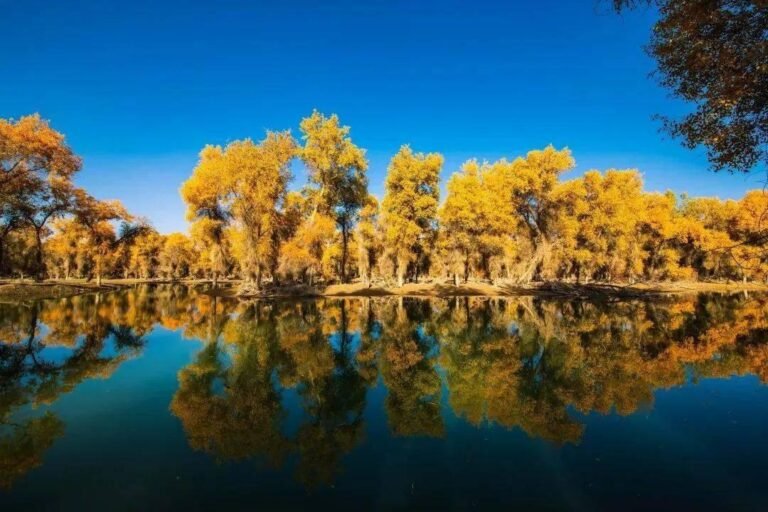
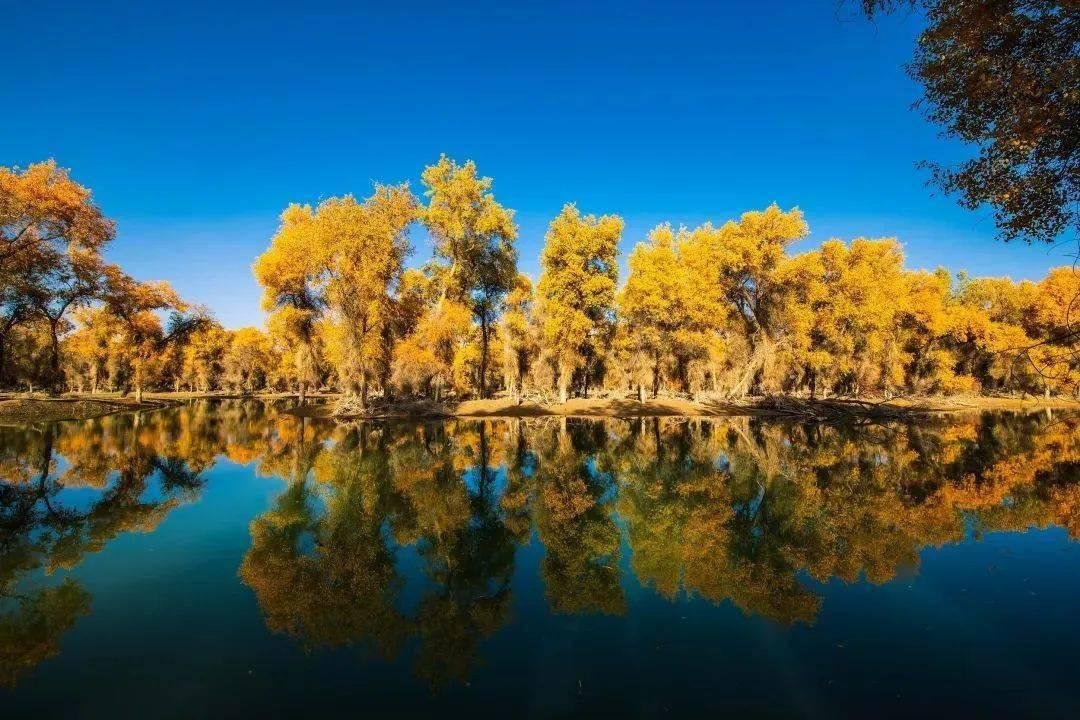
Locals describe it with a line that gets translated roughly as: born without dying for a thousand years, dead without falling for a thousand years, fallen without rotting for a thousand years. That is folk poetry rather than botany, but it is not a bad summary. The trunks are gnarled and pale, the bark cracks into plates, and dead standing trees stay standing for decades in the dry air. When the leaves turn, the whole stand goes from grey-olive to gold at once.
When the Hu Yang Forest Turns Gold
This is the question everyone actually searches, and the honest answer is that there is no single date. The colour is triggered by a sharp drop in night temperature combined with the water level in the river that feeds the forest. A warm stretch in late October can hold the gold back by a week. An early cold snap can finish it a week early. On the ground, that usually means a working window somewhere between 10 October and 5 November, with the full yellow typical of the third week of October.
Early October: the canopy is mostly yellow-green. Good light, almost nobody around, cooler walks. Fine if you want solitude rather than the postcard.
Late October: the peak. Most of the trees are fully gold, the columns of dead trunks are at their most atmospheric, and the river reflects colour in the morning. This is when the bus groups arrive, so go early.
Early to mid November: leaves are falling, the ground is covered in gold, and the bare architecture of dead trunks is fully on show. Photographers who want the dead-trunk look prefer this window.

One trap worth naming: people sometimes plan a Xinjiang autumn around Kanas Lake and then arrive for the hu yang and find only brown twigs. Northern Xinjiang’s larch and pine colour two to three weeks earlier than the southern desert forests — Kanas is usually at its best in the last weeks of September, while the Populus stands of the Tarim are only starting. Driving the expectation wrong is the single easiest way to ruin this trip, so pin your dates to the Tarim, not to the north.
Where the Best Populus Forests in Xinjiang Are
Xinjiang has several stands, and they are not interchangeable. The three that reward a detour:
Tarim Populus Forest (塔里木胡杨林), Bayingolin: the big one and the reason most itineraries exist. A protected forest along the lower Tarim River spanning Luntai and Yuli counties, it is the largest concentrated stand of this species anywhere. This is where the “thousand years” phrase comes from. There is a developed park with a boardwalk loop and an open section you can drive through.
Zepu Jin Huyang (泽普金湖杨), Kashgar prefecture: a stretch of forest along the Yarkand River west of Kashgar, close to the city. Far fewer visitors than the Tarim site, and it drops straight into a >Kashgar loop without a long transfer. If your base is the old city and you want one day of gold, this is the practical pick.
Shaya county, Aksu: continuous forest along the mid Tarim with far fewer facilities. Worth it if you are already driving the river road rather than flying into Korla.
And the correction almost every foreign guide gets wrong: the fame-soaked Ejina hu yang forest that everyone has heard of is in Inner Mongolia, at the edge of the Gobi, not in Xinjiang. It is spectacular and it draws crowds in October. If you are flying into Urumqi or >Kashgar, do not plan around it.
Getting There Without Wasting a Day
For the Tarim forest, most people base in Korla or Luntai. From Korla it is roughly two hours east along the Tarim Highway; from Luntai town it is about an hour and a half on the same road, and Luntai is the end of the southern section of the Duku road, which is handy if you are coming down from the north. A self-drive day trip works, but if your budget has any flexibility a chartered car is easier: the park entrance sits at the end of a long access road, and the sightseeing shuttle inside the park costs extra and can eat ninety minutes of your morning.
For the Zepu forest, it is close to a half-day round trip from Kashgar — leave early, shoot the morning light on the way in, and be back for lunch in the old city. The road runs through the Yarkand valley, and the castor-oil and cotton fields on either side of the highway are part of the reason the drive is pleasant.
You do not need a border permit for the forest itself. You will need one if you continue west into the Pamirs, and that is a separate errand arranged in Kashgar, not something you sort out at the gate.
What It Costs and Where to Stay
This is not an expensive day. Entry is a modest ticket plus a shuttle fee inside the park, and the shuttle is not optional if you want the full loop — it is cheap, though, and the drivers will stop when you ask. Fuel and a hired driver for a full day from Korla is the bigger line item.
Accommodation: Korla has the widest range of hotels, from business chains up to something comfortable, and it is the logical base if the Tarim forest is your only aim. Luntai has smaller hotels and guesthouses. If you are pairing the forest with a southern loop, stay in Kashgar for the old-city nights and do Zepu as a day trip rather than sleeping deep in the desert. For a version of this trip that strings the whole south together, see our 10-day itinerary.
Photographing Gold: What Actually Works
Two things make hu yang photographs look the way they do in guidebooks, and neither is the camera. The first is time of day. Backlit low sun in the first hour after sunrise turns the leaves translucent and lights the whole trunk from behind; that is the look everyone is chasing. Midday is flat and grey, and you will be sharing the boardwalk with forty buses. The second is water. Where the river has pooled behind the trees you get reflections, and reflections are what separate a memorable frame from a snapshot of a sandy thicket.
Compositionally, the dead standing trunks are the asset. Get low, use one trunk sharp in the foreground and let the gold fall out of focus behind it. A wide lens for the river line, a short telephoto for the tonal separation between yellow canopy and pale bark. Bring a lens cloth — the wind here carries fine sand, and it will find the front element.
What to Pack for a Desert Forest in October
The gap between day and night here is the whole story. Afternoons can sit near 20 °C under a strong sun, and by the time you finish shooting at sunset it is near freezing. Layers, not one coat. A windbreaker over a fleece covers most of it.
- A hat and sunglasses — the sun at this latitude is serious even in autumn
- Lip balm and moisturiser; the air is extremely dry
- Solid boots. The riverbank is soft, damp sand with loose gravel, and flat shoes sink
- Cash in small notes for the gate and the shuttle driver
- Camera rain cover that doubles as sand cover
- A thermos. There is very little shade and almost nothing to buy once you are on the access road
What Most First-Time Visitors Get Wrong
Three things, in order of how much damage they do.
First, timing it against the wrong region. As above: Kanas colours in September, the Tarim hu yang in October. Treat them as two different trips, not one autumn with two stops.
Second, treating it as a half-day. The road in is long, the light you want is at the ends of the day, and the park alone will take three or four hours once you add the shuttle. A morning departure is non-negotiable.
Third, expecting facilities at the trailhead. This is a working forest at the edge of a desert, not a developed scenic area with a restaurant plaza. Water, food and shade are On your own. Nobody warns you, and the last shop before the turn-off is forty minutes from the entrance.
If you are coming from abroad and want to check whether the season lines up with your dates, read our best time to visit Xinjiang guide — it breaks the year down month by month, including the shoulder weeks when the Tarim colour is only partly out.
How to Fit the Forest Into an Itinerary
If this is your first trip, the cleanest shape is: fly into Kashgar, spend two nights in the old city, day-trip to Zepu for the forest, then continue on the southern road. If you are driving, the natural loop runs Urumqi south over the Duku road to Kuqa, east along the Tarim to the hu yang stands, and back north — that is the spine of a proper two-week southern trip.
If the forest is the reason you came, give it an overnight, not a day. The difference between arriving at 11:00 and being on site for sunrise is the difference between a car park and a forest you will still be thinking about in March.
Sources Worth Checking Before You Go
Because the turning dates shift with the weather, confirm against current conditions rather than any fixed calendar date, and read up on the species itself before you commit to a two-week trip:
China Daily Travel — seasonal coverage and reporting on Xinjiang destination openings and closures.
People’s Daily English — background reporting on Xinjiang ecology and conservation work along the Tarim River.